 뒤로
뒤로Phylogeny and the Tree of Life: Evolutionary Relationships and Classification
스터디 가이드 - 스마트 노트
 자료에 맞춘 맞춤형 노트, 핵심 정의, 예시, 맥락을 확장해 제공합니다.
Phylogenies Show Evolutionary Relationships
Definition and Importance of Phylogeny
Phylogeny refers to the evolutionary history of a species or group of related species. The scientific discipline of systematics is dedicated to classifying organisms and determining their evolutionary relationships, using evidence from structural features and DNA sequencing. Understanding phylogeny helps biologists trace the lineage of organisms and interpret how traits have evolved over time.
Binomial Nomenclature
Binomial nomenclature is a standardized system for naming species, introduced by Carolus Linnaeus in the 18th century. Each species is assigned a two-part scientific name:
Genus: The first part of the name, always capitalized.
Specific epithet: The second part, unique to each species within the genus.
The full species name is italicized (e.g., Panthera pardus).
Hierarchical Classification
Linnaeus also developed a hierarchical system for grouping species into increasingly inclusive categories. The main taxonomic ranks, from broadest to most specific, are:
Domain
Kingdom
Phylum (plural: phyla)
Class
Order
Family
Genus
Species
Each group at any level of hierarchy is called a taxon.
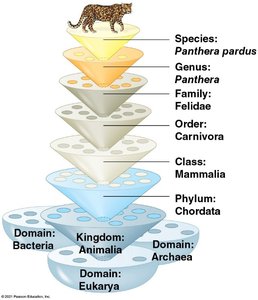
Linking Classification and Phylogeny
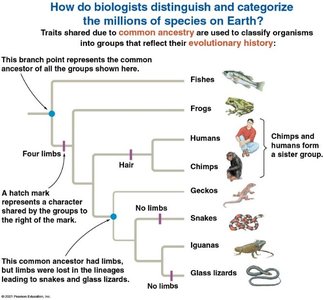
The evolutionary history of organisms is visually represented by phylogenetic trees, which are branching diagrams showing relationships among species. Each branch point (node) on the tree represents the divergence of two evolutionary lineages from a common ancestor. Phylogenetic trees help scientists understand how traits are inherited and how groups are related.
Taxonomic Groupings and Examples
Taxonomic Hierarchy Illustrated
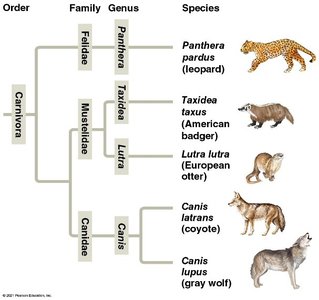
Taxonomic groupings can be visualized using phylogenetic trees that show the relationships among different families, genera, and species within an order. For example, within the order Carnivora, families such as Felidae, Mustelidae, and Canidae contain genera and species like Panthera pardus (leopard), Taxidea taxus (American badger), and Canis lupus (gray wolf).
Phylogenetic Tree Diagrams
Forms of Tree Diagrams
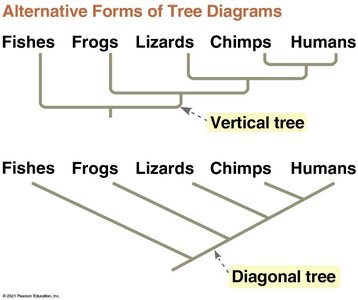
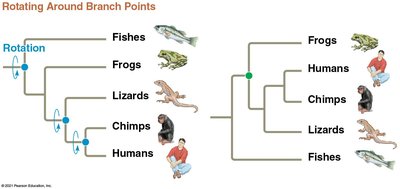
Phylogenetic trees can be drawn in different forms, such as vertical or diagonal trees. Both forms convey the same evolutionary relationships, but the layout may vary for clarity or preference.
Rotating Around Branch Points
Phylogenetic trees can be rotated around branch points without changing the relationships depicted. This flexibility allows scientists to present evolutionary relationships in various ways while maintaining the accuracy of the lineage connections.
Key Terms and Concepts
Phylogeny: The evolutionary history of a species or group.
Systematics: The scientific study of classifying organisms and determining their relationships.
Taxon: A group at any level of the taxonomic hierarchy.
Phylogenetic tree: A diagram representing evolutionary relationships.
Binomial nomenclature: The two-part scientific naming system for species.
Example: Classification of Panthera pardus
Domain: Eukarya
Kingdom: Animalia
Phylum: Chordata
Class: Mammalia
Order: Carnivora
Family: Felidae
Genus: Panthera
Species: Panthera pardus (leopard)
Summary Table: Taxonomic Hierarchy
Level | Example (Panthera pardus) |
|---|---|
Domain | Eukarya |
Kingdom | Animalia |
Phylum | Chordata |
Class | Mammalia |
Order | Carnivora |
Family | Felidae |
Genus | Panthera |
Species | Panthera pardus |
Additional info:
Phylogenetic trees are hypotheses about evolutionary relationships, not definitive facts.
Modern systematics often uses molecular data (DNA, RNA) to refine classifications.
Taxonomic ranks can be further subdivided (e.g., subphylum, subclass).
