 뒤로
뒤로Plant Evolution, Diversity, and Life Cycles: From Algae to Vascular Plants
스터디 가이드 - 스마트 노트
 자료에 맞춘 맞춤형 노트, 핵심 정의, 예시, 맥락을 확장해 제공합니다.
Origins of Life and Early Evolution
Abiogenesis and the Primordial Soup Hypothesis
The origin of life on Earth is hypothesized to have begun with the abiotic synthesis of organic molecules in a 'primordial soup,' as proposed by Charles Darwin. Radiometric dating suggests Earth formed over 4.5 billion years ago, with life emerging in the oceans approximately 3.5 billion years ago. Early life forms were prokaryotic, as evidenced by stromatolite fossils built by cyanobacteria, which played a crucial role in oxygenating the atmosphere.
Abiotic Synthesis: Formation of small organic molecules (e.g., amino acids, nitrogenous bases).
Macromolecule Formation: Joining of small molecules into proteins and nucleic acids.
Protocells: Packaging of molecules into membrane-bound droplets.
Self-Replication: Emergence of molecules capable of inheritance.
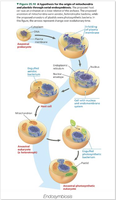
Endosymbiosis Hypothesis
The endosymbiotic theory explains the origin of mitochondria and plastids in eukaryotic cells. It proposes that ancestral eukaryotes engulfed aerobic and photosynthetic bacteria, which became mitochondria and plastids, respectively.
Mitochondria: Derived from aerobic, heterotrophic bacteria.
Plastids: Derived from photosynthetic bacteria.
Serial Endosymbiosis: Multiple engulfment events led to complex eukaryotic cells.
Origins and Evolution of Plants
From Green Algae to Land Plants
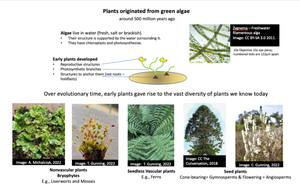
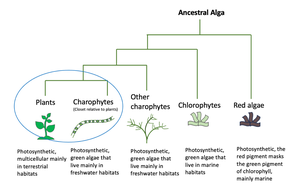
Plants evolved from green algae, specifically charophytes, which are their closest living relatives. Before plants colonized land, Earth's surface was largely barren, with plant colonization beginning around 450 million years ago. Early plants developed reproductive structures, photosynthetic branches, and anchoring mechanisms (holdfasts).
Charophytes: Freshwater green algae with chloroplasts and photosynthetic ability.
Early Adaptations: Reproductive structures, photosynthetic branches, anchoring holdfasts.
Plant Diversity: Over time, plants diversified into nonvascular, seedless vascular, and seed plants.
Major Groups of Plants
Nonvascular Plants: Bryophytes (e.g., liverworts, mosses).
Seedless Vascular Plants: Ferns.
Seed Plants: Gymnosperms (cone-bearing) and Angiosperms (flowering).
Evolutionary Steps in Plant Diversity
Key evolutionary milestones in plant history include the development of vascular tissues, seeds, cones, and flowers. These adaptations enabled plants to colonize diverse terrestrial environments.
Origin of Green Algae: ~600 million years ago (Ediacaran Period).
Land Colonization: ~450 million years ago (Ordovician Period).
Vascular Tissues: Xylem and phloem developed ~400 million years ago (Devonian Period).
First Forests: Seedless vascular plants formed forests ~350 million years ago.
Seed Evolution: Protected embryos (Gymnosperms) ~300 million years ago (Carboniferous Period).
Flower Evolution: Angiosperms ~100 million years ago (Cretaceous Period).
Key Terms and Plant Classification
Definitions and Characteristics
Green Algae: Aquatic, photosynthetic organisms with pigments similar to higher plants.
Nonvascular Plants: Lack specialized tissues for water/nutrient transport; rely on diffusion.
Vascular Plants: Possess xylem and phloem for transport.
Seeds: Embryo surrounded by protective coat (testa); organs include leaves, stems, roots.
Cones: Gymnosperm reproductive structures; male and female cones.
Flowers: Angiosperm reproductive structures; contain stamens (male) and pistils (female).
Rhizoids: Filaments for anchoring and nutrient absorption.
Roots: Anchor, support, and absorb water/minerals.
Eukaryote: Cells with membrane-enclosed nucleus and organelles.
Prokaryote: Cells lacking nucleus and membrane-bound organelles.
Phylogenetic Relationships
Charophytes are the closest relatives to land plants, sharing several traits. Other algae groups (chlorophytes, red algae) are more distantly related.
Adaptations for Terrestrial Life
Key Adaptations in Early Plants
Sporopollenin: Durable polymer preventing zygote desiccation.
Waxy Cuticle: Reduces water loss.
Stomata: Specialized cells for gas exchange and water regulation.
Symbiosis with Fungi: Early plants formed mutualistic relationships for nutrient acquisition.
Shared and Unique Traits
Shared with Charophytes: Rings of cellulose-synthesizing proteins, flagellated sperm structure, phragmoplast formation during cell division.
Unique to Plants: Alternation of generations, protected embryos, walled spores, multicellular gametes, apical meristems.
Alternation of Generations in Plants
General Life Cycle
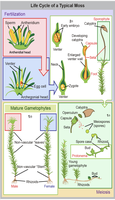
Plants exhibit alternation of generations, alternating between multicellular haploid (gametophyte) and diploid (sporophyte) stages. Each generation gives rise to the other.
Sporophyte (2n): Produces haploid spores via meiosis.
Gametophyte (n): Produces gametes via mitosis; fertilization forms diploid zygote.
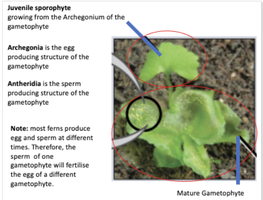
Archegonia: Female gametangia.
Antheridia: Male gametangia.
Nonvascular Plants: Bryophytes
Characteristics and Life Cycle
Bryophytes lack vascular tissues and rely on diffusion for water and nutrient uptake. They thrive in moist environments and anchor with rhizoids. The dominant generation is the haploid gametophyte.
Water Requirement: Flagellated sperm require water to reach eggs.
Sporophyte: Grows from and depends on gametophyte for nutrients.
Spore Production: Sporangium produces numerous spores.
Resilience: Mosses can survive desiccation, temperature extremes, and UV exposure.
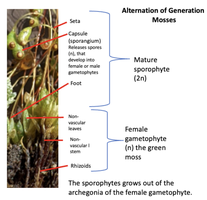
Liverworts: Nonvascular Plant Life Cycle
Life Cycle and Reproduction
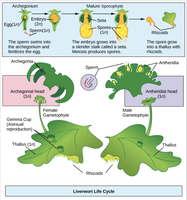
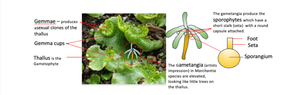
Liverworts are nonvascular plants with a dominant gametophyte stage. They reproduce both sexually and asexually, with water required for sperm motility.
Gemma Cups: Asexual reproduction structures.
Gametangia: Sexual reproduction structures.
Sporophyte: Develops from fertilized egg in archegonium; produces spores via meiosis.
Seedless Vascular Plants: Ferns
Structure and Adaptations
Ferns are seedless vascular plants with specialized tissues for water and nutrient transport. Xylem provides structural support, while phloem distributes organic products. Roots anchor the plant, and leaves are the main photosynthetic organs.
Xylem: Conducts water and minerals; contains lignified tracheas for strength.
Phloem: Distributes sugars, amino acids, and organic products.
Roots: Anchor and absorb nutrients.
Leaves: Primary site of photosynthesis.
Fern Life Cycle
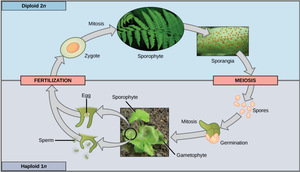
Ferns exhibit alternation of generations, with the sporophyte as the dominant, free-living stage. Gametophytes are independent, heart-shaped, and photosynthetic.
Sporophyte (2n): Large, leafy structure; produces spores in sporangia.
Gametophyte (n): Small, independent, produces gametes.
Independent Embryos: Zygote is not retained in parent; gametophyte and sporophyte are free-living.
Key Terms: Alternation of Generations
Definitions
Alternation of Generations: Life cycle alternating between sporophyte (2n) and gametophyte (n).
Haploid (n): One set of chromosomes.
Diploid (2n): Two sets of chromosomes.
Sporophyte: Diploid generation.
Gametophyte: Haploid generation.
Meiosis: Cell division producing four cells with half genetic information.
Mitosis: Cell division producing two identical daughter cells. or
Zygote: Cell formed by fusion of two gametes; develops into sporophyte.
Plant Group | Vascular Tissue | Dominant Generation | Reproductive Structure |
|---|---|---|---|
Bryophytes | No | Gametophyte (n) | Rhizoids, Gemma cups |
Ferns | Yes | Sporophyte (2n) | Sporangia |
Gymnosperms | Yes | Sporophyte (2n) | Cones |
Angiosperms | Yes | Sporophyte (2n) | Flowers |
Additional info: Table summarizes main plant groups, their vascular status, dominant generation, and reproductive structures.
