 뒤로
뒤로Population Ecology and Human Population Growth
스터디 가이드 - 스마트 노트
 자료에 맞춘 맞춤형 노트, 핵심 정의, 예시, 맥락을 확장해 제공합니다.
Population Ecology
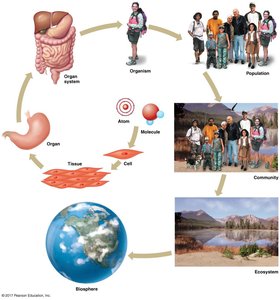
Levels of Biological Organization
Biological systems are organized into hierarchical levels, each with increasing complexity. Understanding these levels is essential for studying ecology and population biology.
Atom & Molecule: The smallest units of matter and their chemical combinations.
Cell: The basic unit of life.
Tissue: Groups of similar cells performing a specific function.
Organ: Structures composed of different tissues working together.
Organ System: Groups of organs that perform related functions.
Organism: An individual living being.
Population: Groups of individuals of the same species living in the same area.
Community: Different populations interacting in a shared environment.
Ecosystem: Communities and their physical environment (biotic and abiotic factors).
Biosphere: All ecosystems on Earth.
Definitions in Ecology
Ecosystem: A community of organisms and their physical environment, including both living (biotic) and non-living (abiotic) components.
Community: Populations of different species that interact within a geographic area.
Population: Individuals of the same species occupying the same area and interacting with each other.
Population Characteristics
Distribution and Density
Populations are described by their distribution (geographic range) and density (number of individuals per unit area or volume).
Distribution: The area where a population is found, determined by suitability for growth and survival.
Population Density: Higher in areas with abundant resources; generally, smaller organisms have higher densities than larger ones.
Population Growth
Population size changes based on the balance between births and deaths. Growth rate can be positive (increasing population) or negative (decreasing population).
Growth Rate Formula:
Biotic Potential: The maximum rate of population growth under ideal conditions, influenced by reproductive characteristics and resource availability.
Doubling Time: The time required for a population to double in size, calculated as:
Example: A population growing at 3% per year will double in 24 years (72/3 = 24).
Exponential Growth
Exponential growth occurs under ideal conditions with unlimited resources, resulting in a J-shaped curve. It has two phases:
Lag Phase: Slow growth due to a small number of individuals.
Exponential Phase: Rapid, accelerating growth.
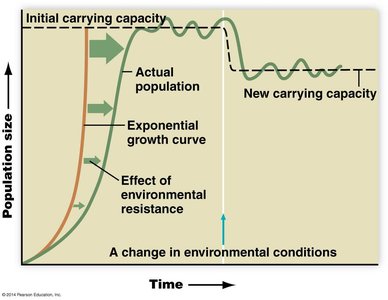
In reality, exponential growth cannot continue indefinitely due to environmental limitations.
Logistic Growth (Realized Growth)
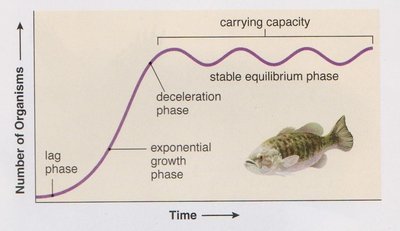
Logistic growth incorporates environmental resistance, resulting in an S-shaped curve. It includes four phases:
Lag Phase
Exponential Phase
Deceleration Phase: Growth slows due to increased competition for resources.
Stable Equilibrium Phase: Population size stabilizes near the carrying capacity.
Carrying Capacity and Environmental Resistance
The carrying capacity is the maximum population size an ecosystem can support indefinitely. Environmental resistance includes all factors that limit population growth, such as limited resources, predation, and disease. Population size fluctuates around the carrying capacity and can change if environmental conditions shift.
Factors Regulating Population Growth
Density-Independent Factors: Affect populations regardless of size (e.g., weather, natural disasters).
Density-Dependent Factors: Impact increases with population density (e.g., competition, predation).
Competition: Individuals compete for limited resources; not all survive or reproduce.
Predation: Predators consume prey; effect increases as prey population grows.
Ecological Strategies
Opportunistic Species: Exhibit exponential growth, small size, early maturity, short lifespan, limited parental care, regulated mainly by density-independent factors.
Equilibrium Species: Exhibit logistic growth, larger size, slow maturity, long lifespan, invest in offspring, regulated mainly by density-dependent factors, often at higher risk of extinction.
Human Population Growth
Historical Trends
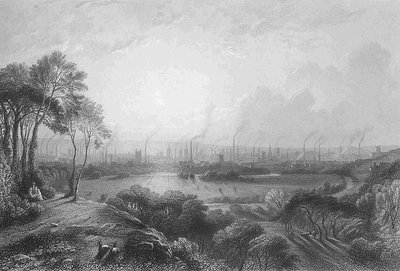
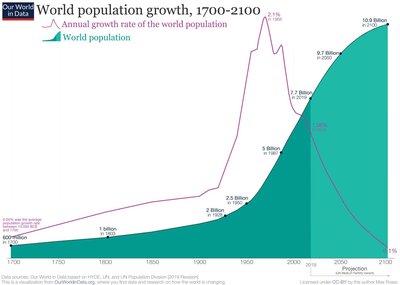
Human population remained low and stable for most of history. Growth accelerated with the advent of agriculture, animal domestication, and especially during the Industrial Revolution. In recent centuries, growth has become explosive due to technological advances and reduced environmental resistance.
Modern Population Growth
Current global population exceeds 8 billion (as of 2022).
Growth rate is about 0.82% per year; doubling time is approximately 88 years.
Some argue humans can surpass carrying capacity by altering the environment, but resource limitations may still apply.
Zero Population Growth and Fertility Rates
Zero Population Growth: Achieved when births equal deaths.
Fertility Rate: Average number of children born per woman. Replacement fertility rate is about 2.1 children per woman.
Global fertility rates have declined from a peak of 5.32 (1963) to 2.32 (2021).
If replacement fertility is achieved, population could stabilize at 9.7 billion by 2050 and 10.9 billion by 2100.
Regional Differences in Population Growth
More Developed Countries (MDCs): North America and Europe; rapid growth from 1850-1950, now modest growth due to lower birth and death rates.
Less Developed Countries (LDCs): Latin America, Asia, Africa; dramatic growth, high birth rates, declining death rates, majority of global population growth occurs here.
Summary Table: Population Growth Factors
Factor | Description | Example |
|---|---|---|
Density-Independent | Affects population regardless of size | Natural disasters, weather |
Density-Dependent | Effect increases with population density | Competition, predation, disease |
Biotic Potential | Maximum possible growth rate | High reproductive rate |
Environmental Resistance | Limits population growth | Resource scarcity, predation |
Carrying Capacity | Maximum sustainable population size | Population stabilizes near this value |
