 뒤로
뒤로Population Ecology: Population Growth and Life History Strategies
스터디 가이드 - 스마트 노트
 자료에 맞춘 맞춤형 노트, 핵심 정의, 예시, 맥락을 확장해 제공합니다.
Population Ecology
Definition and Scope
Population ecology is the study of populations of organisms, especially the regulation of population size, life history traits, and population dynamics. A population is defined as a group of individuals of the same species living in a specific geographic area at a given time. Population ecologists seek to understand how and why the number of individuals in a population changes over time and space.
Key Questions: How does population size change? Where do populations live and why?
Population ecology uses mathematical models to predict and explain changes in population size.
Population Growth
Factors Affecting Population Change
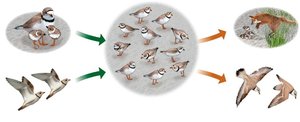
Population size changes due to births, deaths, immigration, and emigration. The balance of these factors determines whether a population grows, shrinks, or remains stable.
Intrinsic Rate of Growth (r)
The intrinsic rate of growth (r) is the rate at which a population increases in size under ideal conditions, with unlimited resources. It is determined by the difference between the birth rate and the death rate per individual.
r is species-specific but relatively constant within a species.
Assumes no resource limitation (ideal conditions).
Exponential Growth Model
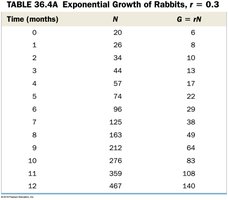
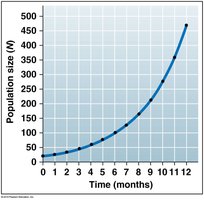
When resources are unlimited, populations can grow exponentially. The exponential growth equation is:
N = population size at time t
r = intrinsic rate of increase
Example: If r = 0.25 individuals/year and N = 1000, then the population grows by 250 individuals per year.
Limitations of Exponential Growth
Exponential growth cannot continue indefinitely because resources become limited. Eventually, factors such as food, space, and predation slow population growth.
Logistic Growth Model
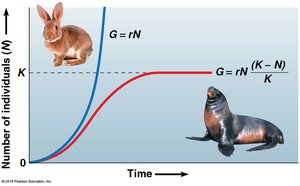
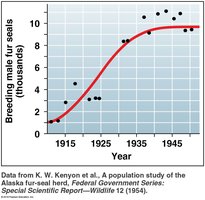
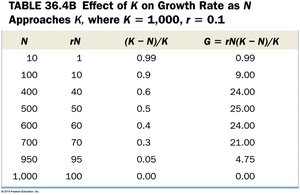
The logistic growth model incorporates resource limitation by introducing the concept of carrying capacity (K), which is the maximum population size that the environment can sustain.
As N approaches K, growth slows and eventually stops.
If N < K, the population grows rapidly; if N = K, growth stops; if N > K, the population shrinks.
The logistic growth equation is:
Age Structure and Population Growth
The age structure of a population affects its growth rate. Populations with more reproductive individuals grow faster than those with fewer. Age structure diagrams help predict future population trends.
Life History Strategies
K-selected vs. r-selected Species
Species exhibit different strategies for survival and reproduction, often described as K-selected and r-selected strategies:
K-selected species: Stable environments, few offspring, high parental care, long lifespan, population size near carrying capacity.
r-selected species: Unstable environments, many offspring, little parental care, short lifespan, rapid population growth.
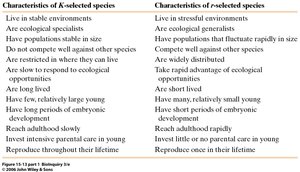
Application: The 'no free lunch' maxim applies—species cannot maximize all aspects of survival and reproduction simultaneously; trade-offs exist between quantity and quality of offspring.
Summary Table: Exponential vs. Logistic Growth
Model | Equation | Assumptions | Population Growth Pattern |
|---|---|---|---|
Exponential | Unlimited resources | J-shaped curve, rapid increase | |
Logistic | Limited resources, carrying capacity | S-shaped curve, levels off at K |
Additional info: Mathematical models are essential tools in population ecology, allowing predictions and management of wildlife, conservation efforts, and understanding human population dynamics.
