뒤로
뒤로Practice Questions: Lipids and Triglyceride Structure
스터디 가이드 - 스마트 노트
 자료에 맞춘 맞춤형 노트, 핵심 정의, 예시, 맥락을 확장해 제공합니다.
Q1. What is one chemical property that all lipids have in common?
Background
Topic: Lipid Chemistry
This question tests your understanding of the fundamental chemical properties shared by all lipids, which are a major class of biological macromolecules.
Key Terms:
Lipid: A diverse group of hydrophobic or amphipathic molecules, including fats, oils, and steroids.
Hydrophobic: Repels water; does not dissolve in water.
Step-by-Step Guidance
Recall that lipids are generally nonpolar molecules, meaning they do not mix well with water.
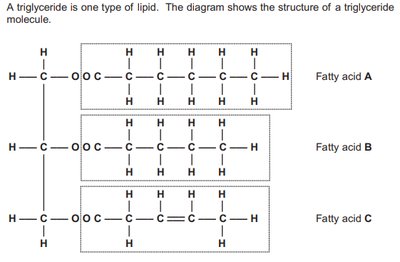
Think about the structure of a triglyceride (as shown in the diagram), which consists of long hydrocarbon chains.
Consider how the chemical property of being hydrophobic affects the biological function of lipids in cells.
Try solving on your own before revealing the answer!
Final Answer:
All lipids are hydrophobic, meaning they do not dissolve in water. This property is due to their long nonpolar hydrocarbon chains, which repel water molecules.
Q2. A triglyceride molecule is formed by condensation reactions. From how many molecules is this triglyceride formed?
Background
Topic: Macromolecule Formation
This question is about the process of forming triglycerides, a type of lipid, through condensation (dehydration synthesis) reactions.
Key Terms and Formula:
Condensation Reaction: A chemical reaction where two molecules combine, releasing a water molecule.
Triglyceride: A lipid molecule made from one glycerol and three fatty acids.
Step-by-Step Guidance
Examine the diagram: Notice the three fatty acid chains attached to a glycerol backbone.
Recall that each fatty acid is joined to glycerol by a condensation reaction, releasing water.
Count the total number of molecules (glycerol + fatty acids) involved in forming a triglyceride.
Try solving on your own before revealing the answer!
Final Answer:
A triglyceride is formed from four molecules: one glycerol and three fatty acids. Each fatty acid is attached to the glycerol by a condensation reaction.
Q3. The structure of a phospholipid molecule is different from that of a triglyceride. Describe how a phospholipid is different.
Background
Topic: Lipid Structure and Function
This question asks you to compare the structure of triglycerides and phospholipids, two important types of lipids in biology.
Key Terms:
Phospholipid: A lipid containing a phosphate group, important in cell membranes.
Triglyceride: A lipid with three fatty acids attached to a glycerol backbone.
Step-by-Step Guidance
Recall the structure of a triglyceride: three fatty acids attached to glycerol.
Think about the structure of a phospholipid: two fatty acids and a phosphate group attached to glycerol.
Consider how the presence of the phosphate group changes the properties of the molecule, especially its interaction with water.
Try solving on your own before revealing the answer!
Final Answer:
A phospholipid differs from a triglyceride in that it has two fatty acid chains and a phosphate group attached to the glycerol backbone, instead of three fatty acids. The phosphate group makes the phospholipid amphipathic, with a hydrophilic head and hydrophobic tails, which is essential for forming cell membranes.