 뒤로
뒤로Protein Synthesis: Transcription, Translation, and Protein Structure
스터디 가이드 - 스마트 노트
 자료에 맞춘 맞춤형 노트, 핵심 정의, 예시, 맥락을 확장해 제공합니다.
Protein Synthesis
Overview of Protein Synthesis
Protein synthesis is the process by which cells generate new proteins, essential for cellular structure and function. This process involves two main steps: transcription and translation. The genetic information stored in DNA is transcribed into messenger RNA (mRNA), which is then translated into a specific sequence of amino acids to form a protein.
Transcription: The process of copying a gene's DNA sequence into mRNA. Occurs in the nucleus.
Translation: The process of decoding the mRNA into a polypeptide chain (protein). Occurs in the cytoplasm.
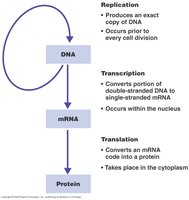
Interactions Between DNA & RNA
Genetic Information Flow
DNA contains the complete genetic instructions for an organism. RNA acts as the messenger, carrying the code for protein synthesis from the nucleus to the cytoplasm. Proteins, in turn, perform most cellular functions.
Genes are segments of DNA that code for proteins.
Gene expression occurs when a gene is transcribed and translated into a protein.
Step 1: Transcription
Transcription Process
Transcription is the synthesis of an RNA molecule from a DNA template. It involves the following steps:
The DNA double helix unwinds at the gene location.
RNA polymerase binds to the DNA and synthesizes a complementary RNA strand (the RNA primary transcript).
The RNA primary transcript contains both introns (non-coding regions) and exons (coding regions).
Ribozymes (catalytic RNA molecules) remove introns and splice exons together, forming mature messenger RNA (mRNA).
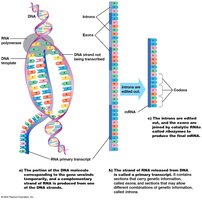
mRNA then exits the nucleus and carries the genetic code to the ribosomes in the cytoplasm.
Step 2: Translation
Translation Process
Translation is the process by which the sequence of codons in mRNA is used to assemble amino acids into a polypeptide chain. This process occurs in three stages:
Initiation: The ribosome assembles around the start codon (AUG) on the mRNA. The first tRNA brings methionine to the ribosome.
Elongation: tRNA molecules bring specific amino acids to the ribosome, matching their anticodons to the codons on the mRNA. Peptide bonds form between amino acids, creating a growing polypeptide chain.
Termination: When a stop codon is reached, the ribosome releases the completed polypeptide and detaches from the mRNA.
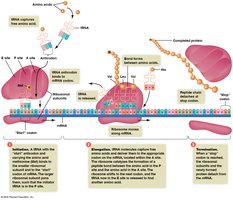
Key Molecules in Translation
mRNA: Carries the genetic code from DNA to the ribosome.
tRNA: Transfers specific amino acids to the ribosome, matching its anticodon to the mRNA codon.
rRNA: Forms the core of the ribosome and catalyzes peptide bond formation.
Codons and the Genetic Code
Each group of three nucleotides (codon) on the mRNA corresponds to a specific amino acid. There are 64 possible codons, but only 20 amino acids, so some amino acids are specified by more than one codon. The start codon is AUG (methionine), and there are three stop codons (UAA, UAG, UGA).
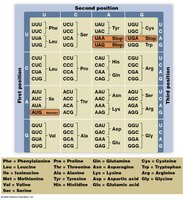
Protein Structure
Levels of Protein Structure
The function of a protein depends on its structure, which is organized into four levels:
Primary Structure: The unique sequence of amino acids in a polypeptide chain, held together by peptide bonds.
Secondary Structure: Local folding of the polypeptide into alpha-helices and beta-sheets, stabilized by hydrogen bonds.
Tertiary Structure: The overall three-dimensional shape of a single polypeptide, determined by interactions among side chains (including disulfide bonds and hydrophobic interactions).
Quaternary Structure: The association of multiple polypeptide chains to form a functional protein complex.
Example: A single amino acid change in the primary structure can cause diseases such as sickle cell anemia.
Summary Table: Key Steps in Protein Synthesis
Step | Location | Main Molecules Involved | Key Events |
|---|---|---|---|
Transcription | Nucleus | DNA, RNA polymerase, mRNA | DNA is copied into mRNA; introns removed, exons spliced |
Translation | Cytoplasm (ribosome) | mRNA, tRNA, rRNA, amino acids | mRNA codons translated into amino acid sequence; polypeptide formed |
Additional info: The process of protein synthesis is tightly regulated and errors in any step can lead to nonfunctional or harmful proteins. Understanding these processes is fundamental to genetics, molecular biology, and biotechnology.
