뒤로
뒤로Regulation of Gene Expression in Prokaryotes and Eukaryotes
스터디 가이드 - 스마트 노트
 자료에 맞춘 맞춤형 노트, 핵심 정의, 예시, 맥락을 확장해 제공합니다.
Regulation of Gene Expression
Overview of Gene Regulation
Gene expression is the process by which information from a gene is used to synthesize functional gene products, such as proteins. Cells regulate gene expression to respond to environmental changes and to ensure that the correct proteins are produced at the right time and place. Regulation can occur at multiple stages, but is often focused on transcription.
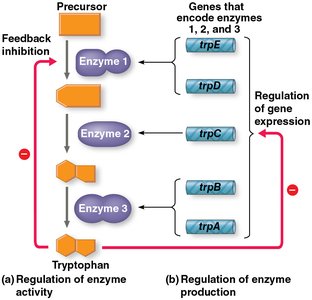
Feedback inhibition: The end product of a metabolic pathway inhibits an enzyme involved earlier in the pathway, preventing overproduction.
Gene regulation: Cells can adjust enzyme production by regulating the expression of the genes encoding those enzymes.
Operons: The Basic Concept
Structure and Function of Operons
In prokaryotes, a group of functionally related genes can be regulated together as a unit called an operon. This allows coordinated control of gene expression.
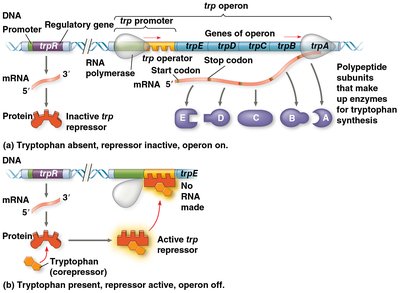
Operator: A DNA segment acting as an on-off switch, usually located within or near the promoter.
Promoter: The DNA sequence where RNA polymerase binds to initiate transcription.
Structural genes: Genes that are co-regulated and encode proteins with related functions.
Regulatory gene: Encodes a repressor protein that can bind to the operator and block transcription.

Negative Gene Regulation: Repressible and Inducible Operons
Operons can be regulated by repressors, which are proteins that bind to the operator to block transcription. The activity of repressors can be modulated by other molecules.
Repressible operon: Usually on; can be turned off by a repressor (e.g., trp operon).
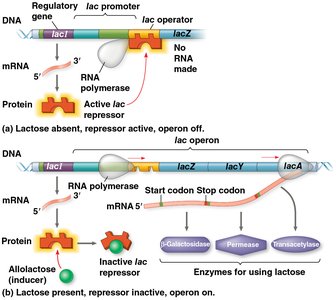
Inducible operon: Usually off; can be turned on by an inducer that inactivates the repressor (e.g., lac operon).
Corepressor: A small molecule that cooperates with a repressor to switch an operon off.
Inducer: A molecule that inactivates the repressor, allowing transcription.
Examples: trp and lac Operons
trp operon: Encodes enzymes for tryptophan synthesis. When tryptophan is present, it acts as a corepressor, activating the repressor and turning the operon off.
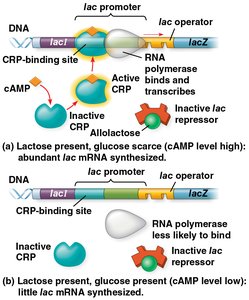
lac operon: Encodes enzymes for lactose metabolism. When lactose is present, allolactose (the inducer) inactivates the repressor, turning the operon on.
Positive Gene Regulation
Some operons are also regulated by activators, which increase the rate of transcription. In the lac operon, the cyclic AMP receptor protein (CRP) acts as an activator when glucose is scarce, enhancing RNA polymerase binding and transcription.
When glucose is low, cAMP levels rise, activating CRP, which binds to the promoter and increases transcription.
When glucose is high, CRP detaches, and transcription decreases.
Regulation of Gene Expression in Eukaryotes
Differential Gene Expression
All cells in a multicellular organism contain the same genome, but different cell types express different sets of genes. This differential gene expression is essential for cell specialization and function.
Abnormal gene expression can lead to diseases such as cancer.
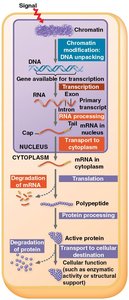
Gene expression is regulated at many stages, including chromatin structure, transcription, RNA processing, and translation.
Regulation of Chromatin Structure
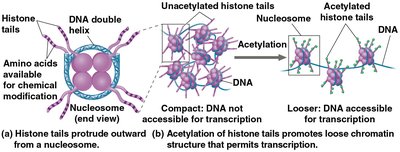
The organization of chromatin affects gene accessibility and expression. Chemical modifications of histones and DNA can either promote or inhibit transcription.
Histone acetylation: Addition of acetyl groups to histone tails loosens chromatin, making DNA accessible for transcription.
DNA methylation: Addition of methyl groups to DNA bases condenses chromatin and reduces transcription.
Epigenetic Inheritance
Epigenetic modifications, such as DNA methylation and histone modification, can be inherited without changing the DNA sequence. These modifications can affect gene expression in offspring and may explain differences between genetically identical individuals.
Organization of a Typical Eukaryotic Gene
Eukaryotic genes are regulated by multiple control elements, which are binding sites for transcription factors. These elements can be close to or far from the promoter and are essential for precise gene regulation.
Enhancers: Distal control elements that can greatly increase transcription of associated genes.
Activators: Proteins that bind to enhancers and stimulate transcription.
Repressors: Proteins that inhibit transcription by blocking activators or altering chromatin structure.
Post-Transcriptional Regulation
Gene expression can also be regulated after transcription through mechanisms such as alternative RNA splicing, mRNA degradation, and protein modification.
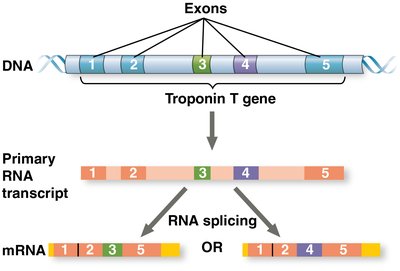
Alternative RNA splicing: Different mRNA molecules are produced from the same primary transcript, increasing protein diversity.
Protein processing and degradation: Proteins can be chemically modified or marked for degradation by ubiquitin, which targets them to proteasomes for breakdown.
Noncoding RNAs and Gene Regulation
Roles of Noncoding RNAs
Noncoding RNAs (ncRNAs) play important roles in regulating gene expression at multiple levels, including mRNA degradation and chromatin modification.
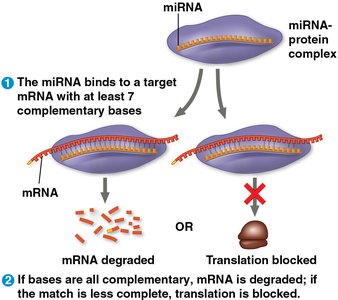
MicroRNAs (miRNAs): Small RNAs that bind to complementary sequences in mRNA, leading to mRNA degradation or translation inhibition.
Small interfering RNAs (siRNAs): Similar to miRNAs, involved in gene silencing and heterochromatin formation.
piwi-interacting RNAs (piRNAs): Involved in silencing transposable elements and maintaining genome stability in germ cells.
Long noncoding RNAs (lncRNAs): Involved in X chromosome inactivation and scaffolding of regulatory complexes.
Differential Gene Expression in Development
Cell Differentiation and Morphogenesis
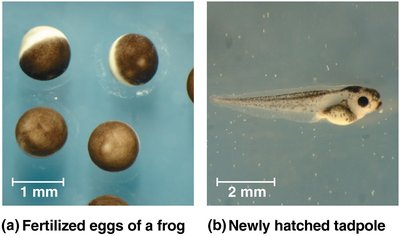
During development, gene expression programs guide the transformation of a single fertilized egg into a complex multicellular organism with specialized cell types and organized tissues.
Cell differentiation: The process by which cells become specialized in structure and function.
Morphogenesis: The physical processes that give an organism its shape.
Cytoplasmic Determinants and Inductive Signals
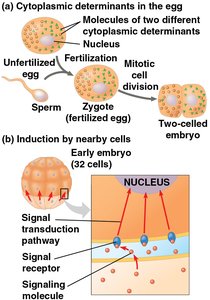
Early development is influenced by cytoplasmic determinants (maternal substances in the egg) and inductive signals (molecules from neighboring cells) that regulate gene expression and cell fate.
Cytoplasmic determinants: Unevenly distributed molecules in the egg that influence gene expression in daughter cells after division.
Induction: Signal molecules from one cell influence the gene expression and differentiation of nearby cells.
Pattern Formation and Positional Information
Pattern formation is the development of spatial organization in tissues and organs. Positional information, provided by gradients of molecules, tells cells their location and guides their fate during development.
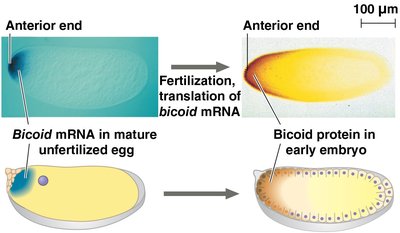
Bicoid gene in fruit flies: Maternal gene that establishes the anterior-posterior axis in the embryo through a gradient of bicoid protein.