 뒤로
뒤로Scientific Evidence Supporting Evolution
스터디 가이드 - 스마트 노트
 자료에 맞춘 맞춤형 노트, 핵심 정의, 예시, 맥락을 확장해 제공합니다.
Theory of Evolution
Overview of Evolution
The theory of evolution is a fundamental concept in biology, explaining the diversity of life on Earth. It posits that all living organisms are related and descended from a common ancestor that existed approximately 3 billion years ago. Evolution is responsible for the nearly 2 million different forms of life observed today.
Descent over time: Populations change slowly over generations, becoming different from their ancestors.
Modification: Changes in phenotype occur due to genetic mutations or gene reshuffling during meiosis.
Unpredictable and natural: Evolution is influenced by chance, natural selection, historical events, and environmental changes.
Evidence for Evolution
Types of Scientific Evidence
Multiple lines of evidence support the theory of evolution, including:
Fossils & fossil record
Comparative anatomy, embryology & biochemistry
Biogeography
Fossil Evidence
Formation and Importance of Fossils
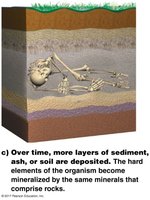
Fossils are preserved remains of organisms, typically formed when remnants are quickly covered by sediment or volcanic ash. Over time, these remains become mineralized, leaving rock-like impressions of hard tissues such as bones and teeth. Fossils provide a rich, though incomplete, record of past life and allow scientists to observe changes in organisms over time.
Fossilization process: Hard elements of organisms become mineralized by the same minerals that comprise rocks.
Age determination: Fossils are dated using radiometric methods (e.g., potassium or carbon-14 dating).
Limitations: Fossil record is incomplete, especially for organisms without hard tissues.
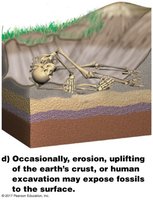
Occasionally, erosion, uplifting of the earth's crust, or human excavation exposes fossils to the surface, allowing scientists to study them.
Comparative Anatomy
Homologous, Analogous, and Vestigial Structures
Comparing anatomical structures among organisms reveals evolutionary relationships:
Homologous structures: Body parts that share a common ancestor, such as the human arm, dog leg, whale flipper, and bird wing. Their resemblance indicates evolutionary relatedness.
Analogous structures: Structures that serve similar functions but do not arise from a common ancestor (e.g., bird and insect wings).
Vestigial structures: Structures with little or no function, often homologous to functional body parts in other organisms (e.g., human tailbone, appendix, ear muscles, wisdom teeth).
Comparative Embryology
Embryonic Development Among Vertebrates
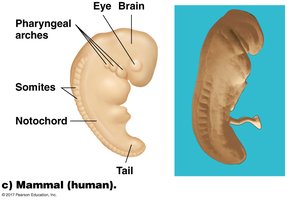
Early embryonic development is remarkably similar among vertebrates, indicating common ancestry. All vertebrates develop:
Notochord: Becomes the core of intervertebral discs.
Somites: Series of folds that become bone, muscle, and skin.
Gill or pharyngeal arches: Develop into gills or parts of the face, middle ear, and mouth.
Comparative Biochemistry
Protein and Gene Similarities
Biochemical comparisons examine similarities between proteins and genes of different species. Identical or nearly identical molecules ("homologous molecules") suggest common ancestry. For example, the protein cytochrome c is identical in humans and chimps, with increasing differences in more distantly related species.
Example: Cytochrome c amino acid differences: humans and chimps (0), rhesus monkey (1), chicken (16), yeast (50).
The greater the difference, the further back the divergence occurred.
Biogeography
Distribution of Species
Biogeography studies the distribution of plants and animals worldwide. Physical barriers (oceans, mountains) and environmental conditions (temperature extremes) influence species migration and survival.
Continental drift: The breakup of Pangea isolated groups, leading to separate evolutionary paths.
Mechanisms of Evolution
Mutations, Natural Selection, Genetic Drift, Gene Flow
Evolution occurs through several processes:
Mutations: Random, rare changes in DNA, often due to replication errors or epigenetics. Accumulation of mutations can lead to speciation.
Natural selection: Individuals with traits better suited to their environment are more likely to survive and reproduce, increasing the frequency of beneficial alleles.
Genetic drift: Random changes in allele frequency, especially in small populations. Includes bottleneck and founder effects.
Gene flow: Redistribution of alleles due to immigration or emigration, mixing gene pools.
Genetic Drift: Bottleneck and Founder Effects
Bottleneck effect: Catastrophic events reduce population size, decreasing genetic variability.
Founder effect: A few individuals establish a new population, which may not represent the original gene pool.
Other Factors
Antigenic shift: Rapid genetic changes in viruses due to recombination, leading to new, potentially more infective strains (e.g., bird flu, swine flu).
Extinction: Complete disappearance of species, often due to environmental changes. At least five mass extinctions have occurred, with the most recent at the end of the Cretaceous period.
Evolutionary Trees and Adaptive Radiation
Depicting Divergence and Speciation
Evolutionary trees illustrate points of divergence, extinction, and adaptive radiation. Adaptive radiation refers to the rapid development of new species from a single ancestor, shown as branching patterns on evolutionary trees.
Key Terms
Mutation: Change in DNA sequence
Natural selection: Differential survival and reproduction
Genetic drift: Random changes in allele frequency
Gene flow: Movement of alleles between populations
Extinction: Complete disappearance of a species
Adaptive radiation: Rapid speciation from a common ancestor
Summary Table: Types of Evidence for Evolution
Type of Evidence | Description | Example |
|---|---|---|
Fossils | Preserved remains, show changes over time | Fossilized skeletons, radiometric dating |
Comparative Anatomy | Homologous, analogous, vestigial structures | Human arm vs. whale flipper |
Comparative Embryology | Similar early development in vertebrates | Notochord, somites, pharyngeal arches |
Comparative Biochemistry | Protein and gene similarities | Cytochrome c differences |
Biogeography | Distribution of species, continental drift | Pangea breakup |
Additional info: This guide expands on lecture notes by providing definitions, examples, and a summary table for exam preparation.
