 뒤로
뒤로CH3 - Molecules
스터디 가이드 - 스마트 노트
 자료에 맞춘 맞춤형 노트, 핵심 정의, 예시, 맥락을 확장해 제공합니다.
Carbon and the Molecular Diversity of Life
The Importance of Carbon
Carbon is the backbone of organic molecules, forming up to four strong covalent bonds. This versatility allows for a wide variety of molecular shapes and functions, which is essential for the complexity of life.
- Key Point: Carbon atoms can bond with hydrogen, nitrogen, oxygen, and phosphorus, creating diverse organic molecules.
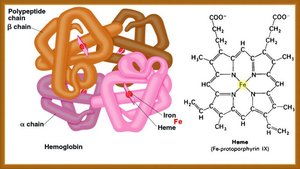
- Key Point: The shape and charge of a molecule are critical for its function, as seen in enzymes and proteins like hemoglobin.
Organic vs. Inorganic Molecules
Organic molecules have a carbon backbone and are covalently bonded to hydrogen and other atoms. Inorganic molecules may contain carbon but lack a carbon backbone.
- Key Point: Organic molecules are primary structural and functional components of living organisms.
- Key Point: Major biological molecules are polymers made from smaller monomers.
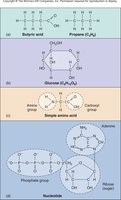
The Structure and Function of Large Biological Molecules
Monomers and Polymers
Biological macromolecules are often polymers, constructed from repeating monomer units.
- Key Point: Dehydration synthesis joins monomers by removing water.
- Key Point: Hydrolysis breaks polymers into monomers by adding water. -
Key Point: Both processes require enzymes.
Carbohydrates
Carbohydrates are composed of sugars and their polymers. They serve as energy sources and structural materials.
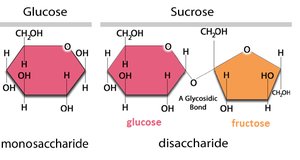
- Key Point: Monosaccharides (e.g., glucose) have formulas that are multiples of CH2O.
- Key Point: Disaccharides (e.g., sucrose) are formed by joining two monosaccharides via a glycosidic bond.
- Key Point: Polysaccharides (e.g., starch, glycogen, cellulose, chitin) are polymers of sugars with storage or structural roles.
- Example: Glucose and fructose have the same molecular formula but different structures, resulting in different properties
. 
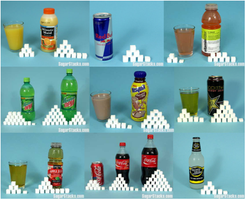
Storage and Structural Polysaccharides
Polysaccharides, polymers of sugars, have storage and structural roles
Storage -
- Starch: Storage polysaccharide in plants, made of glucose monomers.
- Glycogen: Storage polysaccharide in animals.
Structural -
- Cellulose: Structural polysaccharide in plant cell walls; human enzymes cannot break it.
- Chitin: Structural polysaccharide in exoskeleton of fungi and arthropods, contains nitrogen.
Lipids
Lipids are hydrophobic molecules that do not form polymers. They include fats, phospholipids, and steroids.
- Key Point: Lipids are nonpolar and insoluble in water.
- Key Point: Fats are made from glycerol and fatty acids (energy storage, insulation)
-Key Point: phospholipids are components of cell membranes
-Key Point: steroids are essential to hormone production
- Key Point: Fatty acids vary in length and saturation.
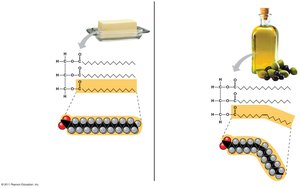
Saturated vs. Unsaturated Fats
- Saturated fatty acids: No double bonds, maximum amount of hydrogen atoms possible, solid at room temperature, common in animal fats.
- Unsaturated fatty acids: One or more double bonds, liquid at room temperature, common in plant oils, cannot pack as tightly
- Example: Unsaturated fats have kinks due to double bonds, preventing tight packing.
Essential Fatty Acids
- Key Point: Human body cannot synthesize essential fatty acids, must come from diet, used for signaling molecules regarding inflammation (e.g., omega-3 and omega-6) 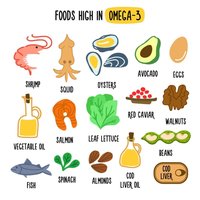
Trans Fats and Hydrogenation
- Key Point: Hydrogenation converts unsaturated fats to saturated fats by adding hydrogen, creating trans fats.
- Key Point: Trans fats are more associated with increased cardiovascular disease risk than saturated fats.
Phospholipids
- Key Point: Phospholipids have hydrophobic tails and a hydrophilic phosphate head, forming cell membranes.
- Key Point: Phospholipids self-assemble into bilayers in water.
Steroids
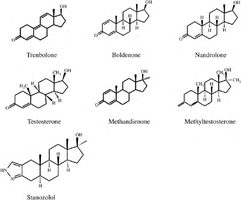
- Key Point: Steroids are lipids, have carbon skeleton, consists of four-ringed carbon structure.
- Key Point: Cholesterol is a membrane component and precursor for hormones.
-Key Point: Anabolic steroids were structured to resemble testosterone
- Example: Estradiol, testosterone, progesterone, cortisol, and aldosterone are steroid hormones.
Proteins
Structure and Function
Proteins are polymers of amino acids, folded into specific shapes for diverse functions.
- Key Point: Protein function depends on its three-dimensional shape.
- Key Point: Proteins serve as enzymes, structural support, transport, storage, communication, defense, and movement.
-Key Point: Enzymes, a protein, act as catalysts for biological reactions
Amino Acids and Protein Structure
- Key Point: There are 20 standard amino acids, each with a unique side chain (R group).
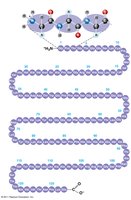
- Key Point: Amino acids are linked by peptide bonds to form polypeptides.
- Key Point: Side chains determine protein folding and properties (hydrophobic, hydrophilic, charged).
Essential Amino Acids
- Key Point: Humans require 21 amino acids; 9 are essential and must be obtained from food.
- Example: Complete proteins provide all essential amino acids; rice and beans together can supply a complete protein profile.


Levels of Protein Structure
- Primary structure: Sequence of amino acids, determined by genetic information.
- Secondary structure: Hydrogen bonding creates alpha helices and beta sheets.
- Tertiary structure: Three-dimensional folding due to interactions among R groups.
- Quaternary structure: Multiple polypeptide chains form a functional protein (e.g., hemoglobin).
Protein Function Examples
Type | Function | Example |
|---|---|---|
Enzymatic | Accelerate chemical reactions | Digestive enzymes |
Defensive | Protection against disease | Antibodies |
Storage | Store amino acids | Casein, ovalbumin |
Transport | Transport substances | Hemoglobin |
Hormonal | Coordinate activities | Insulin |
Receptor | Response to stimuli | Nerve cell receptors |
Contractile/Motor | Movement | Actin, myosin |
Structural | Support | Keratin, collagen |
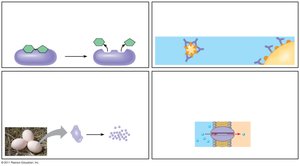
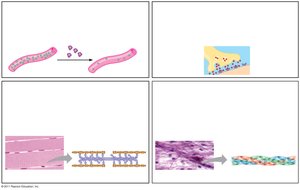
Denaturation
Denaturation is the loss of protein structure due to stressors such as pH, salt, temperature, or solvents. Denatured proteins are biologically inactive. 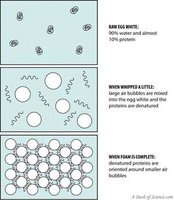
Nucleic Acids
Structure and Function
Nucleic acids are polymers of nucleotides, essential for inheritance and protein synthesis. - Key Point: DNA is double-stranded and contains deoxyribose; RNA is single-stranded and contains ribose. - Key Point: DNA directs its own replication and the synthesis of RNA and proteins. - Key Point: RNA types include mRNA, tRNA, rRNA, miRNA, and siRNA.
DNA and RNA Differences
- DNA: Deoxyribose sugar, thymine base, double-stranded. - RNA: Ribose sugar, uracil base, single-stranded.
Summary Questions
Describe the importance of carbon to life’s molecular diversity.
Identify chemical groups important to life.
Explain how cells make large molecules from small sets of monomers.
Define monosaccharides, disaccharides, and polysaccharides and their functions.
Define lipids, phospholipids, and steroids and their functions.
Explain how trans fats are formed and their health risks.
Describe the chemical structure and importance of proteins.
Describe the chemical structure of nucleic acids and their role in inheritance.
Explain the evolution of lactose tolerance in humans.
Additional info: Academic context was added to clarify definitions, examples, and processes for completeness.
