 뒤로
뒤로Study Guidance for Campbell Essential Biology Chapter 1: Learning About Life
스터디 가이드 - 스마트 노트
 자료에 맞춘 맞춤형 노트, 핵심 정의, 예시, 맥락을 확장해 제공합니다.
Q1. Which would best be described as science based on exploration?
Background
Topic: Scientific Methods in Biology
This question is testing your understanding of the different ways science is conducted, specifically distinguishing between experimental science and exploratory science.
Key Terms:
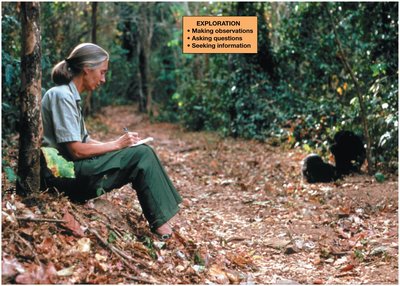
Exploration: In science, this refers to making observations, asking questions, and seeking information without necessarily conducting controlled experiments.
Experimentation: Involves testing hypotheses under controlled conditions.
Step-by-Step Guidance
Consider what activities are involved in scientific exploration (e.g., observing organisms in their natural habitat, recording behaviors, describing new species).
Think about examples from biology where discoveries were made through observation and description rather than experimentation.
Review the options provided and identify which ones involve gathering information through observation and description.
Try solving on your own before revealing the answer!
Final Answer: Science based on exploration involves activities such as describing a new bird species from the Philippines, sequencing the human genome, and searching for preserved specimens. All of these are examples of exploration.
These activities focus on observation, description, and information gathering, rather than controlled experimentation.
Q2. Darwin used the term natural selection to mean:
Background
Topic: Evolution and Natural Selection
This question is testing your understanding of Darwin's theory of evolution and the concept of natural selection.
Key Terms:
Natural Selection: The process by which certain heritable traits become more common in a population because they confer a survival or reproductive advantage.
Heritable Traits: Characteristics passed from parents to offspring through genes.
Step-by-Step Guidance
Recall Darwin's main idea: populations evolve over time due to differential survival and reproduction.
Consider the difference between individual adaptation (changes during a lifetime) and population-level changes (evolution).
Identify which option describes the selection of traits based on environmental conditions.
Try solving on your own before revealing the answer!
Final Answer: Darwin used natural selection to mean that some heritable traits of a population are selected for (or against) by environmental conditions.
This is the mechanism by which evolution occurs, as advantageous traits become more common in the population.
Q3. Within all living organisms, a series of chemical reactions known as metabolism allows these organisms to:
Background
Topic: Metabolism in Biology
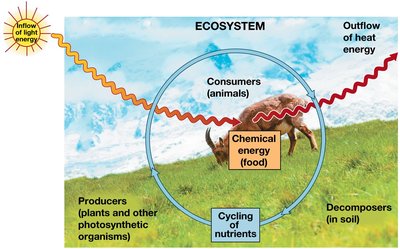
This question is testing your understanding of metabolism and its role in energy conversion and matter recycling in living organisms.
Key Terms:
Metabolism: The sum of all chemical reactions in an organism, including those that convert energy and recycle matter.
Energy Conversion: Changing energy from one form to another (e.g., chemical to kinetic).
Matter Recycling: Transforming molecules and atoms within the organism.
Step-by-Step Guidance
Recall that metabolism includes both catabolic (breaking down molecules) and anabolic (building molecules) reactions.
Think about how organisms use metabolism to convert energy (e.g., cellular respiration, photosynthesis).
Consider how metabolism also recycles matter (e.g., carbon, nitrogen cycles).
Try solving on your own before revealing the answer!
Final Answer: Metabolism allows organisms to both convert energy from one form to another and recycle matter from one form to another.
Both energy conversion and matter recycling are essential functions of metabolism in living organisms.
Q4. Scientists test hypothesis 1: The coral snake’s coloration warns off predators. Which colors of artificial snakes should the scientists use?
Background
Topic: Experimental Design in Biology
This question is testing your ability to design an experiment to test a hypothesis about mimicry and warning coloration in snakes.
Key Terms:
Hypothesis: A proposed explanation for an observation, which can be tested.
Mimicry: When one species evolves to resemble another.
Warning Coloration: Bright colors that signal danger to predators.
Step-by-Step Guidance
Identify the hypothesis: Coral snake coloration warns off predators.
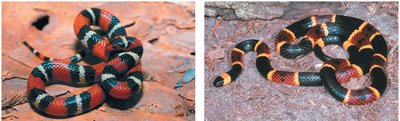
Think about what color patterns are characteristic of coral snakes (red, yellow, black rings).
Consider which artificial snake color combinations would allow scientists to test whether predators avoid the warning coloration.
Try solving on your own before revealing the answer!
Final Answer: Scientists should use brown artificial snakes and artificial snakes with red, yellow, and black rings.
This allows comparison between snakes with warning coloration and those without, testing the hypothesis effectively.
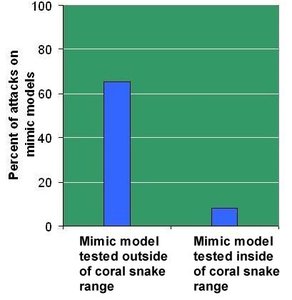
Q5. Scientists plan an experiment to test hypothesis 3: The protection that king snakes receive by mimicking coral snakes will depend on the presence of coral snakes. The artificial snakes in area one experience a 65% attack rate, while the artificial snakes in area two experience a 7% attack rate. This data ______ hypothesis 3.
Background
Topic: Interpreting Experimental Data
This question is testing your ability to interpret data from an experiment and relate it to a hypothesis about mimicry and predator behavior.
Key Terms:
Attack Rate: The percentage of artificial snakes attacked by predators.
Hypothesis Testing: Determining whether data support or refute a hypothesis.
Step-by-Step Guidance
Review the hypothesis: King snake mimicry is more effective where coral snakes are present.
Compare the attack rates in areas with and without coral snakes.
Think about what a lower attack rate in the presence of coral snakes suggests about the effectiveness of mimicry.
Try solving on your own before revealing the answer!
Final Answer: This data supports hypothesis 3.
The lower attack rate in the presence of coral snakes suggests that mimicry is more effective when coral snakes are present.
Q6. Which is the largest unit of organization in living things?
Background
Topic: Levels of Biological Organization
This question is testing your understanding of the hierarchy of biological organization, from smallest to largest.
Key Terms:
Organelle: A specialized structure within a cell.
Organ: A group of tissues working together.
Biosphere: The global sum of all ecosystems.
Population: A group of organisms of the same species.
Organism: An individual living thing.
Step-by-Step Guidance
Recall the levels of organization: organelle, cell, tissue, organ, organism, population, community, ecosystem, biosphere.
Identify which level encompasses all others and represents the broadest scale.
Compare the options and select the largest unit.
Try solving on your own before revealing the answer!
Final Answer: The biosphere is the largest unit of organization in living things.
The biosphere includes all ecosystems and living organisms on Earth.
