 뒤로
뒤로Study Guide for Chapter 12: The Cell Cycle (General Biology)
스터디 가이드 - 스마트 노트
 자료에 맞춘 맞춤형 노트, 핵심 정의, 예시, 맥락을 확장해 제공합니다.
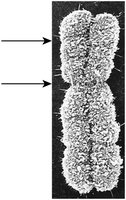
Q1. Explain how mitosis results in genetically identical cells, using the terms chromosome, chromatid, and chromatin.
Background
Topic: Mitosis and Genetic Continuity
This question tests your understanding of how mitosis ensures that daughter cells are genetically identical to the parent cell, and requires you to use key vocabulary related to chromosomes.
Key Terms:
Chromosome: A structure made of DNA and proteins that contains genetic information.
Chromatid: One of two identical halves of a duplicated chromosome.
Chromatin: The complex of DNA and proteins that makes up chromosomes; it is less condensed during interphase.
Step-by-Step Guidance
Recall that before mitosis, DNA is replicated during interphase, resulting in duplicated chromosomes composed of two sister chromatids.
During mitosis, the sister chromatids are separated and distributed to two daughter cells.
Each daughter cell receives an identical set of chromosomes, ensuring genetic identity.
Think about how chromatin condenses into chromosomes during mitosis, and how the structure changes throughout the cell cycle.
Use the terms chromosome, chromatid, and chromatin to describe these processes, but pause before writing your final explanation.
Try solving on your own before revealing the answer!
Final Answer:
Mitosis results in genetically identical cells because each chromosome is duplicated (forming two sister chromatids) during interphase. During mitosis, the chromatids are separated and distributed to each daughter cell. Chromatin condenses into chromosomes, and after division, each cell has the same chromosomal content as the original cell.
Chromatin is the uncondensed form of DNA; chromosomes are condensed structures visible during mitosis; chromatids are the identical halves of a duplicated chromosome. The process ensures that each daughter cell receives an identical set of chromosomes.
Q2. Describe the events of interphase and the M phase.
Background
Topic: Cell Cycle Phases
This question tests your knowledge of the cell cycle, specifically the events that occur during interphase and the mitotic (M) phase.
Key Terms:
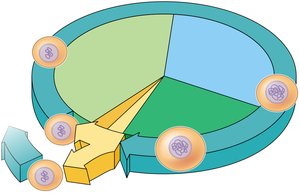
Interphase: The phase of the cell cycle when the cell grows, replicates DNA, and prepares for division.
M phase: The phase when mitosis and cytokinesis occur.
Step-by-Step Guidance
Identify the three subphases of interphase: G1 (cell growth), S (DNA synthesis), and G2 (preparation for mitosis).
Describe what happens in each subphase: G1 (cell increases in size), S (DNA is replicated), G2 (cell prepares for mitosis).
Explain that the M phase includes mitosis (division of the nucleus) and cytokinesis (division of the cytoplasm).
Summarize the main events in the M phase, but stop before listing all the stages of mitosis.
Try solving on your own before revealing the answer!
Final Answer:
Interphase consists of G1 (cell growth), S (DNA replication), and G2 (preparation for mitosis). The M phase includes mitosis (prophase, metaphase, anaphase, telophase) and cytokinesis. During interphase, the cell grows and duplicates its DNA; during the M phase, the cell divides its nucleus and cytoplasm to produce two daughter cells.
Q3. Identify three checkpoints that control the cell cycle, and explain how they operate.
Background
Topic: Cell Cycle Regulation
This question tests your understanding of cell cycle checkpoints and their role in regulating cell division.
Key Terms:
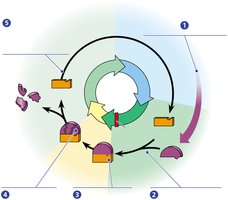
Checkpoint: A control point in the cell cycle where stop and go-ahead signals regulate the cycle.
G1 checkpoint: Determines if the cell is ready to proceed to DNA synthesis.
G2 checkpoint: Ensures DNA replication is complete and the cell is ready for mitosis.
M checkpoint: Ensures all chromosomes are properly attached to the spindle before anaphase.
Step-by-Step Guidance
List the three main checkpoints: G1, G2, and M.
Describe the purpose of each checkpoint: G1 (cell size, nutrients, DNA integrity), G2 (DNA replication, damage repair), M (chromosome attachment to spindle).
Explain how regulatory proteins (such as cyclins and Cdks) help control these checkpoints.
Think about what happens if a checkpoint is not passed, but pause before describing the consequences in detail.
Try solving on your own before revealing the answer!
Final Answer:
The three checkpoints are G1 (cell commits to division), G2 (checks for DNA damage and completion of replication), and M (ensures chromosomes are properly attached to spindle fibers). Each checkpoint is regulated by proteins such as cyclins and cyclin-dependent kinases (Cdks), which act as molecular switches to control progression through the cell cycle.
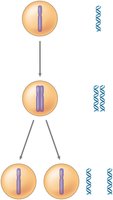
Q4. Study Figure 12.5 in your text. Label the following figure and summarize what occurs at the DNA level in each stage.
Background
Topic: Chromosome Duplication and Distribution
This question tests your ability to interpret diagrams showing chromosome duplication and segregation during cell division.
Key Terms:
Chromosome: A single DNA molecule with associated proteins.
Sister chromatids: Two identical copies of a chromosome joined at the centromere.
Centromere: The region where sister chromatids are joined.
Step-by-Step Guidance
Examine the diagram: the top cell has one chromosome, the middle cell has a duplicated chromosome (two sister chromatids), and the bottom shows two cells each with one chromosome.
Describe what happens to the DNA in each stage: replication, condensation, segregation.
Label the chromosome, sister chromatids, and centromere in each stage.
Summarize the process, but pause before writing the full explanation.
Try solving on your own before revealing the answer!
Final Answer:
In the first stage, the cell has one chromosome. In the second stage, the chromosome is duplicated, forming two sister chromatids joined at the centromere. In the third stage, the chromatids separate, and each daughter cell receives one chromosome, ensuring genetic identity.
