 뒤로
뒤로Membrane Structure and Function (8/16/26)
스터디 가이드 - 스마트 노트
 자료에 맞춘 맞춤형 노트, 핵심 정의, 예시, 맥락을 확장해 제공합니다.
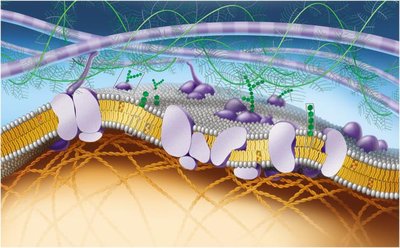
Q1. Explain the fluid mosaic model, describing the components of the membrane.
Background
Topic: Cell Membrane Structure
This question tests your understanding of the organization and composition of the plasma membrane, a fundamental concept in cell biology.
Key Terms and Concepts:
Fluid mosaic model: Describes the structure of cell membranes as a mosaic of components (lipids, proteins, carbohydrates) that gives the membrane a fluid character.
Phospholipids: Amphipathic molecules with hydrophilic heads and hydrophobic tails. (a love-hate relationship with water)
Integral proteins: Embedded within the lipid bilayer.
Peripheral proteins: Loosely attached to the membrane surface.
Cholesterol: Modulates membrane fluidity.
Step-by-Step Guidance
Start by defining what is meant by the 'fluid' and 'mosaic' aspects of the model.
Describe the arrangement of phospholipids in the bilayer and explain why they form this structure (amphipathic nature).
Identify the types of proteins found in the membrane and their general locations (integral vs. peripheral).
Discuss the role of cholesterol and carbohydrates in the membrane.
Consider how the components interact to allow for membrane flexibility and function, but stop before summarizing the full model.
Try solving on your own before revealing the answer!
Final Answer:
The fluid mosaic model envisions the plasma membrane as a dynamic structure where proteins drift laterally in a fluid bilayer of phospholipids. The membrane is composed of a double layer of amphipathic phospholipids, with hydrophilic heads facing outward and hydrophobic tails inward. Integral proteins penetrate the hydrophobic core, while peripheral proteins are attached to the membrane surface. Cholesterol molecules are interspersed within the bilayer, modulating fluidity. Carbohydrates are attached to proteins and lipids on the extracellular surface, contributing to cell recognition. This arrangement allows the membrane to be flexible, self-healing, and selectively permeable.
Q2. Describe how membrane structure results in selective permeability.
Background
Topic: Selective Permeability of Biological Membranes
This question examines your understanding of how the physical and chemical properties of the membrane control what enters and exits the cell.
Key Terms and Concepts:
Selective permeability: The ability of the membrane to allow some substances to cross more easily than others. (21 and over club)
Phospholipid bilayer: Acts as a barrier to most polar and charged molecules. (a security guard to the club)
Transport proteins: Facilitate the movement of specific molecules across the membrane. (Planes that travel through the membrane)
Step-by-Step Guidance
Explain how the hydrophobic core of the phospholipid bilayer restricts passage of ions and polar molecules.
Describe the role of transport proteins (channels and carriers) in enabling specific molecules to cross the membrane.
Discuss how the structure of these proteins determines their specificity for certain substances.
Consider the importance of membrane carbohydrates in cell recognition, but do not yet summarize the full mechanism of selective permeability.
Try solving on your own before revealing the answer!
Final Answer:
The membrane's selective permeability arises from its structure: the hydrophobic interior of the phospholipid bilayer blocks most polar and charged substances, while small nonpolar molecules can diffuse through. Specific transport proteins embedded in the membrane allow only certain ions and molecules to pass, based on size, charge, and shape. This ensures that essential nutrients enter, waste products exit, and the cell maintains homeostasis.
Q3. Use examples to demonstrate the processes of diffusion, osmosis, and facilitated diffusion.
Background
Topic: Passive Transport Mechanisms
This question tests your ability to distinguish between different types of passive transport and to provide real-life examples.
Key Terms and Concepts:
Diffusion: Movement of molecules from high to low concentration.
Osmosis: Diffusion of water across a selectively permeable membrane. (Allows substances to pass through, but in cells, the membrane is selectively permeable; only certain molecules can cross, thanks to its structures and specialized proteins.)
Facilitated diffusion: Passive movement of molecules via transport proteins.
Step-by-Step Guidance
Define each process (diffusion, osmosis, facilitated diffusion).
Provide an example for each: e.g., oxygen diffusion for diffusion, water movement for osmosis, glucose transport for facilitated diffusion.
Explain the role of concentration gradients in each process.
Describe how facilitated diffusion differs from simple diffusion, but do not yet provide the full comparison or all examples.
Try solving on your own before revealing the answer!
Final Answer:
Diffusion: Oxygen moves from areas of high concentration (lungs) to low concentration (bloodstream). Osmosis: Water moves into a plant cell placed in pure water. Facilitated diffusion: Glucose enters a cell via a specific carrier protein. All these processes move substances down their concentration gradients without energy input.
Q4. Describe the process of active transport.
Background
Topic: Active Transport Across Membranes
This question focuses on how cells move substances against their concentration gradients using energy.
Key Terms and Concepts:
Active transport: Movement of substances against their concentration gradient, requiring energy (usually ATP). ( a little bit more energy than used too)
Carrier proteins: Proteins that change shape to move substances across the membrane. (small box to big boxes, from Amazon boxes)
ATP: The energy source for active transport. (the gas for the Amazon truck to drive)
Step-by-Step Guidance
Define active transport and contrast it with passive transport.
Describe the role of carrier proteins in active transport.
Explain how ATP provides energy for the process.
Introduce the sodium-potassium pump as a classic example, but do not yet detail the full mechanism.
Try solving on your own before revealing the answer!
Final Answer:
Active transport uses carrier proteins and energy from ATP to move substances (like ions) against their concentration gradients. The sodium-potassium pump is a key example, moving Na+ out of and K+ into the cell, maintaining essential gradients for cell function.
Q5. Identify the mechanisms a cell uses to transport materials across the membrane in bulk.
Background
Topic: Bulk Transport Mechanisms
This question asks you to describe how cells move large particles or volumes of material across the membrane.
Key Terms and Concepts:
Exocytosis: Secretion of materials via vesicle fusion with the plasma membrane. (out)
Endocytosis: Uptake of materials by forming vesicles from the plasma membrane. (in)
Phagocytosis, pinocytosis, receptor-mediated endocytosis: Types of endocytosis.
Step-by-Step Guidance
Define exocytosis and endocytosis.
Describe the general steps involved in each process.
List and briefly define the subtypes of endocytosis.
Provide a specific example for each mechanism, but do not yet summarize all details or examples.
Try solving on your own before revealing the answer!
Final Answer:
Cells use exocytosis to secrete hormones or neurotransmitters and endocytosis to take in large particles (phagocytosis), fluids (pinocytosis), or specific molecules (receptor-mediated endocytosis). These processes require energy and involve vesicle formation or fusion with the membrane.
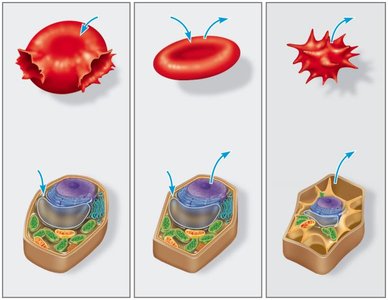
Q6. In the following figure, label the hypotonic solution, isotonic solution, and hypertonic solution. What is indicated by the blue arrows? Label them. Which cell is lysed? Turgid? Flaccid? Plasmolyzed? Apply all these labels.
Background
Topic: Effects of Osmosis on Animal and Plant Cells
This question tests your ability to interpret diagrams showing the effects of different solutions on cells and to apply correct terminology.
Key Terms and Concepts:
Hypotonic: Solution with lower solute concentration than the cell. (low, bottom)
Isotonic: Solution with equal solute concentration as the cell. (equal, in the middle)
Hypertonic: Solution with higher solute concentration than the cell. (high, above)
Lysed, turgid, flaccid, plasmolyzed: Terms describing cell states in different solutions.(like anything other than high, low, or equal, and nothing like bottom, above, or in the middle)
Step-by-Step Guidance
Examine the diagram and identify which solution is hypotonic, isotonic, and hypertonic based on the direction of water movement (blue arrows).
Label the animal and plant cells in each solution according to their appearance (e.g., lysed, turgid, flaccid, plasmolyzed).
Explain why animal cells burst in hypotonic solutions but plant cells become turgid.
Describe the significance of the cell wall in plant cells, but do not yet provide all the labels or the full explanation.
Try solving on your own before revealing the answer!
Final Answer:
From left to right: Hypotonic (animal cell lysed, plant cell turgid), Isotonic (animal cell normal, plant cell flaccid), Hypertonic (animal cell shriveled, plant cell plasmolyzed). The blue arrows indicate the direction of water movement. Plant cells do not burst in hypotonic solutions due to their cell wall, while animal cells can lyse.
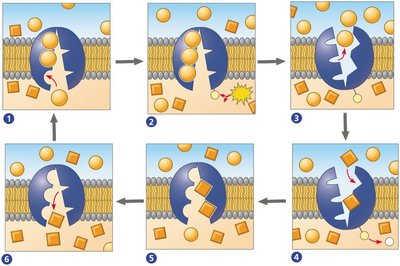
Q7. The sodium–potassium pump is an important system that demonstrates active transport. Use the following diagram to understand how it works. Use these terms to label the figures, and briefly summarize what is occurring in each step: extracellular fluid, cytoplasm, Na+, K+, ATP, ADP, P, and transport protein.
Background
Topic: Active Transport Mechanisms
This question focuses on the stepwise mechanism of the sodium-potassium pump, a classic example of active transport in animal cells.
Key Terms and Concepts:
Sodium-potassium pump: A transport protein that moves Na+ out and K+ into the cell using ATP. ( like someone on shift)
ATP hydrolysis: Provides energy for the pump. (the manager who tells the worker to go on break)
Phosphorylation: Addition of a phosphate group to the protein, causing a conformational change.
Step-by-Step Guidance
Identify the binding of Na+ ions to the pump from the cytoplasm.
Describe how ATP phosphorylates the pump, leading to a conformational change.
Explain the release of Na+ to the extracellular fluid and the binding of K+ ions.
Discuss the release of the phosphate group and the return of the pump to its original shape, but do not yet summarize all steps or provide the full cycle.
Try solving on your own before revealing the answer!
Final Answer:
Step 1: Three Na+ ions bind to the pump from the cytoplasm. Step 2: ATP phosphorylates the pump, causing it to change shape. Step 3: Na+ is released outside the cell. Step 4: Two K+ ions bind from the extracellular fluid. Step 5: The phosphate group is released, and the pump returns to its original shape. Step 6: K+ is released into the cytoplasm. This cycle maintains essential ion gradients across the membrane.
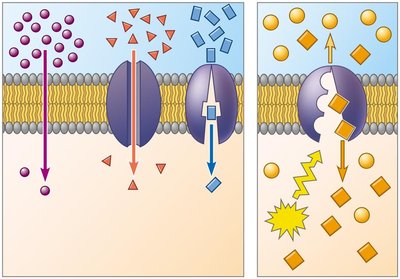
Q8. On the following diagram, add these labels: facilitated diffusion with a carrier protein, facilitated diffusion with a channel protein, active transport with a carrier protein, and simple diffusion. Below each type of transport, give an example of a material that is moved in this manner.
Background
Topic: Types of Membrane Transport
This question asks you to distinguish between different transport mechanisms and to match examples to each.
Key Terms and Concepts:
Simple diffusion: Movement of small, nonpolar molecules (e.g., O2, CO2). (simple,small)
Facilitated diffusion: Movement of polar or charged molecules via channel or carrier proteins (e.g., ions, glucose). (large,complicated)
Active transport: Movement against a gradient using energy (e.g., Na+, K+). (to move the membranes)
Step-by-Step Guidance
Identify each type of transport in the diagram based on the direction of movement and energy use.
Label the proteins as channels or carriers as appropriate.
Match an example molecule to each transport type (e.g., O2 for simple diffusion, glucose for facilitated diffusion, Na+ for active transport).
Explain the difference between passive and active transport, but do not yet provide all labels or examples.
Try solving on your own before revealing the answer!
Final Answer:
Facilitated diffusion with a channel protein: ions (e.g., Na+), facilitated diffusion with a carrier protein: glucose, active transport with a carrier protein: Na+/K+ pump, simple diffusion: O2 or CO2. Each mechanism is suited to the properties of the transported substance.
