 뒤로
뒤로Systematics and Phylogeny: Seeking Order Amid Diversity
스터디 가이드 - 스마트 노트
 자료에 맞춘 맞춤형 노트, 핵심 정의, 예시, 맥락을 확장해 제공합니다.
Systematics and Taxonomy
Introduction to Systematics
Systematics is the scientific discipline focused on classifying organisms and determining their evolutionary relationships. It encompasses taxonomy, which is the naming and classification of organisms, and phylogenetics, the study of evolutionary relationships among species.
Systematics: The scientific field that groups and classifies organisms based on evolutionary relationships.
Taxonomy: The systematic naming and classification of organisms.
Linnaean Hierarchy: A hierarchical classification system developed by Carolus Linnaeus, organizing life into nested categories.
Phylogenetics: The study of evolutionary relationships among organisms.
Taxon (plural: taxa): Any named group at any taxonomic level.
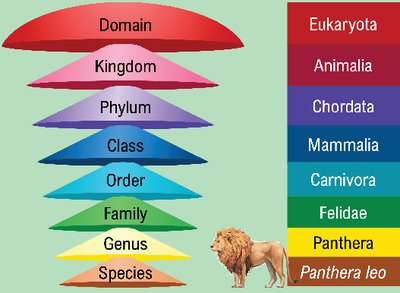
Linnaean Hierarchy
The Linnaean system organizes living things into a series of ranked groups, from the broadest (domain) to the most specific (species).
Domain > Kingdom > Phylum > Class > Order > Family > Genus > Species
Mnemonic: "Dear King Philip Came Over For Good Soup"
Example: Panthera leo (lion) is classified as: Eukaryota, Animalia, Chordata, Mammalia, Carnivora, Felidae, Panthera, leo.
Binomial Nomenclature
Binomial nomenclature is the two-word naming system used in taxonomy, providing each species with a unique scientific name.
Uses Latin or Latinized names.
First word: Genus (capitalized).
Second word: species (lowercase).
Both words are italicized (e.g., Panthera leo).
Correct formatting is essential for scientific communication.
Phylogeny and Phylogenetic Trees
Understanding Phylogeny
Phylogeny refers to the evolutionary history and relationships among species or groups of organisms. These relationships are depicted using phylogenetic trees.
Phylogenetic tree: A branching diagram that shows evolutionary relationships among taxa.
Groups are formed by identifying common ancestors, represented by nodes where branches diverge.
Phylogenetic trees can be read similarly to family trees.
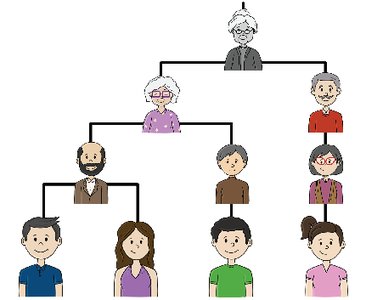
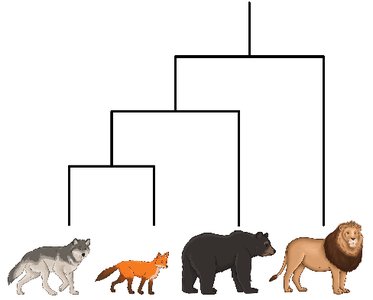
Parts of a Phylogenetic Tree
Phylogenetic trees have specific terminology to describe their structure:
Branch: Represents a lineage over time.
Node (Branch Point): The last common ancestor of multiple taxa.
Root: The common ancestor for all organisms on the tree.
Sister Taxa: Organisms that share an immediate common ancestor.
Polytomy: A node with more than two branches.
Clade (Monophyletic Group): A group that includes a node and all descendants from that node.
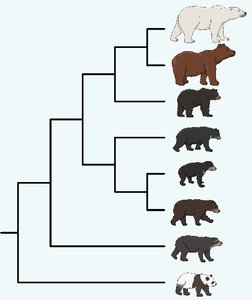
Reading and Interpreting Phylogenetic Trees
Phylogenetic trees can be drawn in different ways but represent the same relationships if the branching order is preserved. The arrangement of taxa at the tips does not affect the relationships depicted.
Only the branching pattern (topology) is important unless otherwise stated.
Branch length may represent time, amount of evolution, or nothing, depending on the tree.
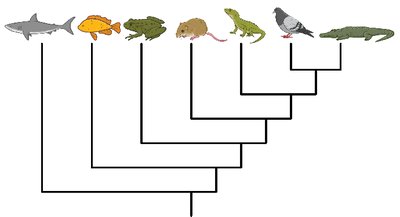
Building Phylogenetic Trees
Shared Derived and Ancestral Characters
Phylogenetic trees are constructed by analyzing shared characters among taxa. These characters can be:
Homologous: Inherited from a common ancestor.
Analogous: Similar due to convergent evolution, not common ancestry.
Shared derived character (synapomorphy): A trait present in more than one taxon that evolved within the group.
Shared ancestral character: A trait present at the base of the tree, inherited from a distant ancestor.
Character Matrix and Outgroups
A character matrix is used to identify shared derived characters and construct trees. An outgroup is a taxon known to be more distantly related to the ingroup, helping to root the tree and identify ancestral traits.
Lays Eggs | 4 Limbs | Amnion | Mammary Glands | Gizzard | |
|---|---|---|---|---|---|
Fish | 1 | 0 | 0 | 0 | 0 |
Frog | 1 | 1 | 0 | 0 | 0 |
Mouse | 0 | 1 | 1 | 1 | 0 |
Platypus | 1 | 1 | 1 | 1 | 0 |
Bird | 1 | 1 | 1 | 0 | 1 |
Crocodile | 1 | 1 | 1 | 0 | 1 |
Additional info: 1 = character present, 0 = character absent.
Parsimony and Maximum Likelihood
Phylogenetic trees are often built using the principle of parsimony, which favors the tree with the fewest evolutionary changes. Maximum likelihood considers the probability of certain changes occurring.
Parsimony: The simplest explanation (fewest changes) is preferred (Occam's Razor).
Maximum Likelihood: Some evolutionary changes are more probable than others; this method incorporates those probabilities.
Cladistics: Types of Groups
Monophyletic, Paraphyletic, and Polyphyletic Groups
Cladistics classifies organisms based on common ancestry. Groups can be:
Monophyletic (Clade): Includes an ancestor and all its descendants.
Paraphyletic: Includes an ancestor and some, but not all, descendants.
Polyphyletic: Does not include the most recent common ancestor of all members.
Only monophyletic groups are used in modern systematics.
Phylogenetics and Genome Evolution
Homologs: Orthologs and Paralogs
Homologous genes are genes descended from a common ancestral gene. They can be:
Orthologs: Homologous genes in different species, diverged after a speciation event.
Paralogs: Homologous genes within the same genome, diverged after a gene duplication event.
The Molecular Clock
The molecular clock uses the number of genetic mutations between species to estimate the time of divergence. Mutation rates can vary among lineages and are influenced by natural selection and other factors.
Mutation rates are estimated by comparing DNA sequences and using fossil record dates as calibration points.
Neutral mutations (not affected by selection) are most reliable for molecular clocks.
Summary Table: Key Terms in Systematics and Phylogeny
Term | Definition |
|---|---|
Systematics | Scientific study of organism classification and evolutionary relationships |
Taxonomy | Naming and classification of organisms |
Phylogeny | Evolutionary history of a group of organisms |
Clade | Ancestor and all its descendants (monophyletic group) |
Parsimony | Preference for the simplest scientific explanation |
Orthologs | Homologous genes in different species |
Paralogs | Homologous genes within the same genome |
