 뒤로
뒤로The Cell Cycle and DNA Structure: Foundations of Eukaryotic Cell Division
스터디 가이드 - 스마트 노트
 자료에 맞춘 맞춤형 노트, 핵심 정의, 예시, 맥락을 확장해 제공합니다.
The Cell Cycle
Overview of the Cell Cycle
The cell cycle is a series of events that eukaryotic cells undergo to grow and divide. This process is essential for development, growth, and maintenance of all living organisms. In actively dividing human cells, the cycle takes approximately 18–24 hours to complete.
Cell growth and division are fundamental characteristics of life, beginning with a single fertilized egg and resulting in trillions of cells in the human body.
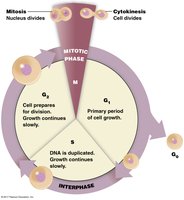
The cell cycle consists of two main phases: Interphase and the Mitotic Phase.
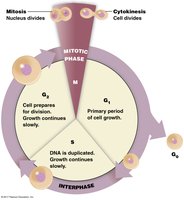
Phases of the Cell Cycle
Interphase: The period of cell growth and DNA duplication, subdivided into three phases:
G1 Phase (First Gap): Primary period of cell growth; cell is at its smallest size and grows rapidly (6–9 hours).
S Phase (Synthesis): DNA is replicated, resulting in duplicated chromosomes; growth continues slowly (7–8 hours).
G2 Phase (Second Gap): Cell continues to grow and prepares for division (6–9 hours).
G0 Phase: A non-dividing, non-growing state. Many cells enter this phase permanently (e.g., neurons, osteocytes), while others can re-enter the cycle if needed.
Mitotic Phase (M Phase): The nucleus and cytoplasm divide, producing two genetically identical daughter cells. This phase is much shorter (30–45 minutes) and includes:
Mitosis: Division of the nucleus and duplicated DNA.
Cytokinesis: Division of the cytoplasm.
DNA Structure and Organization
DNA: The Genetic Material
Deoxyribonucleic acid (DNA) is the hereditary material found in the nucleus of every cell. It consists of approximately 3 billion pairs of nucleotides, which are organized into a double helix structure. The nucleotides pair as follows: adenine (A) with thymine (T), and cytosine (C) with guanine (G).
DNA is also referred to as "base pairs" due to the pairing of nucleotides.
Before a new cell is created, an exact copy of the parental DNA must be produced during the S phase of interphase.
Chromosomes and Chromatin
Chromosomes are structures that organize and package DNA within the nucleus of eukaryotic cells. The number of chromosomes varies by species:
Humans: 46 chromosomes (23 pairs)
Blue whale: 44 chromosomes (22 pairs)
Fruit fly: 8 chromosomes (4 pairs)
During interphase, chromosomes are not visible under a microscope; instead, DNA exists as long, thin strands called chromatin. Chromatin consists of DNA wound around proteins called histones, which help compact and organize the DNA.
During the S phase, chromosomes are duplicated. In late G2 and the mitotic phase, chromatin condenses to form visible chromosomes.
Chromosome Structure During Mitosis
Prior to nuclear division, each chromosome consists of two identical sister chromatids joined at a region called the centromere. These chromatids are separated during mitosis to ensure each daughter cell receives an identical set of chromosomes.
Genes
A gene is a short segment of DNA that contains the instructions (code) for making one or more proteins. Genes are the smallest functional units of DNA and are located at specific positions on chromosomes. Humans have approximately 20,000–21,000 genes distributed across their 46 chromosomes.
Each gene's location on a chromosome is called its locus.
Additional info: The cell cycle is tightly regulated by various checkpoints and molecular signals to ensure accurate DNA replication and division. Errors in the cell cycle can lead to uncontrolled cell growth, as seen in cancer.
