 뒤로
뒤로The Chemical Basis of Life: Elements, Atoms, Compounds, and Water
스터디 가이드 - 스마트 노트
 자료에 맞춘 맞춤형 노트, 핵심 정의, 예시, 맥락을 확장해 제공합니다.
The Chemical Basis of Life
Introduction
All living organisms and their environments are composed of chemicals. Life’s chemistry is fundamentally tied to water, as most biological reactions occur in aqueous environments. Understanding the chemical basis of life is essential for grasping biological processes.
Elements, Atoms, and Compounds
Elements and Matter
Matter is anything that occupies space and has mass. It is composed of chemical elements, which are substances that cannot be broken down into simpler substances by ordinary chemical means. There are 92 naturally occurring elements, but only a few exist in pure form.
Element: A pure substance consisting of only one type of atom.
Compound: A substance made of two or more elements in a fixed ratio.
Example: Sodium chloride (NaCl) is a compound formed from sodium and chlorine.
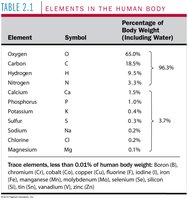
Table 2.1: Elements in the Human Body
Element | Symbol | Percentage of Body Weight (Including Water) |
|---|---|---|
Oxygen | O | 65.0% |
Carbon | C | 18.5% |
Hydrogen | H | 9.5% |
Nitrogen | N | 3.3% |
Calcium | Ca | 1.5% |
Phosphorus | P | 1.0% |
Potassium | K | 0.4% |
Sulfur | S | 0.3% |
Sodium | Na | 0.2% |
Chlorine | Cl | 0.2% |
Magnesium | Mg | 0.1% |
Trace elements (e.g., iron, iodine, zinc) are required in minute quantities but are essential for health.
Formation of Compounds
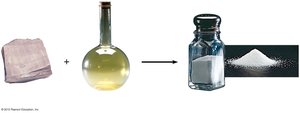
Compounds are more common than pure elements. They are formed when elements combine in fixed ratios, resulting in new substances with unique properties.
Example: Table salt (NaCl) is formed from sodium (Na) and chlorine (Cl).
Atoms: Structure and Properties
Atomic Structure
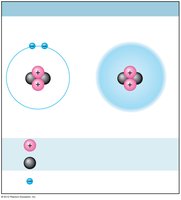
An atom is the smallest unit of matter that retains the properties of an element. Atoms are composed of three subatomic particles:
Protons: Positively charged, found in the nucleus.
Neutrons: Electrically neutral, found in the nucleus.
Electrons: Negatively charged, orbit the nucleus.
The atomic number is the number of protons in an atom. The mass number is the sum of protons and neutrons.
Isotopes
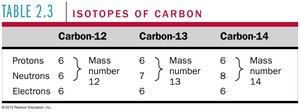
Isotopes are atoms of the same element with different numbers of neutrons. Some isotopes are radioactive, meaning their nuclei decay spontaneously, emitting energy.
Carbon-12 | Carbon-13 | Carbon-14 | |
|---|---|---|---|
Protons | 6 | 6 | 6 |
Neutrons | 6 | 7 | 8 |
Electrons | 6 | 6 | 6 |
Mass Number | 12 | 13 | 14 |
Chemical Bonds
Electron Distribution and Chemical Properties
Electrons are arranged in energy levels called shells. The number of electrons in the outermost shell determines an atom’s chemical properties and reactivity.
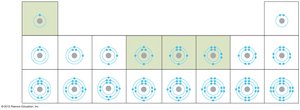
Covalent Bonds
Covalent bonds are the strongest type of chemical bond, formed when two atoms share one or more pairs of electrons. Molecules are formed by covalent bonds.
Nonpolar covalent bond: Electrons are shared equally.
Polar covalent bond: Electrons are shared unequally, resulting in partial charges.
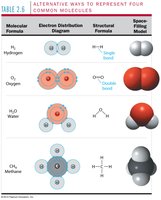
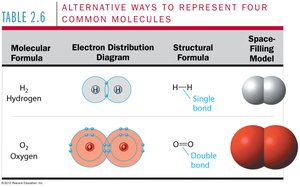
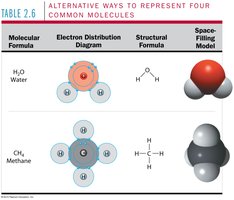
Ionic Bonds
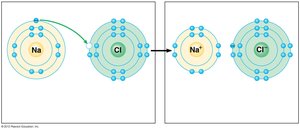
An ion is an atom or molecule with a net electrical charge due to the loss or gain of electrons. Ionic bonds are formed by the attraction between oppositely charged ions.
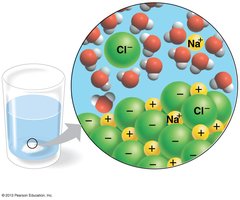
Example: Sodium (Na) loses an electron to become Na+, and chlorine (Cl) gains an electron to become Cl–. The resulting NaCl is held together by ionic bonds.
Hydrogen Bonds
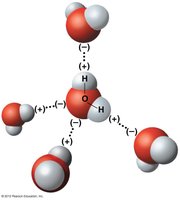
Hydrogen bonds are weak attractions between the partial positive charge of hydrogen in a polar covalent bond and the partial negative charge of another atom. They are crucial for maintaining the three-dimensional structure of large biological molecules.
Chemical Reactions
Making and Breaking Bonds
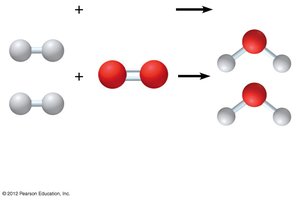
Chemical reactions involve the making and breaking of chemical bonds, resulting in the rearrangement of atoms. Reactants are converted into products.
Example: Formation of water from hydrogen and oxygen:
Water’s Life-Supporting Properties
Cohesion and Adhesion
Water molecules exhibit cohesion (sticking together) due to hydrogen bonding, which is essential for processes like water transport in plants. Adhesion is the tendency of water to stick to other substances.

Temperature Moderation
Water resists temperature changes due to hydrogen bonding. Heat is absorbed to break hydrogen bonds and released when they form, helping organisms maintain stable internal temperatures.
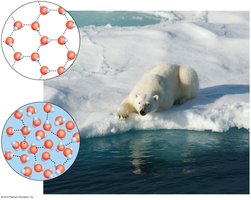
Density of Ice vs. Liquid Water
Ice is less dense than liquid water because hydrogen bonds stabilize and keep water molecules further apart in the solid state. This property allows ice to float, which is vital for aquatic life in cold environments.
Water as a Solvent
Water is known as the "solvent of life" due to its ability to dissolve a wide range of substances. Its polarity allows it to surround and separate ions and polar molecules, forming aqueous solutions.
Acids, Bases, and pH
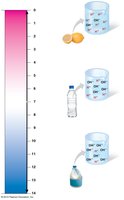
Acids release hydrogen ions (H+) into solutions, while bases accept H+. The pH scale measures the acidity or basicity of a solution, ranging from 0 (most acidic) to 14 (most basic). Buffers help maintain stable pH in biological systems.
Environmental Impact: Acid Precipitation and Ocean Acidification
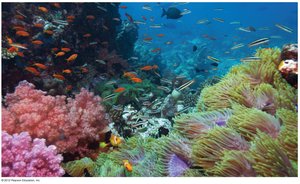
Burning fossil fuels releases compounds that form acids in the atmosphere, leading to acid precipitation. Increased CO2 dissolves in seawater, causing ocean acidification, which threatens marine life.
Water and the Search for Extraterrestrial Life
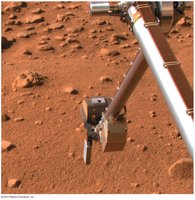
The unique properties of water are essential for life. Astrobiologists search for water as a key indicator of potential life on other planets.
Summary
Elements and compounds are fundamental to living organisms.
Atoms consist of protons, neutrons, and electrons; isotopes vary in neutron number.
Chemical bonds (covalent, ionic, hydrogen) determine molecular structure and function.
Water’s properties (cohesion, temperature moderation, density, solvent ability, pH regulation) are vital for life.
Environmental issues like acid precipitation and ocean acidification are linked to chemical changes in water.
