 뒤로
뒤로The Chemical Context of Life: Atoms, Elements, and Chemical Bonds
스터디 가이드 - 스마트 노트
 자료에 맞춘 맞춤형 노트, 핵심 정의, 예시, 맥락을 확장해 제공합니다.
Overview: A Chemical Connection to Biology
Biology is fundamentally connected to the principles of chemistry and physics. Living organisms are composed of matter, which is organized into a hierarchy from atoms to molecules to cells. At each level, new properties emerge that are not present at the previous level. Understanding the chemical context of life is essential for studying biological processes.
Concept 2.1: Matter, Elements, and Compounds
Definition of Matter
Matter is anything that takes up space and has mass.
Elements and Compounds
An element is a substance that cannot be broken down into other substances by chemical reactions.
A compound is a substance consisting of two or more elements in a fixed ratio.
Compounds have emergent properties different from their constituent elements.
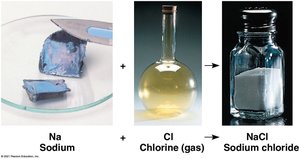
Example: Sodium (a reactive metal) and chlorine (a poisonous gas) combine to form sodium chloride (table salt), which is edible and safe.
The Elements of Life
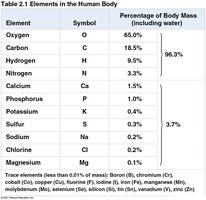
About 20–25% of the 92 natural elements are essential for life.
Major elements: Carbon, hydrogen, oxygen, and nitrogen make up 96% of living matter.
Other important elements: Calcium, phosphorus, potassium, sulfur, sodium, chlorine, and magnesium.
Trace elements are required in minute quantities (e.g., iron, iodine).
Element | Symbol | Percentage of Body Mass (including water) |
|---|---|---|
Oxygen | O | 65.0% |
Carbon | C | 18.5% |
Hydrogen | H | 9.5% |
Nitrogen | N | 3.3% |
Calcium | Ca | 1.5% |
Phosphorus | P | 1.0% |
Potassium | K | 0.4% |
Sulfur | S | 0.3% |
Sodium | Na | 0.2% |
Chlorine | Cl | 0.2% |
Magnesium | Mg | 0.1% |
Concept 2.2: Atomic Structure and Properties
Atoms and Subatomic Particles
An atom is the smallest unit of an element that retains its properties.
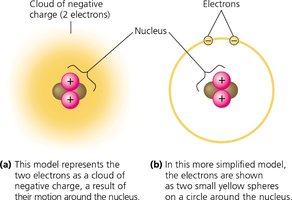
Atoms are composed of protons (positive charge), neutrons (no charge), and electrons (negative charge).
Protons and neutrons are located in the nucleus; electrons form a cloud around the nucleus.
Atomic Number, Mass Number, and Isotopes
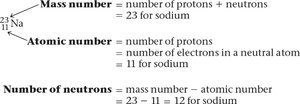
Atomic number = number of protons (also number of electrons in a neutral atom).
Mass number = number of protons + number of neutrons.
Atomic mass is approximately equal to the mass number.
Isotopes are atoms of the same element with different numbers of neutrons.
Radioactive isotopes decay spontaneously, emitting particles and energy.
Energy Levels and Electron Shells
Energy is the capacity to cause change; potential energy is energy due to position or structure.
Electrons have different potential energies depending on their distance from the nucleus.
Electrons occupy electron shells; the first shell is lowest in energy, outer shells are higher.
Electrons can move to higher shells by absorbing energy and fall back by releasing energy.
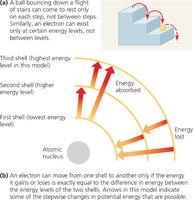
Electron Distribution and the Periodic Table
The arrangement of electrons in shells determines an atom’s chemical behavior.
The periodic table arranges elements by increasing atomic number and electron configuration.
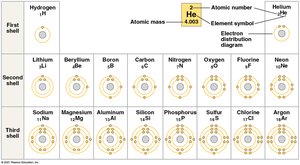
Valence Electrons and Chemical Reactivity
Valence electrons are electrons in the outermost shell (valence shell).
Atoms with full valence shells are chemically inert; those with incomplete shells are reactive.
Electron Orbitals
An orbital is a 3D space where an electron is likely to be found.
Each shell contains a specific number of orbitals; each orbital holds up to 2 electrons.
Atoms interact to complete their valence shells.
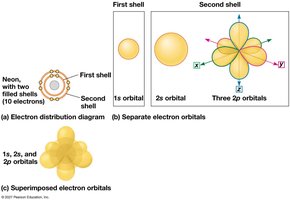
Concept 2.3: Chemical Bonds and Molecular Structure
Chemical Bonds
Atoms with incomplete valence shells can share or transfer electrons, forming chemical bonds.
Strongest bonds in biology: covalent bonds (sharing electrons).
Other important bonds: ionic bonds (transfer of electrons), hydrogen bonds, and Van der Waals interactions (weak attractions).
Covalent Bonds
Covalent bond: Sharing of a pair of valence electrons between two atoms.
Can be single (one pair shared) or double (two pairs shared).
Valence is the number of covalent bonds an atom can form (e.g., H: 1, O: 2, N: 3, C: 4).
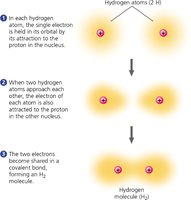
Electronegativity and Polarity
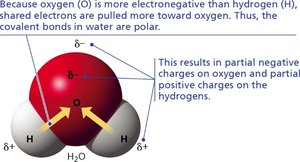
Electronegativity is an atom’s attraction for electrons in a covalent bond.
Nonpolar covalent bond: Electrons are shared equally (e.g., H2).
Polar covalent bond: Electrons are shared unequally, creating partial charges (e.g., H2O).
Ionic Bonds
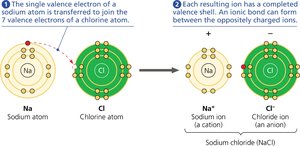
Formed when one atom transfers an electron to another, creating ions.
Cation: Positively charged ion (lost electron).
Anion: Negatively charged ion (gained electron).
Oppositely charged ions attract, forming an ionic bond (e.g., NaCl).
Weak Chemical Interactions
Weak bonds (hydrogen bonds, Van der Waals interactions) are crucial for the structure and function of biological molecules.
Hydrogen Bonds
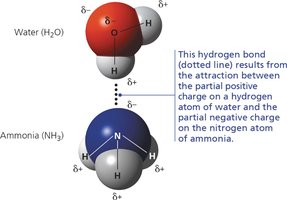
Form when a hydrogen atom covalently bonded to an electronegative atom is attracted to another electronegative atom.
Important in stabilizing DNA, protein structure, and water properties.
Van der Waals Interactions
Weak attractions due to temporary partial charges from uneven electron distribution.
Individually weak, but collectively significant (e.g., gecko adhesion).
Molecular Shape and Function
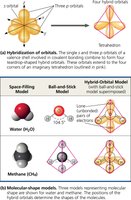
The shape of a molecule is determined by the positions of its atoms’ orbitals.
Shape is critical for molecular recognition and function (e.g., enzyme-substrate, hormone-receptor interactions).
Hybridization of orbitals leads to specific molecular geometries (e.g., tetrahedral for methane, bent for water).
Summary Table: Types of Chemical Bonds
Bond Type | Mechanism | Relative Strength | Example |
|---|---|---|---|
Covalent | Sharing of electrons | Strongest | H2O, CH4 |
Ionic | Transfer of electrons | Strong (in dry state) | NaCl |
Hydrogen | Attraction between H and electronegative atom | Weak (individually) | Between water molecules |
Van der Waals | Temporary partial charges | Very weak (individually) | Gecko adhesion |
Key Terms
Atom: Smallest unit of an element
Element: Pure substance of one type of atom
Compound: Substance of two or more elements in fixed ratio
Isotope: Atoms of same element with different neutrons
Covalent bond: Shared electrons
Ionic bond: Electron transfer, attraction of ions
Hydrogen bond: Weak attraction involving hydrogen
Van der Waals interaction: Weak, temporary attractions
Practice Questions
Describe the difference between an element and a compound. Give an example of each.
Explain how the structure of an atom determines its chemical properties.
Compare and contrast covalent, ionic, and hydrogen bonds in terms of mechanism and biological importance.
Why are weak chemical interactions important in biological systems?
