 뒤로
뒤로The Chemical Context of Life: Elements, Atoms, and Chemical Bonds
스터디 가이드 - 스마트 노트
 자료에 맞춘 맞춤형 노트, 핵심 정의, 예시, 맥락을 확장해 제공합니다.
The Chemical Context of Life
Concept 2.1: Matter Consists of Chemical Elements in Pure Form and in Combinations Called Compounds
Understanding the chemical basis of life begins with the study of matter, elements, and compounds. Matter is anything that takes up space and has mass, and organisms are composed of matter.
Matter: Anything that occupies space and has mass.
Organisms are composed of matter.
Matter consists of chemical elements in pure form and in combinations called compounds.
Elements and Compounds
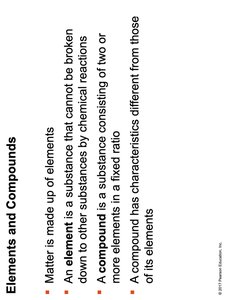
Elements and compounds are fundamental chemical substances. Elements are pure substances, while compounds are combinations of elements in fixed ratios.
Matter is made up of elements.
An element is a substance that cannot be broken down to other substances by chemical reactions.
A compound is a substance consisting of two or more elements in a fixed ratio.
Compounds have characteristics different from those of their elements.
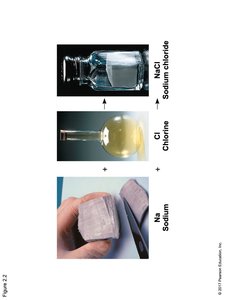
Example: Sodium Chloride Formation
Sodium (Na) and chlorine (Cl) are elements that combine to form sodium chloride (NaCl), a compound with properties distinct from its constituent elements.
The Elements of Life
Only a small fraction of the 92 natural elements are essential for life. These essential elements are required in varying quantities.
About 20–25% of the 92 natural elements are required for life (essential elements).
Carbon, hydrogen, oxygen, and nitrogen make up 96% of living matter.
The remaining 4% consists of calcium, phosphorus, potassium, and sulfur.
Trace elements are required by organisms in only minute quantities.
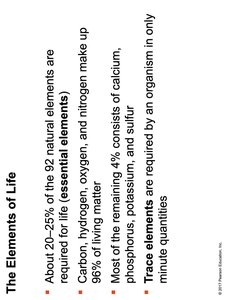
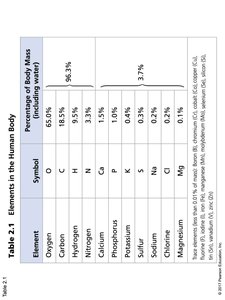
Table: Elements in the Human Body
The following table summarizes the major elements found in the human body and their relative abundance.
Element | Symbol | Percentage of Body Mass (including water) |
|---|---|---|
Oxygen | O | 65.0% |
Carbon | C | 18.5% |
Hydrogen | H | 9.5% |
Nitrogen | N | 3.3% |
Calcium | Ca | 1.5% |
Phosphorus | P | 1.0% |
Potassium | K | 0.4% |
Sulfur | S | 0.3% |
Sodium | Na | 0.2% |
Chlorine | Cl | 0.2% |
Magnesium | Mg | 0.1% |
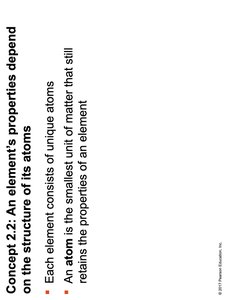
Concept 2.2: An Element’s Properties Depend on the Structure of Its Atoms
The unique properties of each element are determined by the structure of its atoms. Atoms are the smallest units of matter that retain the properties of an element.
Each element consists of unique atoms.
An atom is the smallest unit of matter that still retains the properties of an element.
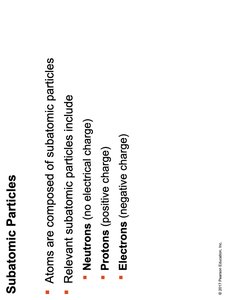
Subatomic Particles
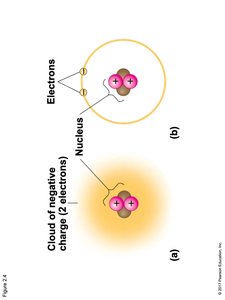
Atoms are composed of subatomic particles, which include neutrons, protons, and electrons.
Relevant subatomic particles include:
Neutrons: No electrical charge
Protons: Positive charge
Electrons: Negative charge
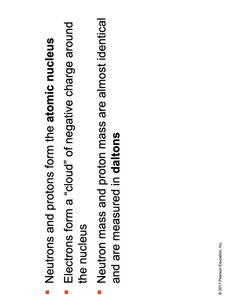
Atomic Nucleus and Electron Cloud
Neutrons and protons form the atomic nucleus, while electrons form a cloud of negative charge around the nucleus. Neutron and proton mass are almost identical and are measured in daltons.
Atomic Number and Atomic Mass
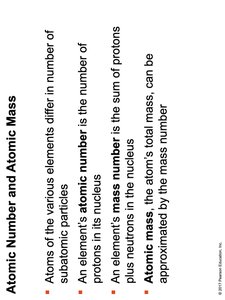
Atoms of different elements differ in their number of subatomic particles. The atomic number and atomic mass are key identifiers for each element.
An element’s atomic number is the number of protons in its nucleus.
An element’s mass number is the sum of protons plus neutrons in the nucleus.
Atomic mass is the atom’s total mass, approximated by the mass number.
Isotopes
Isotopes are atoms of the same element with different numbers of neutrons. Some isotopes are radioactive and decay spontaneously, giving off particles and energy.
All atoms of an element have the same number of protons but may differ in number of neutrons.
Isotopes are two atoms of an element that differ in number of neutrons.
Radioactive isotopes decay spontaneously, giving off particles and energy.
Radioactive Tracers
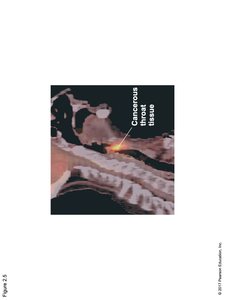
Radioactive isotopes are used as diagnostic tools in medicine and to track atoms through metabolism. They can be used with sophisticated imaging instruments.
Radioactive tracers can be used to track atoms through metabolism.
They are often used in combination with imaging instruments.
Radiometric Dating
Radiometric dating uses the decay of radioactive isotopes to measure the age of fossils and rocks. The rate of decay is expressed as the half-life.
A "parent" isotope decays into its "daughter" isotope at a fixed rate, expressed as the half-life.
In radiometric dating, scientists measure the ratio of different isotopes and calculate how many half-lives have passed since the fossil or rock was formed.
Half-life values vary from seconds or days to billions of years.
The Energy Levels of Electrons
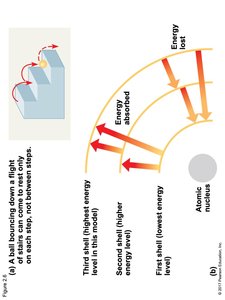
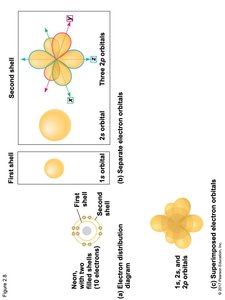
Electrons have potential energy due to their position relative to the nucleus. The energy levels of electrons are called electron shells.
Energy is the capacity to cause change.
Potential energy is the energy that matter has because of its location or structure.
The electrons of an atom differ in their amounts of potential energy.
An electron’s state of potential energy is called its energy level, or electron shell.
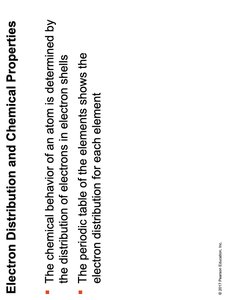
Electron Distribution and Chemical Properties
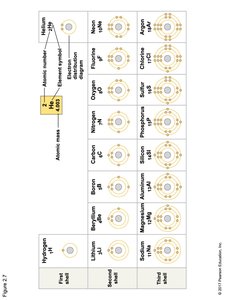
The chemical behavior of an atom is determined by the distribution of electrons in electron shells. The periodic table shows the electron distribution for each element.
The chemical behavior of an atom is determined by the distribution of electrons in electron shells.
The periodic table of the elements shows the electron distribution for each element.
Valence Electrons
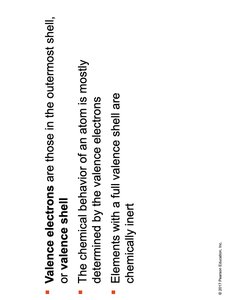
Valence electrons are those in the outermost shell, or valence shell. The chemical behavior of an atom is mostly determined by the valence electrons.
Valence electrons are those in the outermost shell, or valence shell.
The chemical behavior of an atom is mostly determined by the valence electrons.
Elements with a full valence shell are chemically inert.
Electron Orbitals
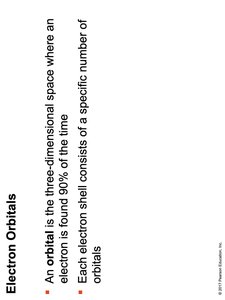
An orbital is the three-dimensional space where an electron is found 90% of the time. Each electron shell consists of a specific number of orbitals.
An orbital is the three-dimensional space where an electron is found 90% of the time.
Each electron shell consists of a specific number of orbitals.
Concept 2.3: The Formation and Function of Molecules Depend on Chemical Bonding Between Atoms
Atoms with incomplete valence shells can share or transfer valence electrons with certain other atoms, resulting in chemical bonds.
Atoms with incomplete valence shells can share or transfer valence electrons with certain other atoms.
These interactions usually result in atoms staying close together, held by attractions called chemical bonds.
Covalent Bonds
A covalent bond is the sharing of a pair of valence electrons by two atoms. The shared electrons count as part of each atom’s valence shell.
A covalent bond is the sharing of a pair of valence electrons by two atoms.
In a covalent bond, the shared electrons count as part of each atom’s valence shell.
Molecules and Covalent Bonds
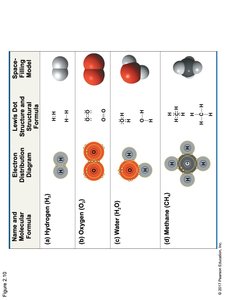
A molecule consists of two or more atoms held together by covalent bonds. Single and double covalent bonds differ in the number of shared electron pairs.
A single covalent bond is the sharing of one pair of valence electrons.
A double covalent bond is the sharing of two pairs of valence electrons.
Structural and Molecular Formulas
The notation used to represent atoms and bonding is called a structural formula. This can be abbreviated further with a molecular formula.
For example, structural formula: H—H
Molecular formula: H2
Bonding Capacity and Compound Formation
Bonding capacity is called the atom’s valence. Covalent bonds can form between atoms of the same element or atoms of different elements.
A compound is a combination of two or more different elements.
Electronegativity and Polar Covalent Bonds
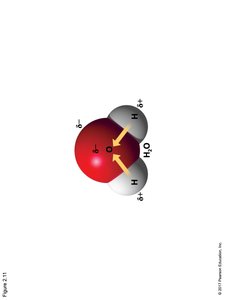
Atoms in a molecule attract electrons to varying degrees. Electronegativity is an atom’s attraction for the electrons in a covalent bond.
The more electronegative an atom is, the more strongly it pulls shared electrons toward itself.
In a nonpolar covalent bond, the atoms share the electron equally.
In a polar covalent bond, one atom is more electronegative and the atoms do not share the electron equally.
Unequal sharing of electrons causes a partial positive or negative charge for each atom or molecule.
Ionic Bonds
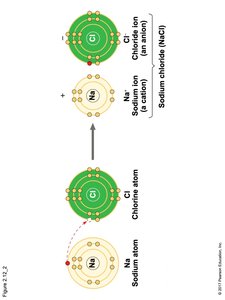
Ionic bonds form when atoms strip electrons from their bonding partners. After the transfer of an electron, both atoms have charges and are called ions.
A cation is a positively charged ion.
An anion is a negatively charged ion.
An ionic bond is an attraction between an anion and a cation.
Ionic Compounds (Salts)
Compounds formed by ionic bonds are called ionic compounds, or salts. Salts, such as sodium chloride, are often found in nature as crystals.
Weak Chemical Interactions
Most of the strongest bonds in organisms are covalent bonds, but many large biological molecules are held in their functional form by weak bonds. The reversibility of weak bonds can be an advantage.
Hydrogen Bonds
A hydrogen bond forms when a hydrogen atom covalently bonded to one electronegative atom is also attracted to another electronegative atom. In living cells, the electronegative partners are usually oxygen or nitrogen atoms.
Van der Waals Interactions
If electrons are not evenly distributed, they may accumulate by chance in one part of a molecule. Van der Waals interactions are attractions between molecules that are close together as a result of these charges.
Collectively, such interactions can be strong, as between molecules of a gecko’s toe hairs and a wall surface.
Molecular Shape and Function
A molecule’s size and shape are key to its function. Molecular shape is determined by the positions of its atoms’ orbitals. In a covalent bond, the s and p orbitals may hybridize, creating specific molecular shapes.
Molecular Shape Determines Biological Recognition
Molecular shape determines how biological molecules recognize and respond to one another. Opiates, such as morphine, and naturally produced endorphins have similar effects because their shapes are similar and they bind the same receptors in the brain.
Additional info:
Dalton is a unit of mass used to express atomic and molecular weights, equivalent to one atomic mass unit (amu).
Half-life () is mathematically defined as the time required for half of the radioactive atoms in a sample to decay.
Electronegativity differences determine whether a bond is polar or nonpolar.
