 뒤로
뒤로The Chemical Context of Life: Elements, Atoms, and Chemical Bonds
스터디 가이드 - 스마트 노트
 자료에 맞춘 맞춤형 노트, 핵심 정의, 예시, 맥락을 확장해 제공합니다.
The Chemical Context of Life
Introduction to Chemistry in Biology
All living organisms are composed of matter, which is governed by the fundamental laws of physics and chemistry. Understanding the chemical basis of life is essential for studying biology, as it explains how organisms interact with their environment and each other.
Biology is the study of life and living organisms.
Organisms are subject to the same physical and chemical laws as non-living matter.
Matter, Elements, and Compounds
Definitions and Properties
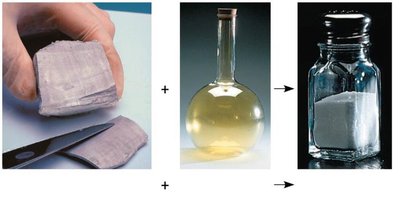
Matter is anything that occupies space and has mass. It is composed of elements, which can combine to form compounds with unique properties.
Matter: Anything that takes up space and has mass.
Element: A substance that cannot be broken down into other substances by chemical reactions.
Compound: A substance consisting of two or more elements in a fixed ratio, with properties different from its constituent elements.
The Elements of Life
Essential and Trace Elements
Of the 92 naturally occurring elements, only a small fraction are essential for life. The majority of living matter is composed of just a few elements, while others are required in trace amounts.
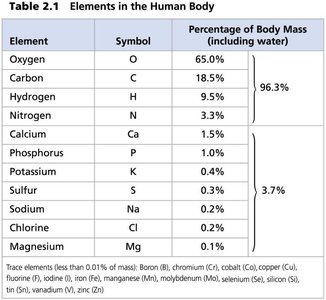
Four elements—carbon (C), hydrogen (H), oxygen (O), and nitrogen (N)—make up about 96% of living matter.
Other important elements include calcium (Ca), phosphorus (P), potassium (K), sulfur (S), sodium (Na), chlorine (Cl), and magnesium (Mg).
Trace elements are required in very small amounts but are vital for proper biological function.
Element | Symbol | Percentage of Body Mass (including water) |
|---|---|---|
Oxygen | O | 65.0% |
Carbon | C | 18.5% |
Hydrogen | H | 9.5% |
Nitrogen | N | 3.3% |
Calcium | Ca | 1.5% |
Phosphorus | P | 1.0% |
Potassium | K | 0.4% |
Sulfur | S | 0.3% |
Sodium | Na | 0.2% |
Chlorine | Cl | 0.2% |
Magnesium | Mg | 0.1% |
Atoms and Subatomic Particles
Structure of Atoms
An atom is the smallest unit of an element that retains its chemical properties. Atoms are composed of subatomic particles: protons, neutrons, and electrons.
Protons: Positively charged particles found in the nucleus.
Neutrons: Electrically neutral particles found in the nucleus.
Electrons: Negatively charged particles that orbit the nucleus in electron shells.
The number of protons determines the atomic number and identity of the element.
The sum of protons and neutrons gives the mass number.
Isotopes and Radioactivity
Isotopes are atoms of the same element with different numbers of neutrons. Some isotopes are unstable and radioactive, emitting particles and energy as they decay.
Isotopes: Atoms with the same number of protons but different numbers of neutrons.
Radioactive isotopes: Unstable isotopes that decay spontaneously.
Energy Levels and Electron Shells
Electron Arrangement and Chemical Behavior
The arrangement of electrons in shells around the nucleus determines an atom's chemical properties. Electrons have potential energy based on their position relative to the nucleus.
Electron shells: Energy levels where electrons are found.
Electrons in the outermost shell (valence shell) are called valence electrons and are most involved in chemical reactions.
Atoms with full valence shells are chemically inert (unreactive).
Chemical Bonds
Covalent Bonds
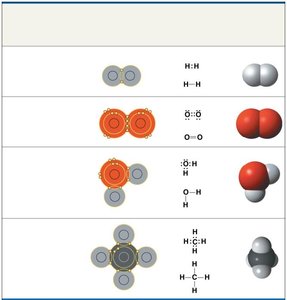
Covalent bonds form when two atoms share pairs of valence electrons. These bonds can be single, double, or triple, depending on the number of shared electron pairs.
Covalent bond: Sharing of a pair of valence electrons between two atoms.
Single bond: Sharing of one pair of electrons.
Double bond: Sharing of two pairs of electrons.
Molecules are formed by covalent bonds between atoms.
Electronegativity and Bond Polarity
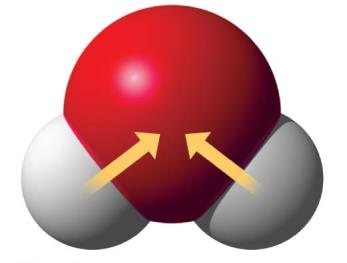
Electronegativity is an atom's ability to attract shared electrons. Differences in electronegativity between atoms lead to polar or nonpolar covalent bonds.
Nonpolar covalent bond: Electrons are shared equally between atoms.
Polar covalent bond: Electrons are shared unequally, resulting in partial charges (δ+ and δ−) on the atoms.
Ionic Bonds
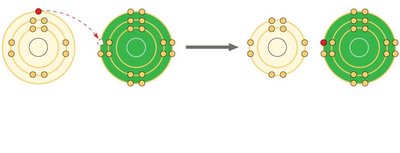
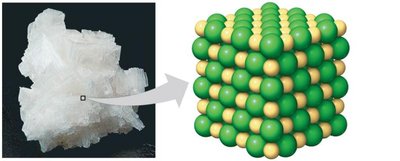
Ionic bonds form when one atom transfers electrons to another, resulting in oppositely charged ions that attract each other. Compounds formed by ionic bonds are called salts.
Cation: Positively charged ion (loses electrons).
Anion: Negatively charged ion (gains electrons).
Ionic bond: Attraction between a cation and an anion.
Salt: Compound formed by ionic bonds, often found as crystals in nature.
Weak Chemical Interactions
Hydrogen Bonds
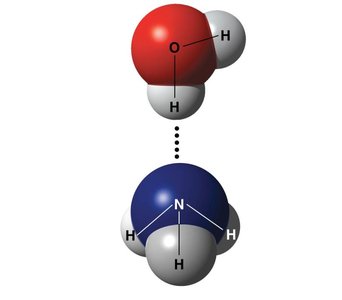
Hydrogen bonds are weak attractions that occur when a hydrogen atom covalently bonded to one electronegative atom is attracted to another electronegative atom, such as oxygen or nitrogen. These bonds are crucial for the structure and function of biological molecules.
Hydrogen bonds stabilize the structures of proteins and nucleic acids.
They are responsible for many of water's unique properties.
Van der Waals Interactions
Van der Waals interactions are weak attractions that occur when transient, uneven electron distributions create temporary dipoles in molecules. These interactions are important for the three-dimensional structure of large biological molecules.
They are individually weak but can be significant when many occur together.
Molecular Shape and Function
Importance of Molecular Shape
The shape of a molecule is determined by the positions of its atoms' orbitals and is critical for its biological function. Molecular shape determines how molecules recognize and interact with each other, such as in enzyme-substrate binding or hormone-receptor interactions.
Molecular recognition is often based on complementary shapes.
