 뒤로
뒤로The Chemical Context of Life: Foundations for General Biology
스터디 가이드 - 스마트 노트
 자료에 맞춘 맞춤형 노트, 핵심 정의, 예시, 맥락을 확장해 제공합니다.
The Chemical Context of Life
Introduction
Understanding biology begins with a solid grasp of chemistry. Biological processes are governed by the properties and interactions of atoms and molecules. This section provides an overview of matter, atomic structure, chemical bonds, and molecular shapes, forming the essential foundation for further study in biology.
Matter, Elements, and Compounds
Definitions and Classifications
Matter: Anything that occupies space and has mass.
Elements: Pure substances that cannot be broken down into simpler substances by normal chemical reactions. Examples: carbon (C), hydrogen (H), oxygen (O), nitrogen (N).
Compounds: Substances composed of two or more different elements combined in a fixed ratio. Example: H2O (water) vs. H2O2 (hydrogen peroxide).
Essential Elements for Life
Main Essential Elements (96% of body mass): Carbon, Oxygen, Hydrogen, Nitrogen.
Other Essential Elements (4%): Calcium, phosphorus, potassium, sulfur, etc.
Trace Elements: Required in very small quantities (e.g., iron, iodine, copper), but crucial for biological processes.
Atomic Structure
Subatomic Particles
Atoms: The smallest unit of an element retaining its chemical properties.
Neutrons: Neutral particles in the nucleus; number can vary (isotopes).
Protons: Positively charged particles in the nucleus; number defines the element.
Electrons: Negatively charged particles orbiting the nucleus; involved in chemical bonding.
Neutral Atom: Number of protons equals number of electrons.
Deciphering the Periodic Table and Atomic Properties
Symbol: Abbreviation for the element (e.g., C for carbon).
Atomic Number: Number of protons; unique to each element.
Atomic Mass: Sum of protons and neutrons (measured in Daltons).
Isotopes and Radioactivity
Isotopes
Atoms of the same element with different numbers of neutrons.
Example: Carbon-12 (6 protons, 6 neutrons), Carbon-14 (6 protons, 8 neutrons).
Calculating Neutrons: Number of neutrons = Atomic Mass - Number of Protons.
Radioactive Isotopes
Unstable isotopes that decay over time, releasing energy.
Half-life: Time required for half of a radioactive sample to decay.
Applications: Radiometric dating, tracing molecules in biological systems.
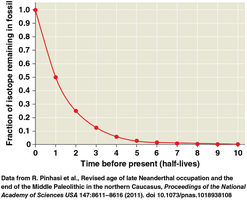
Example: If Np-240 has a half-life of 1 hour and you start with 60 grams, after 4 hours (4 half-lives), the remaining mass is calculated as:
grams
Electron Behavior and Energy Levels
Energy and Electron Shells
Energy: Capacity to cause change; electrons have potential energy based on their position relative to the nucleus.
Electron Shells: Discrete energy levels where electrons reside.
Electrons absorb energy to move to higher shells and release energy when falling to lower shells.
Valence Electrons and Shells
Valence Shell: Outermost shell; electrons here are involved in bonding.
First shell holds 2 electrons; subsequent shells hold up to 8 (octet rule).
Electron Orbitals and Sublevels
Orbitals: 3D regions where electrons are likely found (s, p, d, f sublevels).
S Orbitals: Spherical; hold 2 electrons.
P Orbitals: Dumbbell-shaped; 3 per shell, each holds 2 electrons (total 6).
D Orbitals: Cloverleaf-shaped; 5 per shell, each holds 2 electrons (total 10).
F Orbitals: Complex shapes; 7 per shell, each holds 2 electrons (total 14).
Examples of Electron Configuration:
Helium: 1s2
Neon: 1s2 2s2 2p6
Carbon: 1s2 2s2 2p2
Chemical Bonds
Intramolecular Forces (Strong Bonds)
Covalent Bonds: Sharing of electron pairs between atoms. Can be single (one pair), double (two pairs), or triple (three pairs) bonds.
Electronegativity: Atom's attraction for electrons in a bond.
Nonpolar Covalent Bond: Electrons shared equally.
Polar Covalent Bond: Electrons shared unequally, creating partial charges (e.g., H2O).
Ionic Bonds: One atom transfers electrons to another, forming ions (cations and anions) that attract each other.
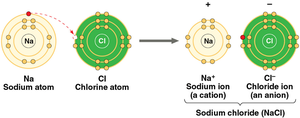
Example: Sodium (Na) donates an electron to chlorine (Cl), forming Na+ (cation) and Cl- (anion), which combine to form sodium chloride (NaCl).
Intermolecular Forces (Weaker Attractions)
Hydrogen Bonds: Attraction between a hydrogen atom (already in a polar bond) and an electronegative atom (like O or N) on another molecule.
Van der Waals Interactions: Temporary attractions due to momentary uneven electron distributions, important in large numbers (e.g., gecko adhesion).
Molecular Shape and Function
Hybridization and Molecular Geometry
Hybridization: Mixing of atomic orbitals to form new hybrid orbitals for bonding.
sp Hybridization: Linear shape (e.g., CO2).
sp2 Hybridization: Trigonal planar or bent (e.g., SO2, H2O with one lone pair).
sp3 Hybridization: Tetrahedral, pyramidal, or bent (e.g., CH4, NH3, H2O).
Lone Pairs: Non-bonding electrons can distort molecular geometry.
Biological Significance: Molecular shape determines function (e.g., enzyme-substrate specificity).
Chemical Reactions
Dynamic Processes of Life
Chemical Reactions: Making and breaking of chemical bonds to form new substances.
Reactants: Starting substances.
Products: Substances formed by the reaction.
Reversible Reactions: Most biological reactions are reversible.
Chemical Equilibrium: State where forward and reverse reaction rates are equal; concentrations of reactants and products remain constant.
