 뒤로
뒤로The Chemical Context of Life: Matter, Elements, and Chemical Bonds
스터디 가이드 - 스마트 노트
 자료에 맞춘 맞춤형 노트, 핵심 정의, 예시, 맥락을 확장해 제공합니다.
Overview: A Chemical Connection to Biology
Biology and Chemistry
Living organisms are governed by the fundamental laws of physics and chemistry. Biology is a multidisciplinary science, integrating concepts from chemistry to explain life processes. Life is organized hierarchically, from atoms to molecules, and then to cells, with emergent properties appearing at each level.
Emergent properties: New characteristics arise when simple components combine into more complex structures.
Transition from nonlife to life: Occurs as molecules organize into cells.
Concept 2.1: Matter, Elements, and Compounds
Matter and Its Forms
Matter is anything that occupies space and has mass. It is composed of elements and compounds.
Element: A pure substance that cannot be broken down by chemical reactions.
Compound: A substance made of two or more elements in a fixed ratio, with properties different from its constituent elements.
Emergent Properties of Compounds
When elements combine, the resulting compound often has new properties.
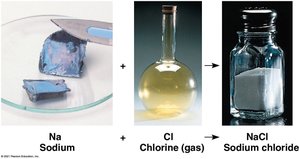
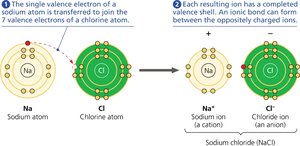
Example: Sodium (a metal) and chlorine (a gas) combine to form sodium chloride (NaCl), an edible salt.
The Elements of Life
Only a subset of the 92 naturally occurring elements are essential for life.
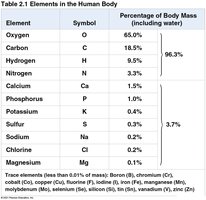
Major elements: Carbon, hydrogen, oxygen, and nitrogen make up 96% of living matter.
Other essential elements: Calcium, phosphorus, potassium, and sulfur.
Trace elements: Required in minute quantities (e.g., iron, iodine).
Element | Symbol | Percentage of Body Mass (including water) |
|---|---|---|
Oxygen | O | 65.0% |
Carbon | C | 18.5% |
Hydrogen | H | 9.5% |
Nitrogen | N | 3.3% |
Calcium | Ca | 1.5% |
Phosphorus | P | 1.0% |
Potassium | K | 0.4% |
Sulfur | S | 0.3% |
Sodium | Na | 0.2% |
Chlorine | Cl | 0.2% |
Magnesium | Mg | 0.1% |
Concept 2.2: Atomic Structure and Properties
Atoms and Subatomic Particles
Atoms are the smallest units of matter retaining the properties of an element.
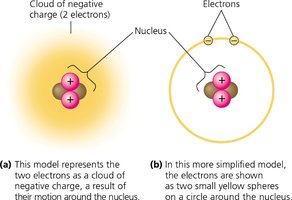
Subatomic particles: Protons (positive), neutrons (neutral), electrons (negative).
Atomic nucleus: Dense core of protons and neutrons.
Electron cloud: Electrons move around the nucleus.
Atomic Number and Atomic Mass
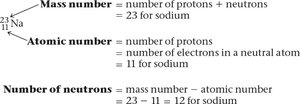
Atomic number: Number of protons in the nucleus; also equals the number of electrons in a neutral atom.
Mass number: Sum of protons and neutrons.
Atomic mass: Approximate total mass of an atom.
Isotopes
Isotopes are atoms of the same element with different numbers of neutrons.
Stable isotopes: Do not decay.
Radioactive isotopes: Decay spontaneously, emitting particles and energy.
Example: Carbon-12, Carbon-13 (stable); Carbon-14 (radioactive).
Energy Levels of Electrons
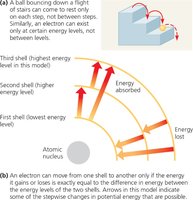
Electrons have potential energy based on their distance from the nucleus.
Electron shells: Discrete energy levels where electrons reside.
Energy transitions: Electrons absorb or release energy to move between shells.
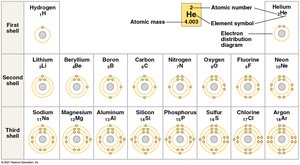
Electron Distribution and the Periodic Table
The arrangement of electrons in shells determines an atom’s chemical properties.
Periodic table: Shows electron distribution for each element.
Valence electrons: Electrons in the outermost shell; determine chemical reactivity.
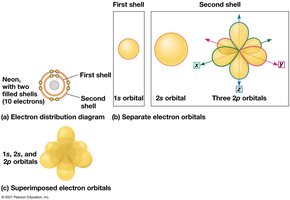
Electron Orbitals
Orbitals are three-dimensional regions where electrons are likely to be found.
Each shell: Contains a specific number of orbitals.
Maximum per orbital: 2 electrons.
Concept 2.3: Chemical Bonds and Molecular Formation
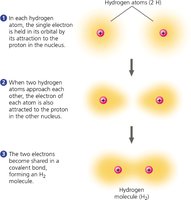
Covalent Bonds
Covalent bonds involve the sharing of valence electrons between atoms.
Single bond: One pair of electrons shared.
Double bond: Two pairs of electrons shared.
Bonding capacity (valence): Number of covalent bonds an atom can form.
Electronegativity and Types of Covalent Bonds
Electronegativity is an atom’s ability to attract electrons in a bond.
Nonpolar covalent bond: Electrons shared equally.
Polar covalent bond: Electrons shared unequally, creating partial charges.
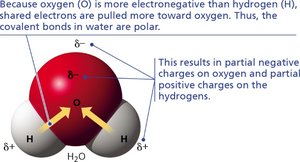
Ionic Bonds and Ionic Compounds
Ionic bonds form when electrons are transferred from one atom to another, creating ions.
Cation: Positively charged ion.
Anion: Negatively charged ion.
Ionic compound: Formed by the attraction between cations and anions (e.g., NaCl).
Weak Chemical Interactions
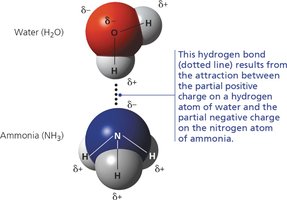
Hydrogen bonds: Weak attractions between a hydrogen atom covalently bonded to an electronegative atom and another electronegative atom.
Importance: Stabilize DNA, protein structure, and water properties.
Van der Waals Interactions
Temporary partial charges: Created by uneven electron distribution.
Collective strength: Many weak interactions together can be strong (e.g., gecko adhesion).
Molecular Shape and Function
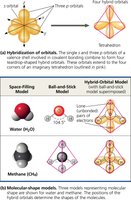
The shape of a molecule is determined by the arrangement of its atoms’ orbitals and is crucial for its biological function.
Hybridization: s and p orbitals combine to form specific shapes.
Recognition: Molecules with similar shapes can bind the same biological receptors.
Summary Table: Types of Chemical Bonds
Bond Type | Strength | Example | Biological Importance |
|---|---|---|---|
Covalent | Strong | H2, O2, H2O | Forms stable molecules |
Ionic | Strong (dry), weak (in water) | NaCl | Forms salts, dissociates in water |
Hydrogen | Weak | Between water molecules | Stabilizes DNA, proteins, water properties |
Van der Waals | Very weak | Gecko adhesion | Molecular stability, shape |
Key Terms and Concepts
Element: Pure substance, cannot be broken down chemically.
Compound: Substance of two or more elements in fixed ratio.
Atom: Smallest unit of an element.
Isotope: Atom with same protons, different neutrons.
Covalent bond: Shared electrons.
Ionic bond: Transferred electrons, attraction of ions.
Hydrogen bond: Weak attraction involving hydrogen and electronegative atoms.
Van der Waals interaction: Weak, temporary attractions.
Valence electrons: Outermost shell electrons, determine reactivity.
Electronegativity: Atom’s pull on shared electrons.
Example Exam Questions
How many protons, neutrons, and electrons are in an isotope of titanium with mass number 48?
What numbers must be placed as coefficients in the blanks for the chemical reaction below in order to ensure that matter is conserved? Fe3O4 + __C → __Fe + __CO
Which bond type is most similar to a person carefully walking on a slippery sidewalk?
Additional info: This guide expands on brief points with academic context, definitions, and examples for clarity and completeness.
