 뒤로
뒤로The Chemistry and Structure of the Cell: Atoms, Elements, and Chemical Bonds
스터디 가이드 - 스마트 노트
 자료에 맞춘 맞춤형 노트, 핵심 정의, 예시, 맥락을 확장해 제공합니다.
The Chemistry and Structure of the Cell
Atoms and Subatomic Particles
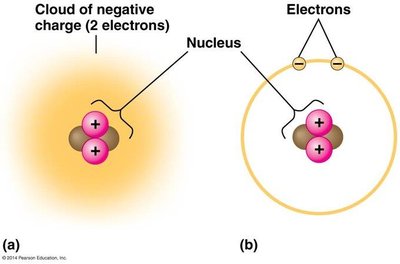
Atoms are the fundamental building blocks of matter, forming the basis for all chemical substances. Each atom consists of a nucleus containing protons and neutrons, surrounded by electrons in orbitals.
Atom: The smallest unit of an element that retains its chemical properties.
Subatomic particles:
Protons: Positively charged particles found in the nucleus.
Neutrons: Neutral particles found in the nucleus.
Electrons: Negatively charged particles found in orbitals around the nucleus.
The charge and arrangement of these particles determine the atom's structure and behavior.
Elements and the Periodic Table
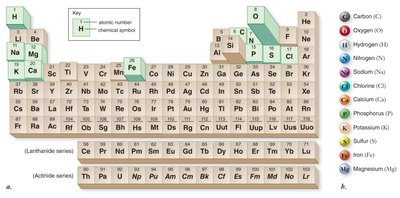
Elements are pure substances that cannot be broken down by ordinary chemical means. The periodic table organizes elements based on their atomic number and properties.
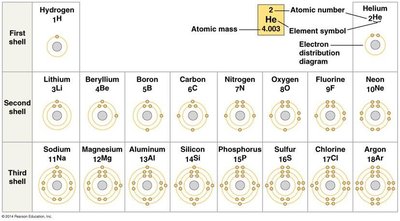
Atomic number: Number of protons in the nucleus.
Atomic mass: Sum of protons and neutrons in the nucleus.
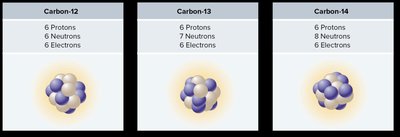
Most elements exist as mixtures of isotopes, which are atoms of the same element with different numbers of neutrons.
Electron Orbitals and Energy Levels
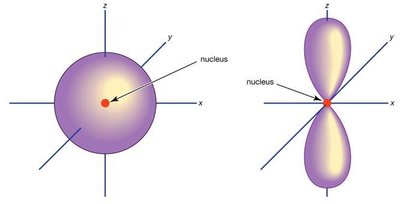
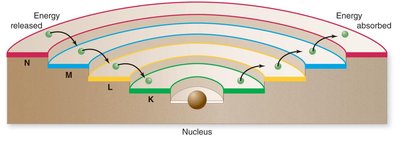
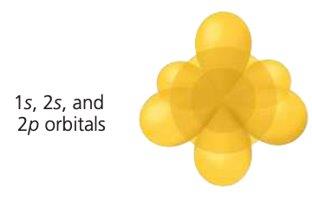
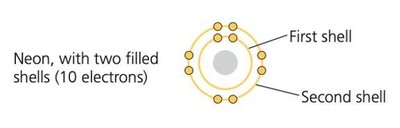
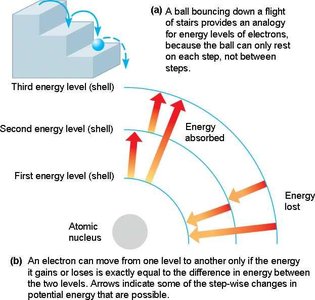
Electrons occupy specific regions called orbitals, which vary in shape and energy. Orbitals are grouped into shells, each with a distinct energy level.
Orbitals: Areas around the nucleus where electrons are likely to be found (e.g., s, p, d, f orbitals).
No orbital can contain more than two electrons.
Shells: Collections of orbitals with similar energy.
Electrons farther from the nucleus have higher potential energy.
Valence Electrons and the Octet Rule
Valence electrons are found in the outermost shell and determine an element's chemical properties and reactivity. Atoms tend to gain, lose, or share electrons to achieve a full valence shell, usually containing eight electrons (the octet rule).
Valence shell: Outermost energy level of an atom.
Octet rule: Atoms are most stable when their valence shell is full (typically 8 electrons).
This rule explains the reactivity and bonding behavior of elements.
Chemical Bonds and Molecules
Chemical bonds are forces that hold atoms together in molecules and compounds. The main types of chemical bonds are ionic, covalent, and hydrogen bonds, each with distinct properties and strengths.
Molecule: Group of atoms held together by chemical bonds.
Compound: Molecule containing atoms of more than one element.
Bonds vary in strength and type, influencing molecular stability and function.
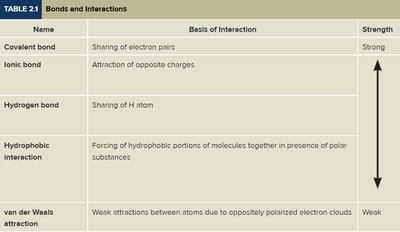
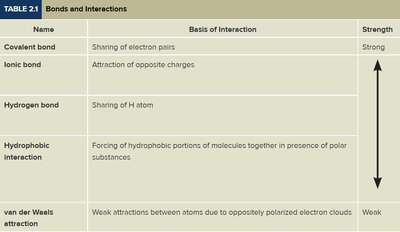
Name | Basis of Interaction | Strength |
|---|---|---|
Covalent bond | Sharing of electron pairs | Strong |
Ionic bond | Attraction of opposite charges | Strong |
Hydrogen bond | Sharing of H atom | Weak |
Hydrophobic interaction | Forcing of hydrophobic portions together in presence of polar substances | Weak |
van der Waals attraction | Weak attractions between atoms due to polarized electron clouds | Weak |
Ions and Ionic Bonds
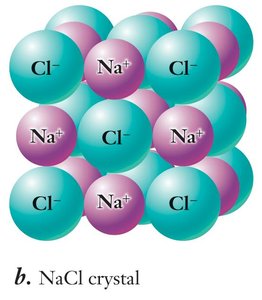
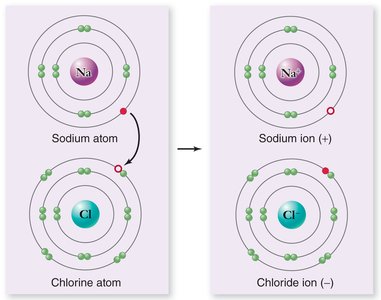
Ionic bonds form when atoms transfer electrons to achieve a full valence shell, resulting in charged ions. Oppositely charged ions attract each other, forming ionic compounds.
Ion: Atom with unequal numbers of protons and electrons.
Anion: Negatively charged ion (gains electrons).
Cation: Positively charged ion (loses electrons).
Ionic bonds are strong in dry environments but weaker in water.
Covalent Bonds
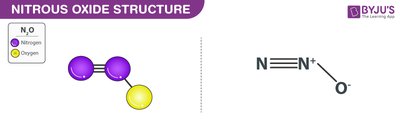
Covalent bonds form when two atoms share one or more pairs of valence electrons. These bonds are very stable and are the basis for most biological molecules.
Single, double, and triple covalent bonds: Represent sharing of one, two, or three pairs of electrons, respectively.
Covalent bonds satisfy the octet rule and result in molecules with no net charge.
Polar and Nonpolar Covalent Bonds
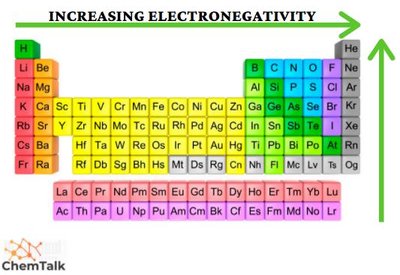
Electronegativity is an atom's tendency to attract electrons. If atoms in a covalent bond have similar electronegativity, the bond is nonpolar; if they differ, the bond is polar, creating partial charges.
Nonpolar covalent bond: Electrons shared equally.
Polar covalent bond: Electrons shared unequally, resulting in partial positive and negative charges.
Hydrogen Bonds
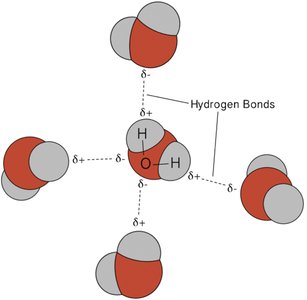
Hydrogen bonds are weak attractions between polar molecules, especially involving hydrogen. Though individually weak, they are collectively important in stabilizing structures like DNA and proteins.
Hydrogen bond: Attraction between a hydrogen atom and a highly electronegative atom (e.g., oxygen, nitrogen).
Common in water and biological macromolecules.
Summary Table: Types of Chemical Bonds
Name | Basis of Interaction | Strength |
|---|---|---|
Covalent bond | Sharing of electron pairs | Strong |
Ionic bond | Attraction of opposite charges | Strong |
Hydrogen bond | Sharing of H atom | Weak |
Hydrophobic interaction | Forcing of hydrophobic portions together in presence of polar substances | Weak |
van der Waals attraction | Weak attractions between atoms due to polarized electron clouds | Weak |
Key Equations and Concepts
Atomic mass:
Electron configuration:
Octet rule: Atoms tend to fill their valence shell with 8 electrons.
Example Applications
Isotopes: Carbon-12, Carbon-13, and Carbon-14 are isotopes used in radiometric dating and biological research.
Ionic compounds: Sodium chloride (NaCl) forms from the transfer of electrons between sodium and chlorine.
Hydrogen bonds: Responsible for the unique properties of water, such as high boiling point and surface tension.
Additional info: This guide expands on brief points with academic context, definitions, and examples to ensure completeness and clarity for General Biology students.
