 뒤로
뒤로The History of Life on Earth: Origin and Early Evidence
스터디 가이드 - 스마트 노트
 자료에 맞춘 맞춤형 노트, 핵심 정의, 예시, 맥락을 확장해 제공합니다.
History of Life on Earth
Conditions on Early Earth and the Origin of Life
The early Earth provided unique chemical and physical conditions that made the origin of life possible. Scientists propose that simple cells could have arisen through a series of four key stages:
Abiotic synthesis of small organic molecules: Simple molecules such as amino acids and nucleotides could form without biological processes.
Formation of macromolecules: These small molecules joined to create larger, more complex molecules like proteins and nucleic acids.
Packaging into protocells: Molecules became enclosed in membrane-bound droplets, maintaining internal chemistry distinct from their environment.
Origin of self-replicating molecules: The emergence of molecules capable of replication, such as RNA, was crucial for the development of life.
Earth's Early Atmosphere and Abiotic Synthesis
Earth formed about 4.6 billion years ago. Early conditions included frequent collisions with rocks and ice, which vaporized water and delayed sea formation. The atmosphere contained little oxygen but was rich in water vapor and gases from volcanic eruptions, such as nitrogen, carbon dioxide, methane, ammonia, and hydrogen.
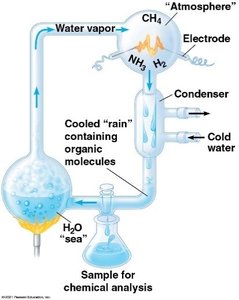
Reducing Atmosphere Hypothesis: In the 1920s, Oparin and Haldane suggested that the early atmosphere was reducing, favoring the formation of organic molecules. In 1953, Miller and Urey experimentally demonstrated that organic molecules could form abiotically in such an environment.
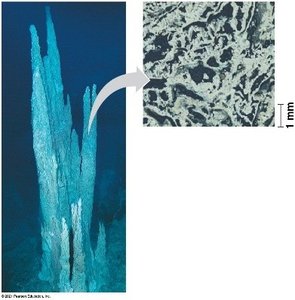
Alternative Formation Sites: Some evidence suggests organic compounds may have formed near volcanoes or in deep-sea hydrothermal vents. "Black smoker" vents are extremely hot and unstable for organic compounds, while alkaline vents provide a more suitable environment with warm, high pH water.
Meteorites: Meteorites, such as the Murchison meteorite, have been found to contain amino acids, lipids, sugars, and nitrogenous bases, suggesting extraterrestrial sources for organic molecules.
Abiotic Synthesis of Macromolecules
Laboratory experiments have shown that all four RNA monomers can form spontaneously under certain conditions. RNA polymers can assemble when monomers are dripped onto hot surfaces like sand, clay, or rock, and these polymers may have acted as weak catalysts on early Earth.
Protocells: The First Cellular Structures
Replication and metabolism are essential properties of life and may have appeared together in protocells. Protocells are fluid-filled vesicles with membrane-like structures, capable of:
Simple growth without dilution of contents
Reproduction
Metabolism
Maintaining an internal environment distinct from surroundings
Montmorillonite clay, common on early Earth, increases vesicle formation rates and allows organic molecules to be absorbed through vesicle membranes.
Self-Replicating RNA
The first genetic material was likely RNA, which plays a central role in protein synthesis. RNA molecules called ribozymes can catalyze various reactions, including making complementary copies of RNA. Laboratory experiments have produced self-replicating ribozymes, and natural selection can favor RNA molecules with improved replication abilities.
RNA could have served as a template for DNA assembly, with double-stranded DNA being more stable and accurate for replication.
Earliest Evidence of Life
Some rocks from 3.7 billion years ago contain evidence of prokaryotic cells, marking the earliest signs of life.
Stromatolites: Oldest Fossils
Stromatolites are layered structures formed by the activity of prokaryotes, particularly cyanobacteria. They represent the oldest large-scale fossils found on Earth, dating back to 3.5 billion years ago.
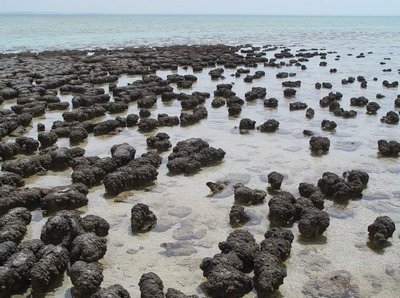
Example: Modern stromatolites can still be found in shallow marine environments, providing insight into early life forms and their ecological impact.
Additional info: The Miller-Urey experiment is a classic demonstration of abiotic synthesis, showing that amino acids and other organic molecules can form under simulated early Earth conditions. Alkaline hydrothermal vents are considered promising sites for the origin of life due to their stable, warm, and chemically rich environments. Stromatolites are important for understanding the evolution of photosynthesis and the oxygenation of Earth's atmosphere.
