 뒤로
뒤로The Origin of Species: Mechanisms and Patterns of Speciation
스터디 가이드 - 스마트 노트
 자료에 맞춘 맞춤형 노트, 핵심 정의, 예시, 맥락을 확장해 제공합니다.
Chapter 24 – The Origin of Species
I. How Do New Species Originate from Existing Species?
Speciation is the evolutionary process by which one species splits into two or more distinct species. This process is central to understanding the diversity and unity of life, forming a bridge between microevolution (small-scale changes within populations) and macroevolution (broad patterns of evolutionary change above the species level).
Microevolution: Changes in allele frequencies within a population over time.
Macroevolution: Large-scale evolutionary changes that result in the formation of new species and higher taxonomic groups.
Biological Species Concept: A species is a group of populations whose members can interbreed in nature, produce viable, fertile offspring, and are reproductively isolated from other such groups.
Gene Flow: The transfer of alleles or genes from one population to another, which maintains genetic cohesion within a species.
Reproductive Isolation
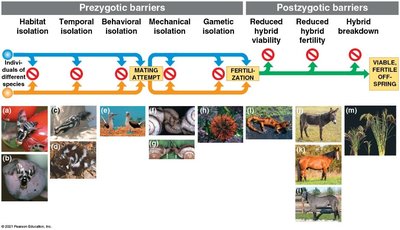
Reproductive isolation consists of biological barriers that prevent members of different species from interbreeding and producing viable, fertile offspring. These barriers are essential for maintaining species boundaries and can be classified based on whether they act before or after fertilization.
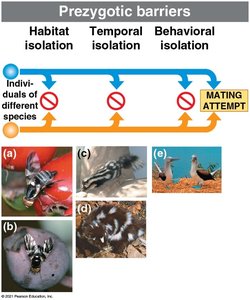
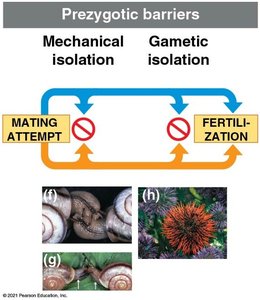
Prezygotic Barriers: Prevent fertilization from occurring.
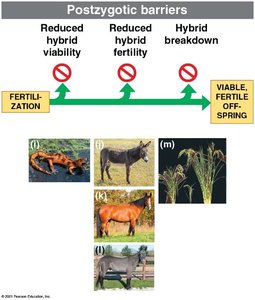
Postzygotic Barriers: Prevent hybrid offspring from developing into viable, fertile adults.
Prezygotic Barriers
Habitat Isolation: Species occupy different habitats and rarely encounter each other (e.g., apple maggot flies vs. blueberry maggot flies).
Temporal Isolation: Species breed at different times (e.g., western spotted skunks mate in summer, eastern spotted skunks in winter).
Behavioral Isolation: Unique courtship rituals or behaviors prevent mating (e.g., blue-footed boobies require specific courtship displays).
Mechanical Isolation: Morphological differences prevent successful mating (e.g., snail species with incompatible shell spirals).
Gametic Isolation: Sperm of one species cannot fertilize eggs of another due to incompatible gamete recognition proteins (e.g., sea urchin species).
Postzygotic Barriers
Reduced Hybrid Viability: Hybrid offspring have impaired development or survival (e.g., hybrid salamanders often do not complete development).
Reduced Hybrid Fertility: Hybrids are sterile due to chromosomal differences (e.g., mules, the offspring of a horse and donkey, are sterile).
Hybrid Breakdown: First-generation hybrids are viable and fertile, but their offspring are feeble or sterile (e.g., certain cultivated rice hybrids).
II. Speciation Can Take Place With or Without Geographic Isolation
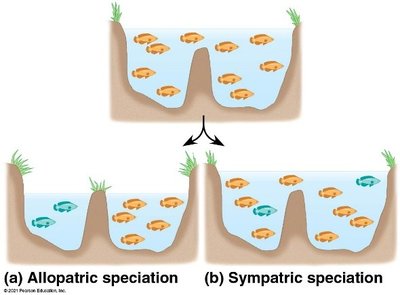
Speciation can occur in two primary ways: allopatric speciation (with geographic isolation) and sympatric speciation (without geographic isolation).
Allopatric Speciation: Gene flow is interrupted when a population is divided into geographically isolated subpopulations. Over time, genetic divergence leads to the formation of new species. Example: A lake splits into two, isolating fish populations.
Sympatric Speciation: Speciation occurs within the same geographic area, often due to polyploidy (especially in plants), sexual selection, or habitat differentiation. This is less common than allopatric speciation.
III. The Tempo of Speciation: Rapid or Gradual?
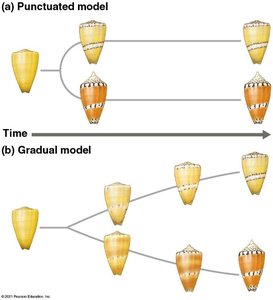
The rate at which speciation occurs can vary. The fossil record shows both rapid and gradual patterns of species formation.
Punctuated Equilibria: Long periods of apparent stasis are punctuated by sudden changes, resulting in rapid speciation events (proposed by Stephen Jay Gould).
Gradual Model: Species diverge slowly and steadily over time.
From Speciation to Macroevolution
As differences accumulate through successive speciation events, new groups of organisms form that may differ greatly from their ancestors. Macroevolution is the cumulative effect of many speciation and extinction events, shaping the diversity of life over geological time.
Some groups expand and diversify, while others shrink or go extinct.
Understanding speciation helps explain both the origin of new species and the patterns of biodiversity observed today.
