 뒤로
뒤로The Scientific Method and the Chemistry of Water in Biology
스터디 가이드 - 스마트 노트
 자료에 맞춘 맞춤형 노트, 핵심 정의, 예시, 맥락을 확장해 제공합니다.
The Scientific Method
Overview of the Scientific Method
The scientific method is a systematic approach used to acquire knowledge about the natural world. It involves making observations, forming hypotheses, testing predictions, and refining ideas based on evidence. This process minimizes bias and ensures that conclusions are based on reliable data.
Observation & Generalization: Scientists observe phenomena and use inductive reasoning to make general statements from specific cases.
Formulate a Hypothesis: A hypothesis is an educated guess or a testable statement about the natural world, based on observations.
Testable Prediction: Predictions are derived from hypotheses using deductive reasoning and are often structured as "if...then" statements.
Experiment or Observe: Experiments are carefully designed to test predictions by manipulating variables and collecting data.
Modify & Repeat: Based on results, hypotheses may be refined and experiments repeated to increase confidence in findings.
Example: If Drug X lowers blood pressure in mammals, then administering 10mg/day to humans with high blood pressure should reduce their blood pressure within one month.
Experimental Design
Controlled experiments are essential for reliable results. They involve manipulating one variable (independent variable) while keeping others constant, and measuring the effect on another variable (dependent variable).
Independent Variable: The factor intentionally changed (e.g., drug dose).
Dependent Variable: The outcome measured (e.g., blood pressure).
Control Group: Does not receive the experimental treatment; used for comparison.
Placebo: A false treatment used to eliminate psychological effects.
Reporting and Evaluating Scientific Results
Results are published in peer-reviewed journals, which are the most credible sources. Other sources include science magazines, books, and reputable websites (e.g., those ending in .edu, .gov, or .org). Critical thinking is essential—always evaluate the credibility of sources and look for supporting evidence.
Critical Thinking and Data Analysis
Facts vs. Conclusions: Facts are verifiable; conclusions are judgments based on facts.
Correlation vs. Causation: A relationship between variables does not imply one causes the other.
Anecdotes vs. Evidence: Personal stories are not substitutes for systematic evidence.
Theory in Science
In science, a theory is a broad, extensively tested explanation for a range of phenomena. It is supported by a large body of evidence and is the highest status a hypothesis can achieve.
The Chemistry of Living Things: Water
Importance of Water
Water is the most essential molecule for life, making up about 60% of human body weight. It is involved in numerous biological processes and is critical for survival. Access to clean, safe drinking water is a major health concern in many regions.
Solvent Properties: Water dissolves many substances, facilitating chemical reactions and transport of materials in the body.
Temperature Regulation: Water absorbs and holds heat, helping to maintain stable body temperature.
Chemical Reactions: Water participates in synthesis (dehydration synthesis) and breakdown (hydrolysis) of biomolecules.
Chemical Structure and Properties of Water
Water is a polar molecule, meaning it has slightly charged ends due to unequal sharing of electrons. The oxygen atom is slightly negative, while the hydrogen atoms are slightly positive. This polarity allows water molecules to form hydrogen bonds with each other, giving water its unique properties.
Hydrophilic Substances: Polar molecules that dissolve easily in water.
Hydrophobic Substances: Non-polar molecules that do not mix well with water.
Water as a Biological Solvent
Water's polarity makes it an excellent solvent for ionic and polar substances. For example, when table salt (NaCl) is added to water, the positive and negative ions are surrounded by water molecules and kept in solution.
Water in the Human Body
Transport: Water is the main component of bodily fluids, aiding in the transport of nutrients and waste.
Temperature Regulation: Sweating and evaporation help cool the body.
Chemical Reactions: Water is involved in metabolic reactions, including the synthesis and breakdown of macromolecules.
Hydrogen Ions and pH
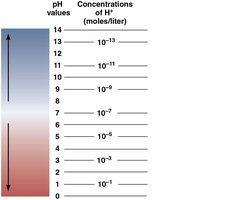
Water can dissociate into hydrogen ions (H+) and hydroxide ions (OH-). The concentration of hydrogen ions determines the pH of a solution, which is crucial for biological processes.
Acids: Substances that donate H+ ions.
Bases: Substances that accept H+ ions.
pH Scale: Measures the concentration of H+ ions; ranges from 0 (most acidic) to 14 (most basic).
$\text{pH} = -\log_{10}[\text{H}^+]$
pH in the Body and Buffer Systems
The pH of body fluids, especially blood (normally pH 7.4), must be tightly regulated. Changes in pH can affect molecular transport, reaction rates, and protein structure, threatening homeostasis. Buffers help maintain stable pH by accepting or donating H+ ions as needed.
Bicarbonate Buffer System: The main buffer in blood, involving bicarbonate ions (HCO3-) and carbonic acid (H2CO3).
$\text{H}_2\text{CO}_3 \rightleftharpoons \text{HCO}_3^- + \text{H}^+$
Example: If blood becomes too acidic, bicarbonate ions accept H+ to form carbonic acid, reducing acidity. If blood is too alkaline, carbonic acid donates H+ to increase acidity.
