 뒤로
뒤로Understanding Chemical Bonds in Biology
스터디 가이드 - 스마트 노트
 자료에 맞춘 맞춤형 노트, 핵심 정의, 예시, 맥락을 확장해 제공합니다.
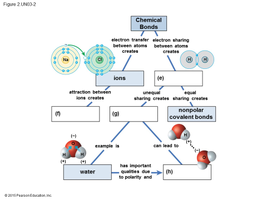
Q1. Complete the concept map about chemical bonds by identifying the missing terms (labeled as [a]–[h]) and explain the relationships between ions, polar covalent bonds, nonpolar covalent bonds, and water.
Background
Topic: Chemical Bonds in Biology
This question tests your understanding of the different types of chemical bonds (ionic, polar covalent, and nonpolar covalent), how they form, and their significance in biological molecules such as water. Recognizing how electrons are shared or transferred between atoms is fundamental to understanding molecular structure and function in biology.
Key Terms and Concepts:
Ions: Atoms or molecules that have gained or lost electrons, resulting in a net charge.
Ionic Bonds: Formed by the attraction between oppositely charged ions.
Covalent Bonds: Formed when two atoms share electrons.
Polar Covalent Bonds: Electrons are shared unequally, leading to partial charges on atoms.
Nonpolar Covalent Bonds: Electrons are shared equally between atoms.
Hydrogen Bonds: Weak attractions between the partially positive hydrogen atom of one molecule and the partially negative atom of another molecule (often oxygen or nitrogen).
Step-by-Step Guidance
Examine the top of the concept map: It starts with "Chemical Bonds" and splits into two main types based on electron transfer (ionic) and electron sharing (covalent).
Follow the left branch: Electron transfer creates ions, which are attracted to each other to form ionic bonds. Think about what type of attraction holds these ions together ([a]).
Follow the right branch: Electron sharing can be unequal or equal. Unequal sharing creates polar covalent bonds, while equal sharing creates nonpolar covalent bonds. Consider what property of the atoms causes unequal sharing ([b]).
Look at the example of water: Water is an example of a molecule with polar covalent bonds. This polarity allows water molecules to form another type of bond with each other ([c]).
Consider the importance of these bonds: The polarity of water leads to unique properties, such as cohesion, adhesion, and high specific heat. Think about what these properties are called and why they matter in biology ([d]).
Try solving on your own before revealing the answer!
Final Answer:
[a] = ionic bonds (attraction between ions)
[b] = polar covalent bonds (unequal sharing of electrons)
[c] = hydrogen bonds (between water molecules)
[d] = emergent properties of water (such as cohesion, adhesion, high specific heat, etc.)
[e] = NaCl (example of an ionic compound)
[f] = O2 (example of a nonpolar covalent bond)
[g] = polar covalent bonds (in water)
[h] = hydrogen bonds (between water molecules)
These terms complete the concept map and illustrate the relationships between different types of chemical bonds and their importance in biological molecules like water.
