 뒤로
뒤로Viruses: Structure, Replication, and Impact on Living Organisms
스터디 가이드 - 스마트 노트
 자료에 맞춘 맞춤형 노트, 핵심 정의, 예시, 맥락을 확장해 제공합니다.
Chapter 19 – Viruses
I. Introduction to Viruses
Viruses are infectious particles composed of genetic material encased in a protein coat. They are much simpler than prokaryotic cells and occupy a unique position between living organisms and non-living chemicals. Viruses are incapable of independent metabolism or reproduction and must infect host cells to propagate.
Definition: A virus is an infectious particle consisting of genes (either DNA or RNA) packaged in a protein coat called a capsid.
Key Features: Simpler than cells, cannot reproduce or metabolize outside a host, cause a wide variety of diseases.
Biological Status: Exist in a "borrowed life" state, between living and non-living matter.
II. The Discovery of Viruses
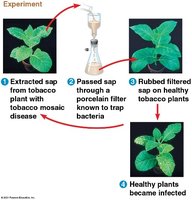
The discovery of viruses began with studies on tobacco mosaic disease, which affected tobacco plants. Early researchers hypothesized that the disease was caused by bacteria, but later experiments showed the infectious agent was much smaller and could not be cultured like bacteria. In 1935, Wendell Stanley crystallized the infectious particle, confirming it as the tobacco mosaic virus (TMV).
III. Structure of Viruses
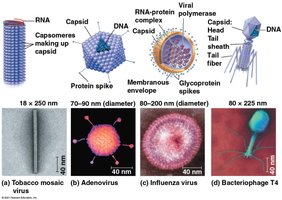
Viruses are not cells but are composed of nucleic acid (DNA or RNA) surrounded by a protein coat (capsid), and sometimes a membranous envelope. Their simple structure makes them useful for biological research.
Viral Genomes: May be double- or single-stranded DNA or RNA, linear or circular, with 3 to 2,000 genes.
Capsid: Protein shell built from subunits called capsomeres; can be helical or icosahedral in shape.
Viral Envelope: Some viruses have an envelope derived from host cell membranes, containing both viral and host molecules.
Bacteriophages (Phages): Viruses that infect bacteria, with complex structures including a head, tail, and tail fibers.
IV. Viral Replication Cycles
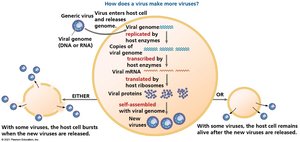
Viruses are obligate intracellular parasites, meaning they can only replicate within host cells. Each virus has a specific host range. The replication cycle involves entry into the host, synthesis of viral components using host machinery, assembly of new viruses, and release from the host cell.
Entry: Viral genome enters the host cell by various mechanisms.
Replication: Host cell machinery is hijacked to produce viral proteins and genomes.
Assembly: Viral components self-assemble into new virus particles.
Release: New viruses exit the host cell, sometimes lysing (breaking open) the cell.
A. Replicative Cycles of Phages
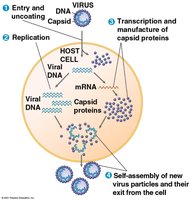
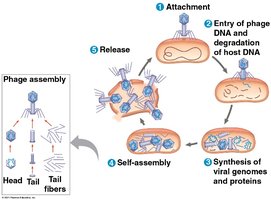
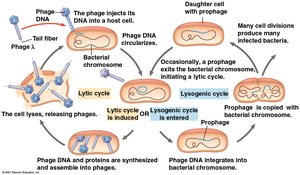
Bacteriophages (phages) are well-studied viruses that infect bacteria. They have two main reproductive cycles: the lytic cycle and the lysogenic cycle.
Lytic Cycle: Results in the destruction of the host cell and release of new phages. Virulent phages reproduce only by this cycle.
Lysogenic Cycle: Viral DNA integrates into the host genome as a prophage and is replicated along with the host cell without killing it. Temperate phages can switch between lytic and lysogenic cycles.
B. Bacterial Defenses Against Phages
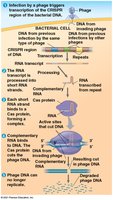
Bacteria have evolved several defense mechanisms against phage infection, including:
Surface Protein Mutations: Prevent phage attachment.
Restriction Enzymes: Cut foreign DNA, protecting bacterial DNA via methylation.
CRISPR-Cas System: Adaptive immune system that recognizes and destroys phage DNA based on previously encountered sequences.
C. Replicative Cycles of Animal Viruses
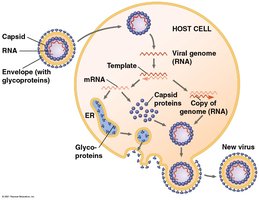
Animal viruses are classified based on their genome (DNA or RNA, single- or double-stranded) and the presence or absence of an envelope. Many animal viruses have both an envelope and an RNA genome.
Viral Envelopes: Derived from host membranes, contain glycoproteins for host cell recognition and entry.
Herpesvirus: Envelope derived from the nuclear envelope, replaced by Golgi-derived membrane.
D. Viral Genetic Material and Retroviruses
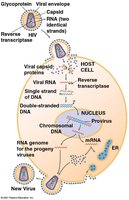
Retroviruses, such as HIV, use reverse transcriptase to convert their RNA genome into DNA, which integrates into the host genome as a provirus. The provirus is a permanent resident, and its DNA is transcribed to produce new viral genomes and proteins.
Reverse Transcriptase: Enzyme that synthesizes DNA from an RNA template.
Provirus: Integrated viral DNA in the host genome, transcribed by host RNA polymerase.
V. Evolution of Viruses
Viruses likely evolved from mobile genetic elements such as plasmids and transposons. The largest known viruses have genomes encoding proteins for translation, DNA repair, and other functions, blurring the line between viruses and cellular life. The evolutionary origins of viruses remain debated.
VI. Viruses and Prions as Pathogens
A. Viral Diseases in Animals
Viruses can damage or kill animal cells by releasing hydrolytic enzymes, producing toxins, or through toxic viral components. Vaccines stimulate immune defenses and can prevent viral diseases, but antibiotics are ineffective. Antiviral drugs inhibit viral replication or assembly.
B. Emerging Viral Diseases
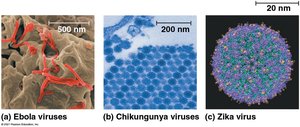
Emerging viruses are those that suddenly become apparent, often due to mutation, spread from isolated populations, or transmission from animals. Examples include HIV, Ebola, chikungunya, and Zika viruses.
Mutation: Creates new viral strains that can spread more easily.
Animal Reservoirs: Many new human diseases originate from animal viruses.
Influenza: Type A influenza viruses cause epidemics and pandemics due to genetic reassortment and high mutation rates.
C. Viral Diseases in Plants
Plant viruses cause a variety of symptoms and are mostly RNA viruses. They spread by horizontal transmission (through damaged cell walls) or vertical transmission (inherited from parent plants).
D. Prions: Proteins as Infectious Agents
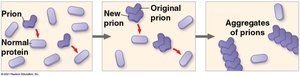
Prions are infectious proteins that cause degenerative brain diseases in animals and humans. They are misfolded proteins that induce normal proteins to misfold, forming aggregates that disrupt cell function. Prion diseases include scrapie, mad cow disease, and Creutzfeldt-Jakob disease.
Properties: Transmitted in food, act slowly, and are highly resistant to destruction.
Mechanism: Prions convert normal proteins into the misfolded prion form, leading to disease.
