 뒤로
뒤로Water and Carbon: The Chemical Basis of Life (General Biology Study Notes)
스터디 가이드 - 스마트 노트
 자료에 맞춘 맞춤형 노트, 핵심 정의, 예시, 맥락을 확장해 제공합니다.
Water and Carbon: The Chemical Basis of Life
Introduction to Chemical Evolution
Chemical evolution is the leading explanation for the origin of life on Earth. It describes the process by which simple carbon-containing molecules formed increasingly complex substances, eventually leading to molecules capable of self-replication. This transition marked the shift from chemical to biological evolution, fulfilling the five characteristics of life.
Atoms, Ions, and Molecules: The Building Blocks of Chemical Evolution
Basic Atomic Structure
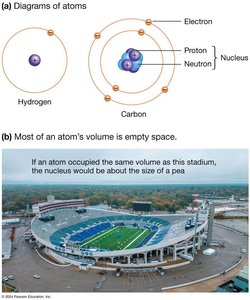
Atoms consist of a nucleus (containing protons and neutrons) surrounded by electrons.
Protons have a positive charge (+1), neutrons are neutral, and electrons have a negative charge (-1).
Atoms are electrically neutral when the number of protons equals the number of electrons.
Elements are substances consisting entirely of one type of atom.
Atomic number: Number of protons in the nucleus (written as a subscript to the left of the element symbol).
Mass number: Sum of protons and neutrons in an atom.
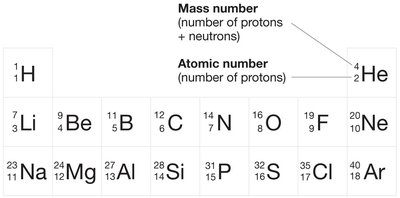
Dalton (Da): Unit of atomic mass; protons and neutrons each have a mass of 1 Da.
Isotopes: Atoms of the same element with different numbers of neutrons (e.g., Carbon-12, Carbon-13, Carbon-14).
Atomic weight: Average mass of all naturally occurring isotopes, weighted by abundance.
Radioactive isotopes: Unstable isotopes that decay over time.
Electron Arrangement and Chemical Behavior
Electrons occupy regions called orbitals, grouped into electron shells.
Electron shells are filled from the innermost to the outermost.
The valence shell is the outermost shell; electrons here are called valence electrons.
Atoms are most stable when their valence shells are full, often achieved by forming chemical bonds.
Covalent and Ionic Bonding
Covalent Bonds
Covalent bonds form when two atoms share unpaired valence electrons, resulting in a stable molecule.

Nonpolar and Polar Covalent Bonds
Electronegativity: The ability of an atom to attract electrons in a bond. Increases up and to the right on the periodic table (O > N > S, C, H, P).
Nonpolar covalent bond: Electrons are shared equally (e.g., H2).
Polar covalent bond: Electrons are shared unequally, creating partial charges (e.g., H2O).

Ionic Bonds and the Electron-Sharing Continuum
Ionic bond: Electrons are completely transferred from one atom to another, forming ions.
Cation: Positively charged ion (loses electron).
Anion: Negatively charged ion (gains electron).

Bonds exist on a continuum: nonpolar covalent (equal sharing) → polar covalent (unequal sharing) → ionic (electron transfer).

Simple Molecules and Bonding
The number of unpaired electrons determines how many bonds an atom can form (single, double, triple bonds).

Molecular Geometry
The shape of a molecule is determined by the geometry of its bonds and affects its behavior.
Examples: Methane (tetrahedral), Water (bent), Carbon dioxide (linear).

Representing Molecules
Molecular formulas show the types and numbers of atoms.
Structural formulas show how atoms are bonded.
Ball-and-stick and space-filling models show three-dimensional geometry.

Properties of Water and the Early Oceans
Water as a Solvent
Water makes up about 75% of a cell and is an excellent solvent due to its polarity.
Solute: Substance dissolved in a solvent to form a solution.
Structure and Polarity of Water
Water is small, bent, and highly polar due to polar covalent bonds.
Partial negative charge on oxygen, partial positive charges on hydrogens.
Water molecules form hydrogen bonds with each other and with polar solutes.
Hydrophilic and Hydrophobic Interactions
Hydrophilic molecules (ions, polar molecules) dissolve in water due to hydrogen bonding.
Hydrophobic molecules (nonpolar, uncharged) do not dissolve; they cluster together via hydrophobic interactions and van der Waals forces.
Cohesion, Adhesion, and Surface Tension
Cohesion: Attraction between like molecules (water to water).
Adhesion: Attraction between unlike molecules (water to other substances).
Surface tension: Cohesive force at the surface of a liquid, making it behave like an elastic membrane.
Density and Phase Changes of Water
Water is denser as a liquid than as a solid due to its open crystal structure in ice, causing ice to float.
Water's Heat Capacity
Water has a high specific heat (energy required to raise temperature of 1g by 1°C) due to extensive hydrogen bonding.
High heat of vaporization: Large amount of energy needed to convert water from liquid to gas.
Acids, Bases, and pH
Acid–Base Chemistry in Water
Water can dissociate into hydrogen ions (H+) and hydroxide ions (OH-).
Acids: Donate protons (increase H+ concentration).
Bases: Accept protons (decrease H+ concentration).
Buffers: Minimize changes in pH, maintaining homeostasis.
pH Scale
pH is a logarithmic measure of hydrogen ion concentration:
Acidic: pH < 7; Neutral: pH = 7; Basic: pH > 7.
Chemical Reactions, Energy, and Chemical Evolution
Chemical Reactions and Energy
Chemical reaction: Process in which substances are transformed into different substances.
Endothermic reactions: Absorb energy.
Exothermic reactions: Release energy.
Types of Energy
Potential energy: Stored energy due to position or arrangement (e.g., chemical bonds).
Kinetic energy: Energy of motion (e.g., thermal energy).
First law of thermodynamics: Energy cannot be created or destroyed, only transformed.
Spontaneity and Entropy
A reaction is spontaneous if it proceeds without continuous external input.
Spontaneity is favored when products have lower potential energy and/or greater disorder (entropy) than reactants.
Second law of thermodynamics: Entropy (disorder) always increases in spontaneous processes.
Investigating Chemical Evolution
Miller-Urey Experiment
Stanley Miller's 1953 experiment simulated early Earth conditions and demonstrated that complex organic molecules (e.g., amino acids) could form from simple precursors with energy input.
Conclusion: Chemical evolution is plausible under early Earth conditions.
Life is Carbon-Based
Carbon's Versatility
Carbon forms four covalent bonds, allowing for a vast diversity of organic molecules.
Organic compounds contain carbon bonded to other elements (H, N, O, P, S).
Functional Groups
Functional groups are specific groups of atoms within molecules that determine the chemical behavior of those molecules. Common functional groups include:
Functional Group | Properties |
|---|---|
Amino (-NH2) | Acts as a base, attracts protons |
Carboxyl (-COOH) | Acts as an acid, donates protons |
Carbonyl (C=O) | Sites for linking molecules |
Hydroxyl (-OH) | Acts as a weak acid |
Phosphate (-PO4) | Has two negative charges |
Sulfhydryl (-SH) | Forms disulfide bonds |
Macromolecules and Polymerization
Macromolecules: Large molecules made of smaller subunits (monomers).
Polymerization: Process of linking monomers to form polymers via condensation (dehydration) reactions (loss of water).
Hydrolysis: Breaking polymers into monomers by adding water.
Polymerization is energetically unfavorable unless monomer concentration is high.
