 뒤로
뒤로Water and Carbon: The Chemical Basis of Life (General Biology Study Notes)
스터디 가이드 - 스마트 노트
 자료에 맞춘 맞춤형 노트, 핵심 정의, 예시, 맥락을 확장해 제공합니다.
Water and Carbon: The Chemical Basis of Life
Introduction to Chemical Evolution
Chemical evolution is the leading explanation for the origin of life on Earth. It describes the formation of increasingly complex carbon-containing substances, eventually leading to molecules capable of self-replication. This process marks the transition from chemical to biological evolution, where natural selection takes over and life fulfills its five fundamental characteristics.
Chemical evolution: Formation of complex molecules from simple substances.
Biological evolution: Begins when molecules replicate and become metabolically active.
Five characteristics of life: Cellular organization, metabolism, homeostasis, growth, and reproduction.
Atoms, Ions, and Molecules: The Building Blocks of Chemical Evolution
Four types of atoms—hydrogen, carbon, nitrogen, and oxygen—make up 96% of matter in organisms. Understanding their physical structures and how they combine is essential for grasping chemical evolution.
Atoms: Consist of a nucleus (protons and neutrons) surrounded by electrons.
Elements: Made entirely of one type of atom.
Atomic number: Number of protons in the nucleus.
Mass number: Sum of protons and neutrons.
Isotopes: Variants of elements with different numbers of neutrons.
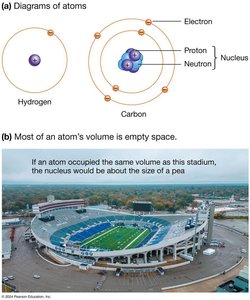

Atomic Structure and Stability
Atoms are most stable when their valence shells are full. Stability is achieved through chemical bonds, primarily covalent bonds, where atoms share electrons.
Valence shell: Outermost electron shell.
Valence electrons: Electrons in the valence shell.
Covalent bonds: Formed by sharing unpaired valence electrons.
Covalent Bonding and Molecular Formation
Covalent bonding allows atoms to achieve stability by sharing electrons. Hydrogen atoms, for example, share electrons to fill their valence shells.
Molecule: Group of atoms connected by covalent bonds.
Example: Two hydrogen atoms form H2 by sharing electrons.

Nonpolar and Polar Covalent Bonds
Electrons in covalent bonds are not always shared equally. The degree of sharing depends on electronegativity, which is the strength with which atoms pull electrons toward themselves.
Nonpolar covalent bond: Electrons are shared equally (e.g., H2).
Polar covalent bond: Electrons are shared unequally, resulting in partial charges (e.g., H2O).
Electronegativity: Increases up and to the right on the periodic table; O > N > S, C, H, P.

Ionic Bonding, Ions, and the Electron-Sharing Continuum
Ionic bonds form when electrons are completely transferred from one atom to another, resulting in charged ions. The continuum of electron sharing ranges from equal sharing (nonpolar covalent) to complete transfer (ionic).
Cation: Atom loses electron, becomes positively charged.
Anion: Atom gains electron, becomes negatively charged.
Ionic bond: Attraction between oppositely charged ions.


Simple Molecules Formed from C, H, N, and O
The number of unpaired electrons in the valence shell determines how many bonds an atom can form. Atoms with multiple unpaired electrons can form double or triple bonds.
Single bonds: One pair of shared electrons.
Double bonds: Two pairs of shared electrons.
Triple bonds: Three pairs of shared electrons.

The Geometry of Simple Molecules
The shape of a molecule is dictated by the geometry of its bonds, which influences its behavior. For example, methane forms a tetrahedral shape, while water is bent due to unshared electron pairs.
Methane (CH4): Tetrahedral geometry.
Water (H2O): Planar and bent geometry.
Nitrogen (N2) and carbon dioxide (CO2): Linear geometry.

Representing Molecules
Molecules can be represented in several ways: molecular formulas, structural formulas, ball-and-stick models, and space-filling models. These representations help visualize the three-dimensional geometry and bonding of molecules.
Molecular formula: Indicates types and numbers of atoms.
Structural formula: Shows bonding relationships.
Ball-and-stick model: Visualizes geometry and bond angles.
Space-filling model: Shows relative sizes and spatial arrangement.

Properties of Water and the Early Oceans
Water as a Solvent
Water is the basis of life, making up about 75% of a cell. It is an excellent solvent, meaning it can dissolve a wide variety of substances, facilitating chemical reactions.
Solvent: Substance in which solutes dissolve to form a solution.
Solute: Substance dissolved in a solvent.
Water’s Structure and Unique Properties
Water’s small size, bent shape, highly polar covalent bonds, and overall polarity make it unique. These properties contribute to its efficiency as a solvent and its role in biological systems.
Polarity: Oxygen has partial negative charge; hydrogen has partial positive charge.
Hydrogen bonds: Weak electrical interactions between water molecules.
Hydrophilic and Hydrophobic Interactions
Water dissolves ions and polar molecules (hydrophilic), but not nonpolar compounds (hydrophobic). Hydrophobic molecules cluster together, stabilized by van der Waals interactions.
Hydrophilic: Water-loving; dissolves in water.
Hydrophobic: Water-fearing; does not dissolve in water.
van der Waals interactions: Weak attractions between nonpolar molecules.
Cohesion, Adhesion, and Surface Tension
Water molecules exhibit cohesion (attraction to each other) and adhesion (attraction to other substances). These properties are essential for processes like water transport in plants and surface tension.
Cohesion: Attraction between like molecules.
Adhesion: Attraction between unlike molecules.
Surface tension: Cohesive force at the surface of a liquid.
Density and High Energy Absorption of Water
Water is denser as a liquid than as a solid, which is why ice floats. Water also has a high capacity for absorbing energy, due to its high specific heat and the breaking of hydrogen bonds.
Specific heat: Energy required to raise temperature of 1 gram of substance.
Ice: Forms an insulating layer on water surfaces.
Acid–Base Chemistry and pH
Water can dissociate into hydrogen ions and hydroxide ions, leading to acid–base reactions. The pH scale measures the concentration of protons in solution, indicating whether a solution is acidic, basic, or neutral.
Acid: Gives up protons, increases hydronium ion concentration.
Base: Acquires protons, decreases hydronium ion concentration.
pH: Logarithmic scale; acids have pH < 7, bases have pH > 7, neutral is pH 7.
Buffer: Minimizes changes in pH, helps maintain homeostasis.
Determining Concentration and Molarity
The concentration of protons and other solutes is often measured in moles and molarity. Molecular weight is the sum of atomic weights of all atoms in a molecule.
Mole: Mass equal to atomic weight in grams.
Molarity (M): Number of moles of solute per liter of solution.
Chemical Reactions, Energy, and Chemical Evolution
Origins of Chemical Evolution
Chemical evolution may have begun in the atmosphere (dominated by volcanic gases) or deep-sea hydrothermal vents (hot rocks, reactive gases, and minerals).
Atmosphere: Water vapor, carbon dioxide, nitrogen.
Hydrothermal vents: Hot rocks, gases, reactive metals.
How Chemical Reactions Happen
Chemical reactions involve the rearrangement of atoms. Reactions can be endothermic (absorb energy) or exothermic (release energy). The first law of thermodynamics states that energy is conserved.
Endothermic: Absorbs thermal energy.
Exothermic: Releases thermal energy.
First law of thermodynamics: Energy cannot be created or destroyed.
Potential and Kinetic Energy
Energy exists as potential (stored) or kinetic (motion). The position of electrons in bonds affects the potential energy of molecules.
Potential energy: Stored due to position.
Kinetic energy: Energy of motion.
Chemical energy: Potential to form stronger bonds.
Spontaneity and Entropy in Chemical Reactions
Reactions are spontaneous if they proceed without external influence. Spontaneity is determined by lower potential energy and increased entropy (disorder). The second law of thermodynamics states that entropy always increases.
Spontaneous reaction: Proceeds without added energy.
Entropy: Measure of disorder.
Second law of thermodynamics: Entropy increases in spontaneous processes.
Investigating Chemical Evolution
Miller’s Spark-Discharge Experiment
Stanley Miller's experiment in 1953 demonstrated that complex organic compounds could be synthesized from simple molecules under conditions simulating early Earth. The experiment produced amino acids, supporting the theory of chemical evolution.
Experimental setup: Simulated early Earth atmosphere.
Results: Formation of amino acids, precursors to proteins.
Conclusion: Chemical evolution occurs readily with high free energy and kinetic energy.
Life is Carbon Based
Carbon’s Role in Biological Molecules
Except for water, almost all molecules in organisms contain carbon. Carbon forms four covalent bonds, allowing for a limitless array of molecular shapes and combinations.
Organic compounds: Molecules containing carbon bonded to other elements.
Complex shapes: Result from multiple carbon atoms and various bond types.
Functional Groups in Organic Molecules
Functional groups containing H, N, O, P, and S define the chemical behavior of organic molecules. They participate in acid-base reactions, link molecules, and influence molecular properties.
Functional Group | Properties |
|---|---|
Amino | Attracts protons, acts as base |
Carboxyl | Drops proton, acts as acid |
Carbonyl | Links molecules into more-complex compounds |
Hydroxyl | Acts as weak acid |
Phosphate | Has two negative charges |
Sulfhydryl | Links via disulfide bonds |
Assembly of Macromolecules
Small organic molecules can assemble into large macromolecules through polymerization. Monomers join via condensation reactions, forming polymers. Hydrolysis breaks polymers into monomers, increasing entropy and favoring free monomers.
Macromolecule: Large molecule made of monomers.
Polymerization: Linking monomers together.
Condensation reaction: Forms polymers, releases water.
Hydrolysis: Breaks polymers, consumes water.
Process | Description |
|---|---|
Condensation | Monomers join, water released |
Hydrolysis | Polymers break, water consumed |
Example: Proteins, nucleic acids, and carbohydrates are macromolecules formed by polymerization of monomers.
