 뒤로
뒤로Water and Carbon: The Chemical Basis of Life (Chapter 2 Study Notes)
스터디 가이드 - 스마트 노트
 자료에 맞춘 맞춤형 노트, 핵심 정의, 예시, 맥락을 확장해 제공합니다.
Water and Carbon: The Chemical Basis of Life
Introduction
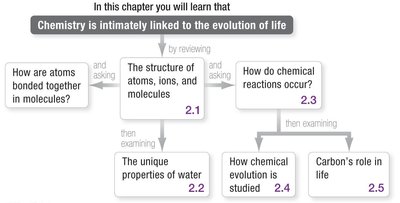
This chapter explores the fundamental chemical principles that underlie biological systems, focusing on the structure and properties of atoms, ions, and molecules, and the unique characteristics of water that make life possible. Understanding these concepts is essential for grasping how chemical evolution led to the complexity of living organisms.
The Structure of Atoms, Ions, and Molecules
Atoms: The Building Blocks of Matter
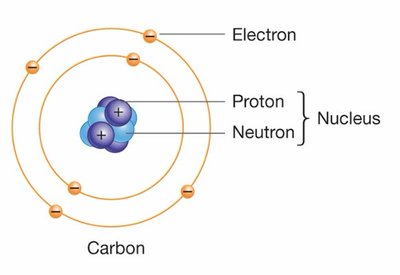
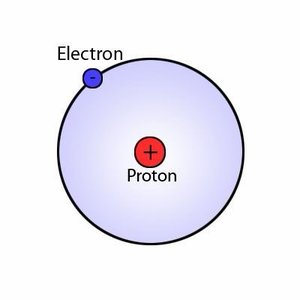
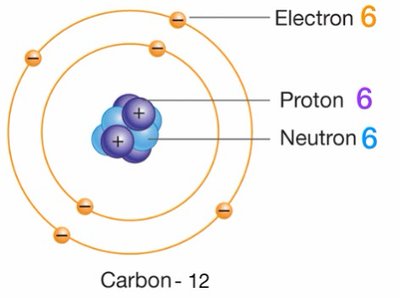
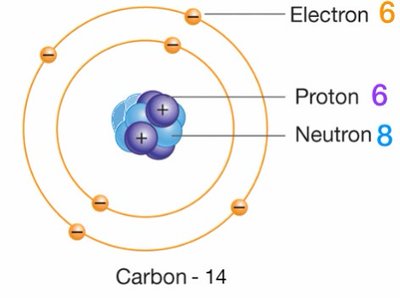
Atom: The smallest unit of an element, consisting of a nucleus (protons and neutrons) surrounded by electrons.
Element: A pure substance made of only one type of atom.
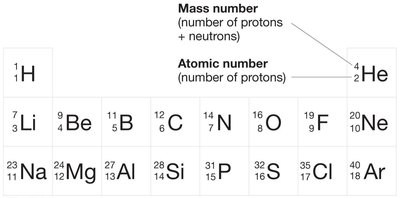
Atomic Number: The number of protons in the nucleus, unique to each element.
Mass Number: The sum of protons and neutrons in an atom.
Isotopes: Atoms of the same element with different numbers of neutrons, resulting in different masses. Some isotopes are stable, while others are radioactive and decay over time.
Electron Arrangement and Chemical Properties
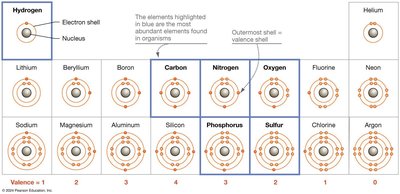
Electrons occupy shells around the nucleus. The outermost shell is called the valence shell.
The number of unpaired electrons in the valence shell determines the number of bonds an atom can form.
Atoms with full valence shells are chemically inert (e.g., noble gases).
Molecules and Compounds
Molecule: Two or more atoms held together by covalent bonds (e.g., H2, H2O).
Compound: A substance made of atoms of different elements (e.g., H2O, NaCl).
Chemical Bonds: Covalent and Ionic
Covalent Bonds
Formed when atoms share pairs of electrons.
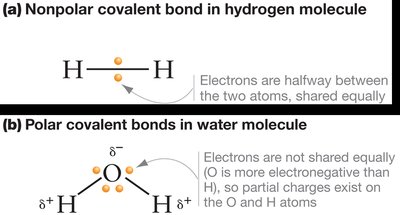
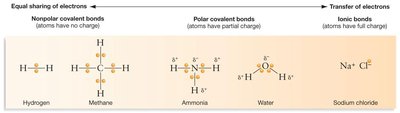
Nonpolar Covalent Bond: Electrons are shared equally (e.g., H2, CH4).
Polar Covalent Bond: Electrons are shared unequally due to differences in electronegativity (e.g., H2O).
Electronegativity order: O > N > C = H
Ionic Bonds
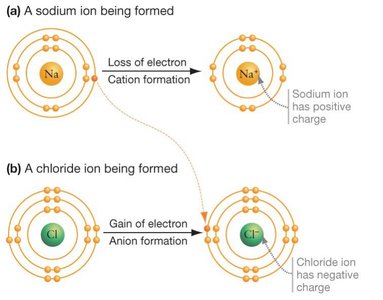
Formed when electrons are completely transferred from one atom to another, resulting in charged ions.
Cation: Atom that loses an electron (positive charge).
Anion: Atom that gains an electron (negative charge).
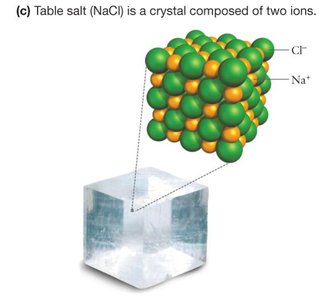
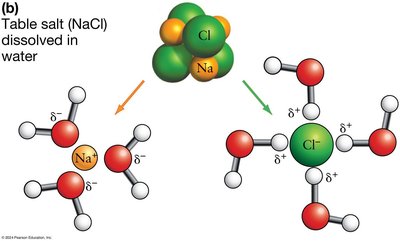
Ionic compounds (e.g., NaCl) are held together by electrostatic attraction between oppositely charged ions.
Bond Continuum
Chemical bonds exist on a continuum from equal sharing (nonpolar covalent) to unequal sharing (polar covalent) to complete transfer (ionic).
Multiple Bonds
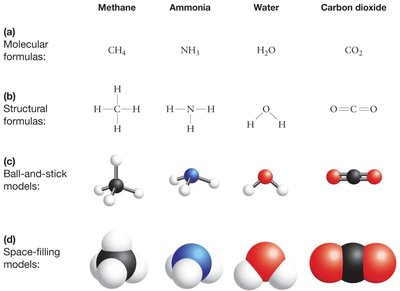
Atoms with more than one unpaired electron can form double or triple bonds (e.g., O2, N2).
The Unique Properties of Water
Water: Structure and Polarity
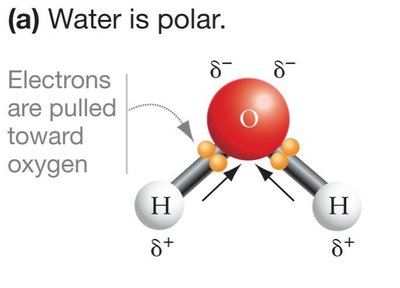
Water (H2O) is a polar molecule with a bent geometry.
Oxygen is more electronegative than hydrogen, creating partial charges (δ− on O, δ+ on H).
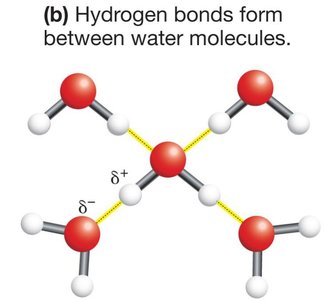
Water molecules form hydrogen bonds with each other and with other polar molecules.
Solubility: Hydrophilic and Hydrophobic Substances
Hydrophilic: "Water-loving"; ions and polar molecules dissolve easily in water due to interactions with partial charges.
Hydrophobic: "Water-fearing"; nonpolar molecules do not dissolve in water and tend to aggregate via hydrophobic interactions.
Properties of Water Due to Hydrogen Bonding
Cohesion: Water molecules stick to each other, resulting in high surface tension.
Adhesion: Water molecules stick to other polar or charged surfaces.
Surface Tension: The cohesive force at the surface of water allows light objects to rest on it without sinking.
Density: Water is denser as a liquid than as a solid; ice floats due to its open crystal structure.
High Specific Heat: Water can absorb large amounts of energy with only a small change in temperature.
High Heat of Vaporization: Large amounts of energy are required to convert water from liquid to gas.
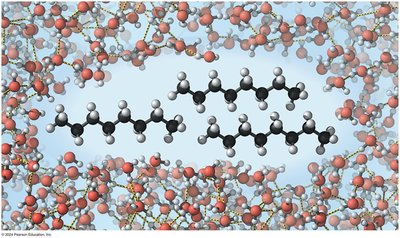
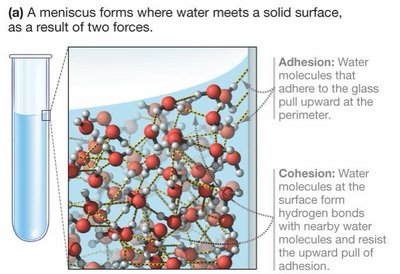
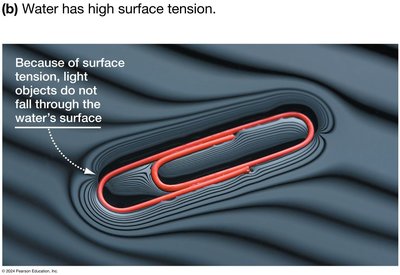
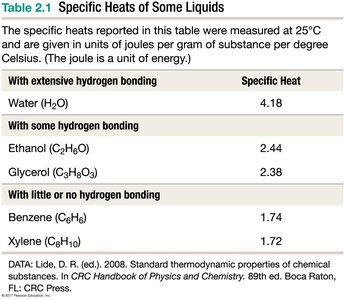
Table: Properties of Water
Property | Cause | Biological Consequences |
|---|---|---|
Solvent for charged or polar compounds | Electrostatic attractions between partial charges on water and opposite charges on other polar molecules or ions | Facilitates chemical reactions in cells |
Denser as a liquid than a solid | Hydrogen bonds form a low-density crystal structure in ice | Ice floats, insulating aquatic environments |
High specific heat | Many hydrogen bonds must be broken for water molecules to move faster | Stabilizes temperature in organisms and environments |
High heat of vaporization | Water must absorb lots of heat energy to break hydrogen bonds and change from liquid to gas | Evaporative cooling (e.g., sweating) |
Acids, Bases, and pH
Water Dissociation and pH Scale
Water molecules can dissociate into hydrogen ions (H+) and hydroxide ions (OH−).
Acid: Substance that donates protons (increases [H+]).
Base: Substance that accepts protons (decreases [H+]).
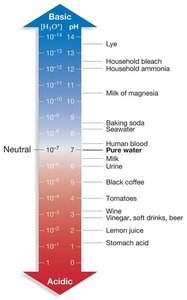
pH: A measure of proton concentration, calculated as
pH 7 is neutral; lower values are acidic, higher values are basic.
Buffers: Substances that minimize changes in pH, helping maintain homeostasis in organisms.
Summary
Life depends on the chemical properties of atoms, especially carbon, hydrogen, nitrogen, and oxygen.
Chemical bonds (covalent and ionic) and the unique properties of water are foundational to biological structure and function.
Understanding acids, bases, and pH is essential for studying cellular processes and homeostasis.
