 뒤로
뒤로Water and Life: Properties, Acids, Bases, and pH (Chapter 3 Study Notes)
스터디 가이드 - 스마트 노트
 자료에 맞춘 맞춤형 노트, 핵심 정의, 예시, 맥락을 확장해 제공합니다.
Water and Life
Introduction
Water is essential for all known forms of life. Its unique chemical and physical properties, largely due to hydrogen bonding, make Earth suitable for living organisms. This chapter explores the molecular structure of water, its emergent properties, and the importance of acids, bases, and pH in biological systems.
Polar Covalent Bonds and Hydrogen Bonding
Structure of Water Molecules
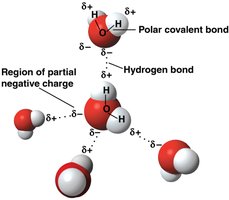
Polar covalent bonds occur when electrons are shared unequally between atoms, as in water (H2O), where electrons spend more time near the oxygen atom than the hydrogen atoms.
This unequal sharing creates a polar molecule with a partial negative charge near the oxygen and partial positive charges near the hydrogens.
Hydrogen bonds form between the slightly positive hydrogen of one water molecule and the slightly negative oxygen of another, resulting in a network of interactions.
Emergent Properties of Water
1. Cohesion and Adhesion
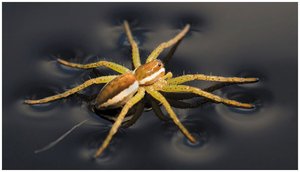
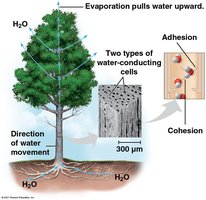
Cohesion is the attraction between water molecules due to hydrogen bonding, resulting in high surface tension.
Surface tension allows small organisms, such as insects, to walk on water without sinking.
Adhesion is the attraction between water molecules and other substances, such as plant cell walls, aiding in water transport against gravity in plants.
2. Moderation of Temperature
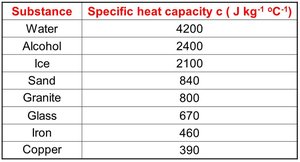
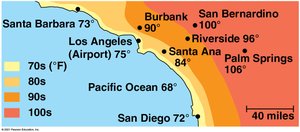
Water can absorb or release large amounts of heat with only slight changes in its own temperature due to its high specific heat.
Specific heat is the amount of heat required to change the temperature of 1 g of a substance by 1°C. For water, this value is 1 cal/(g·°C).
Hydrogen bonding is responsible: heat is absorbed to break bonds and released when bonds form.
This property stabilizes temperatures in organisms and environments, especially in coastal regions.
Substance | Specific heat capacity c (J kg-1 °C-1) |
|---|---|
Water | 4200 |
Alcohol | 2400 |
Ice | 2100 |
Sand | 840 |
Granite | 800 |
Glass | 670 |
Iron | 460 |
Copper | 390 |
Evaporative Cooling
Evaporation is the transformation of a substance from liquid to gas.
Heat of vaporization is the amount of heat required for 1 g of liquid to become gas.
As water evaporates, the surface cools, a process called evaporative cooling, which helps regulate temperature in organisms and environments.
3. Expansion Upon Freezing
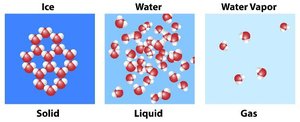
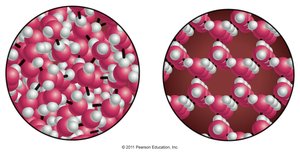
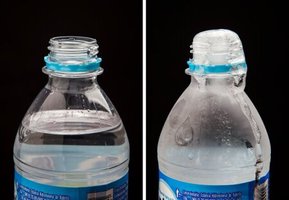
Water is less dense as a solid (ice) than as a liquid because hydrogen bonds form a crystalline lattice that spaces molecules farther apart.
This property allows ice to float, insulating bodies of water and protecting aquatic life during cold periods.
Ecological Impact
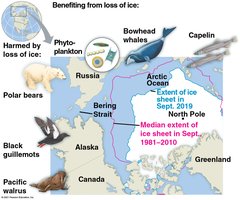
Global warming is reducing ice cover, threatening species that depend on ice for survival.

4. Water: The Solvent of Life
A solution is a homogeneous mixture of substances; the solvent is the dissolving agent, and the solute is the substance dissolved.
An aqueous solution is one where water is the solvent.
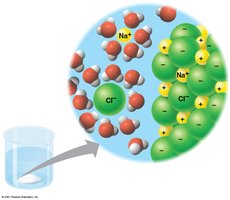
Water's polarity allows it to dissolve ionic compounds (e.g., NaCl) and polar molecules, forming hydration shells around ions.
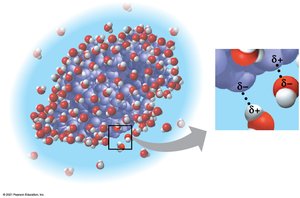
Large polar molecules, such as proteins, can also dissolve in water if they have ionic and polar regions.
Hydrophilic and Hydrophobic Substances
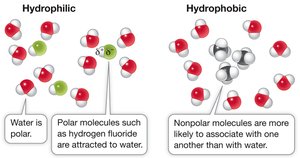
Hydrophilic substances have an affinity for water (e.g., salts, sugars).
Hydrophobic substances do not interact with water (e.g., oils), and are major components of cell membranes.
Solute Concentration in Aqueous Solutions
Molecular mass is the sum of the masses of all atoms in a molecule (e.g., H2O = 18 daltons).
The mole (mol) is a unit for counting molecules: 1 mol = 6.02 × 10²³ molecules (Avogadro’s number).
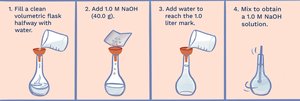
Molarity (M) is the number of moles of solute per liter of solution.
Acids, Bases, and pH
Dissociation of Water Molecules
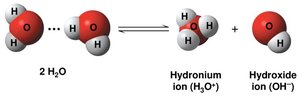
Water molecules can dissociate into hydronium ions (H3O+) and hydroxide ions (OH–).
This process is rare but crucial, as H+ and OH– are highly reactive and affect cellular chemistry.
Acids and Bases
An acid increases the H+ concentration of a solution (proton donor).
A base reduces the H+ concentration (proton acceptor).
Strong acids and bases dissociate completely in water; weak acids and bases dissociate partially and reversibly.
The pH Scale
The pH of a solution is defined as the negative logarithm of the H+ concentration:
In pure water at 25°C:
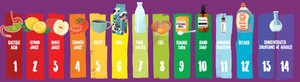
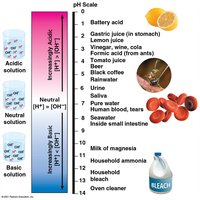
pH values range from 0 (most acidic) to 14 (most basic); neutral solutions have pH = 7.
The pH scale is logarithmic: each unit change represents a tenfold change in H+ concentration.
Buffers
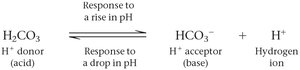
Buffers are substances that minimize changes in pH by reversibly binding H+ or OH–.
Most buffers consist of a weak acid and its conjugate base.
Buffers are critical for maintaining stable pH in biological systems, such as blood.
Buffer System in Human Blood
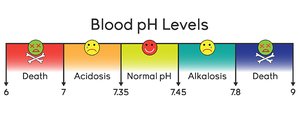
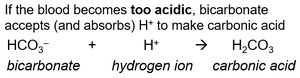
The bicarbonate buffer system helps maintain blood pH near 7.4.
If blood becomes too acidic, bicarbonate (HCO3–) absorbs H+ to form carbonic acid (H2CO3).
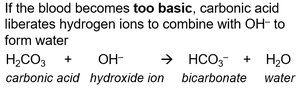
If blood becomes too basic, carbonic acid releases H+ to combine with OH– and form water.
Summary Table: Properties of Water
Property | Biological Importance |
|---|---|
Cohesion/Adhesion | Transport of water in plants, surface tension |
High Specific Heat | Stabilizes temperature in organisms and environments |
Expansion Upon Freezing | Ice floats, insulating aquatic life |
Versatile Solvent | Facilitates chemical reactions and transport of substances |
Additional info: The notes above expand on the original lecture content with definitions, examples, and equations to ensure a comprehensive, self-contained study guide for General Biology students.
