 뒤로
뒤로Water and Life: Properties, Structure, and Biological Importance
스터디 가이드 - 스마트 노트
 자료에 맞춘 맞춤형 노트, 핵심 정의, 예시, 맥락을 확장해 제공합니다.
Water and Life
The Molecule That Supports All of Life
Water is essential for life on Earth, existing in all three physical states—solid, liquid, and gas. Its unique properties arise from its molecular structure, enabling interactions with other molecules and supporting biological processes.
Key Point 1: Water is the only common substance found naturally as a solid, liquid, and gas.
Key Point 2: Water's emergent properties make Earth suitable for life.
Key Point 3: The structure of water allows it to interact with other molecules.
Structure of Water Molecule
Polar Covalent Bonds and Hydrogen Bonding
The water molecule (H2O) consists of two hydrogen atoms covalently bonded to an oxygen atom. Electrons spend more time near the oxygen, making water a polar molecule with uneven charge distribution. This polarity enables water molecules to form hydrogen bonds with each other.
Key Point 1: Electronegativity of oxygen causes partial negative charge (δ–) at the oxygen end and partial positive charge (δ+) at the hydrogen ends.
Key Point 2: Water is not charged overall, but its polarity allows hydrogen bonding.
Example: Hydrogen bonds are weak attractions between oppositely charged regions of water molecules.
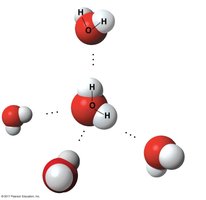
Emergent Properties of Water
Four Properties That Facilitate Life
Water's emergent properties are crucial for sustaining life. These include cohesive behavior, moderation of temperature, expansion upon freezing, and versatility as a solvent.
Cohesion: Hydrogen bonds hold water molecules together, resulting in high surface tension.
Adhesion: Water's attraction to other substances, such as plant cell walls, helps counter gravity.
Moderation of Temperature: Water absorbs and releases heat with minimal temperature change due to high specific heat.
Expansion Upon Freezing: Water is less dense as a solid, allowing ice to float.
Versatility as a Solvent: Water dissolves many substances due to its polarity.
Cohesion and Surface Tension
Cohesion refers to the attraction between water molecules, resulting in high surface tension. This property allows certain organisms to move across water surfaces.
Example: Some insects can walk on water due to surface tension.
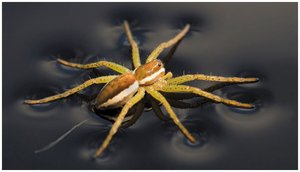
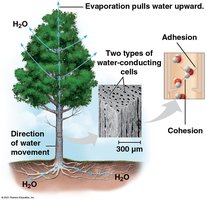
Adhesion and Water Transport in Plants
Adhesion is the attraction between water and other substances, such as plant cell walls. This property, along with cohesion, enables water to move upward in plants against gravity.
Example: Water moves from roots to leaves through adhesion and cohesion.
Moderation of Temperature
Water moderates temperature by absorbing heat from warmer air and releasing it to cooler air. Its high specific heat (1 cal/g·°C) allows it to resist temperature changes, stabilizing environments and supporting life.
Key Point: Heat is absorbed when hydrogen bonds break and released when they form.
Example: Coastal areas experience less temperature fluctuation due to water's high specific heat.
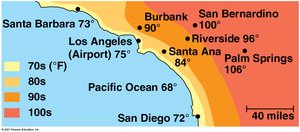
Evaporative Cooling
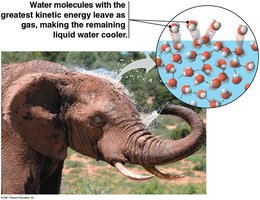
Evaporation transforms liquid water into gas, cooling the remaining surface. This process stabilizes temperatures in organisms and bodies of water.
Heat of Vaporization: The heat required for 1 g of liquid to become gas.
Example: Sweating cools the body by evaporative cooling.
Expansion Upon Freezing
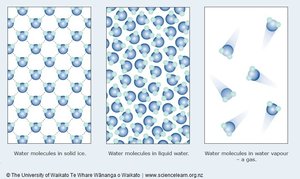
Water is less dense as a solid than as a liquid. At 0°C, water molecules form a crystalline lattice, causing ice to float. This property insulates bodies of water, preventing them from freezing solid and supporting aquatic life.
Key Point: Floating ice insulates water below, maintaining a habitable environment.
Water: The Solvent of Life
Solutions, Solvents, and Solutes
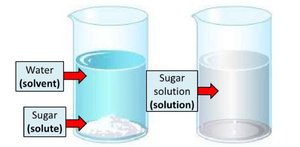
A solution is a homogeneous mixture of substances. The solvent is the dissolving agent, and the solute is the substance dissolved. Water is a versatile solvent, dissolving ionic and polar compounds, but not non-polar or hydrophobic substances.
Example: Water dissolves salt (NaCl) and sugar, but not lipids.
How Water Dissolves Substances
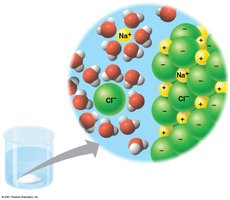
Water's polarity allows it to surround ions and polar molecules, forming hydration shells. This enables water to dissolve a wide range of substances.
Key Point: Hydration shells form around dissolved ions, stabilizing them in solution.
Hydrophilic and Hydrophobic Substances
Hydrophilic substances have an affinity for water (e.g., salts, acids, carbohydrates), while hydrophobic substances do not (e.g., lipids, hydrocarbons).
Key Point: Hydrophilic substances dissolve in water; hydrophobic substances do not.
Solute Concentration in Aqueous Solutions
Moles, Molecular Mass, and Molarity
Chemical reactions in organisms often involve solutes dissolved in water. The number of molecules is measured in moles, where 1 mole = molecules (Avogadro's number). Molecular mass is the sum of atomic masses in a molecule, measured in g/mol. Molarity (M) is the number of moles of solute per liter of solution.
Formula:
Example: 1 mole of NaCl in 1 liter of water is a 1M solution.
Acidic and Basic Conditions
Acids, Bases, and pH
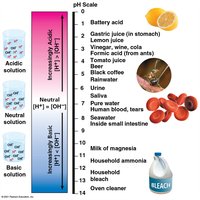
Acids increase the H+ concentration in a solution, while bases reduce it. The pH scale measures acidity or alkalinity, ranging from 0 (most acidic) to 14 (most basic). Most biological fluids have pH values between 6 and 8.
Formula:
Formula:
Example: Pure water has a pH of 7.
Acid-Base Reactions
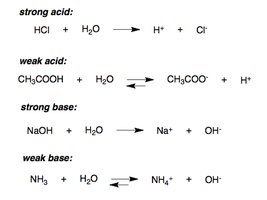
Strong acids and bases dissociate completely in water, while weak acids and bases reversibly release and accept hydrogen ions. These reactions shift the balance of H+ and OH– away from neutrality.
Example: HCl is a strong acid; NaOH is a strong base.
Buffers
Buffers minimize changes in pH by combining reversibly with H+ ions. Most buffer solutions contain a weak acid and its corresponding base, helping maintain stable internal pH in living cells.
Key Point: Buffers are essential for maintaining homeostasis in biological systems.
Practice Problems and Calculations
Calculating Molarity and pH
Practice problems involve converting mass to moles, calculating molarity, and determining pH and pOH using logarithmic formulas.
Formula:
Example: For a 0.0235 M HCl solution, pH = ; pOH = .
Summary Table: Water's Properties and Biological Importance
Property | Description | Biological Importance |
|---|---|---|
Cohesion | Attraction between water molecules | Surface tension, water transport in plants |
Adhesion | Attraction between water and other substances | Counteracts gravity in plants |
High Specific Heat | Resists temperature change | Stabilizes environments |
Expansion Upon Freezing | Ice is less dense than liquid water | Insulates aquatic life |
Solvent Versatility | Dissolves many substances | Supports biochemical reactions |
Additional info: All explanations have been expanded for academic clarity and completeness. Practice problems and calculations are included to reinforce quantitative understanding.
