 뒤로
뒤로Water and Life: Properties, Structure, and Biological Importance
스터디 가이드 - 스마트 노트
 자료에 맞춘 맞춤형 노트, 핵심 정의, 예시, 맥락을 확장해 제공합니다.
Chapter 3: Water and Life
Concept 3.1: Polar Covalent Bonds in Water Molecules Result in Hydrogen Bonding
Water is a unique molecule essential for life, largely due to its molecular structure and the interactions between its molecules. The polarity of water and its ability to form hydrogen bonds underlie many of its life-supporting properties.
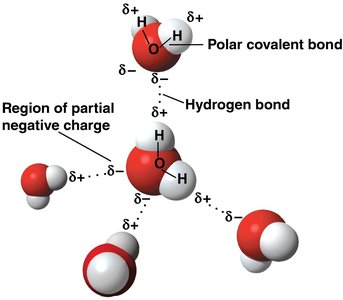
Structure of a Water Molecule: Water (H2O) has a bent (V-shaped) structure, with two hydrogen atoms covalently bonded to one oxygen atom.
Electronegativity: Oxygen is more electronegative than hydrogen, causing electrons to be shared unequally. This results in a partial negative charge (δ⁻) on the oxygen and partial positive charges (δ⁺) on the hydrogens.
Polarity: Water is a polar molecule, meaning it has regions of partial positive and negative charge.
Hydrogen Bonding: The partial charges allow water molecules to form hydrogen bonds with each other, where the δ⁺ hydrogen of one molecule is attracted to the δ⁻ oxygen of another.
Concept 3.2: Four Emergent Properties of Water Contribute to Earth’s Suitability for Life
Water’s structure and hydrogen bonding give rise to four key properties that make life possible on Earth:
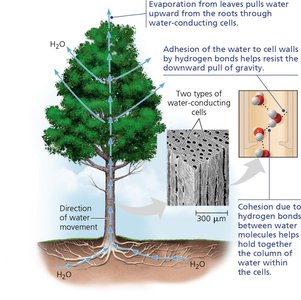
Cohesive Behavior: Water molecules stick together due to hydrogen bonding, a phenomenon called cohesion. This leads to high surface tension, allowing water to resist external force.
Adhesion: Water molecules can also stick to other substances, such as the walls of plant cells, helping water move upward against gravity.
Role in Plants: Cohesion and adhesion together enable the transport of water and nutrients from roots to leaves in plants, even against gravity.
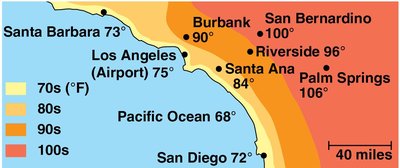
Ability to Moderate Temperature: Water can absorb or release large amounts of heat with only slight changes in its own temperature, due to its high specific heat capacity (1 cal/g·°C). This property stabilizes environmental and organismal temperatures.
Heat Exchange: Water absorbs heat from warmer air and releases heat to cooler air, moderating climate and weather patterns, especially near large bodies of water.
Expansion Upon Freezing: Water is less dense as a solid than as a liquid, so ice floats. This is due to the hydrogen bonds forming a crystalline structure in ice, keeping molecules further apart. Floating ice insulates bodies of water, protecting aquatic life in winter.
Versatility as a Solvent: Water is an excellent solvent for ionic and polar substances, earning it the title "universal solvent." This property is crucial for biochemical reactions and transport of substances in living organisms.
Water as a Solvent
Water’s polarity allows it to dissolve many substances, facilitating chemical reactions and transport in cells.
Solution: A homogeneous mixture of two or more substances.
Solvent: The dissolving agent (water in aqueous solutions).
Solute: The substance dissolved in the solvent.
Hydration Shell: When ionic compounds like NaCl dissolve, water molecules surround each ion, keeping them separated and dispersed.
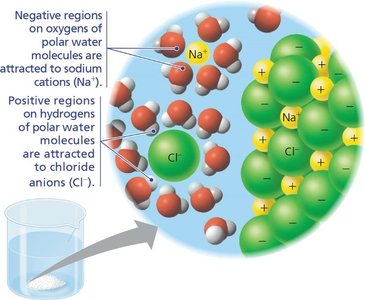
Dissolving Polar Molecules: Water can also dissolve large polar molecules, such as proteins, if they have ionic and polar regions.
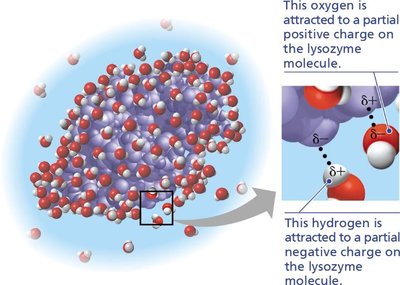
Hydrophilic Substances: Substances with an affinity for water (e.g., salts, sugars).
Hydrophobic Substances: Substances that repel water, usually nonpolar (e.g., oils, major components of cell membranes).
Solute Concentration in Aqueous Solutions
Molecular Mass: The sum of the masses of all atoms in a molecule.
Mole (mol): 6.02 × 10²³ molecules (Avogadro’s number).
Molarity (M): Number of moles of solute per liter of solution.
Concept 3.3: Acidic and Basic Conditions Affect Living Organisms
The balance of hydrogen ions (H+) and hydroxide ions (OH−) in water is critical for biological systems. Acids, bases, and buffers regulate this balance.
Dissociation of Water: Water molecules can dissociate into hydronium ions (H3O+, often written as H+) and hydroxide ions (OH−).
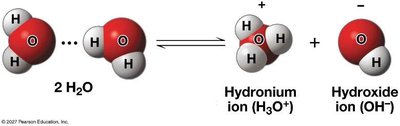
Acids: Substances that increase H+ concentration in solution (e.g., HCl).
Bases: Substances that reduce H+ concentration, either by accepting H+ (e.g., NH3) or by releasing OH− (e.g., NaOH).
Strong vs. Weak Acids/Bases: Strong acids/bases dissociate completely; weak acids/bases dissociate partially and reversibly.
The pH Scale
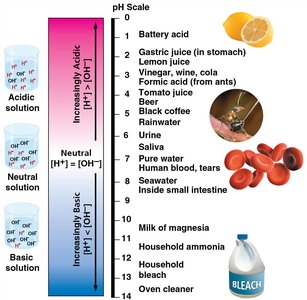
Definition: pH is the negative logarithm (base 10) of the hydrogen ion concentration.
Neutral Solution: [H+] = [OH−] = 10^{-7} \ M$, so pH = 7.
Acidic Solution: pH < 7 (higher [H+]).
Basic Solution: pH > 7 (lower [H+]).
Most biological fluids: pH 6–8.
Buffers and pH Regulation
Buffers are crucial for maintaining stable pH in biological systems, preventing harmful fluctuations.
Buffer: A substance that minimizes changes in H+ and OH− concentrations by accepting or donating H+ as needed.
Biological Example: The carbonic acid (H2CO3)–bicarbonate (HCO3−) buffer system in blood helps maintain pH around 7.4.
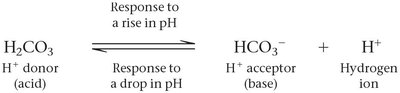
If blood pH drops (more acidic), the buffer absorbs excess H+.
If blood pH rises (more basic), the buffer releases H+.
Summary Table: Properties of Water and Their Biological Importance
Property | Description | Biological Importance |
|---|---|---|
Cohesion | Water molecules stick together via hydrogen bonds | Enables water transport in plants, surface tension |
Adhesion | Water molecules stick to other substances | Helps water move against gravity in plant tissues |
High Specific Heat | Resists temperature changes | Stabilizes climate and organismal temperature |
Expansion Upon Freezing | Ice is less dense than liquid water | Ice floats, insulating aquatic life |
Versatile Solvent | Dissolves ionic and polar substances | Facilitates biochemical reactions and transport |
Additional info:
Water’s properties are foundational for all biological systems, influencing everything from climate to cellular function.
Understanding acids, bases, and buffers is essential for grasping how cells maintain homeostasis and how enzymes function optimally.
