 뒤로
뒤로Water and Life: Properties, Structure, and Biological Importance
스터디 가이드 - 스마트 노트
 자료에 맞춘 맞춤형 노트, 핵심 정의, 예시, 맥락을 확장해 제공합니다.
The Molecule That Supports All of Life
Introduction to Water's Role in Biology
Water is fundamental to life on Earth, serving as the medium for biological processes and supporting the existence of living organisms. Its unique properties stem from its molecular structure and interactions.
Water makes life possible on Earth by providing a stable environment for biochemical reactions.
Water is the only common substance to exist in the natural environment in all three physical states: solid, liquid, and gas.
The structure of the water molecule allows it to interact with other molecules, facilitating diverse biological functions.
Structure and Bonding in Water
Polar Covalent Bonds and Hydrogen Bonding
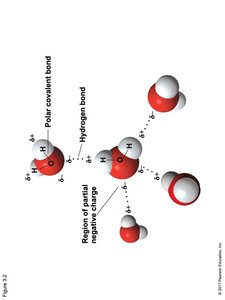
The water molecule (H2O) is composed of two hydrogen atoms covalently bonded to an oxygen atom. The unequal sharing of electrons results in polarity, which is crucial for water's properties.
In the water molecule, the electrons of the polar covalent bonds spend more time near the oxygen than the hydrogen.
The water molecule is thus a polar molecule, with an unevenly distributed charge.
Polarity allows water molecules to form hydrogen bonds with each other.
Emergent Properties of Water
Four Properties That Facilitate Life
Water exhibits several emergent properties that make it suitable for life, including cohesion, moderation of temperature, expansion upon freezing, and versatility as a solvent.
Cohesive behavior
Ability to moderate temperature
Expansion upon freezing
Versatility as a solvent
Cohesion and Adhesion of Water Molecules
Cohesion and Adhesion Explained
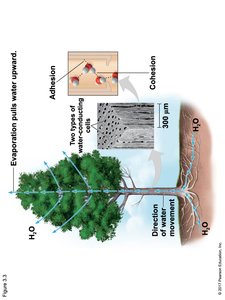
Cohesion refers to the attraction between water molecules due to hydrogen bonding, while adhesion is the attraction between water and other substances.
Hydrogen bonds hold water molecules together, a phenomenon called cohesion.
Cohesion helps the transport of water against gravity in plants.
Adhesion is the attraction between different substances, such as water and plant cell walls.
Surface Tension
Surface Tension of Water
Surface tension is a measure of how difficult it is to break the surface of a liquid. Water's surface tension is unusually high due to hydrogen bonding.
Surface tension is the result of hydrogen bonding between molecules at the air-water interface and to the water below.

Moderation of Temperature by Water
Water's Role in Temperature Regulation
Water absorbs heat from warmer air and releases stored heat to cooler air, helping to moderate temperature changes in the environment.
Water can absorb or release a large amount of heat with only a slight change in its own temperature.
Temperature and Heat
Understanding the concepts of kinetic energy, thermal energy, temperature, and heat is essential for grasping water's thermal properties.
Kinetic energy is the energy of motion.
Thermal energy is the kinetic energy associated with random motion of atoms or molecules.
Temperature represents the average kinetic energy of molecules in a body of matter.
Heat is the thermal energy in transfer from one body of matter to another.
Units of Heat
A calorie (cal) is the amount of heat required to raise the temperature of 1 g of water by 1°C.
1 kcal = 1,000 cal; joule (J) is another unit of energy: 1 J = 0.239 cal, or 1 cal = 4.184 J.
Water's High Specific Heat
Specific Heat and Its Biological Importance
Specific heat is the amount of heat that must be absorbed or lost for 1 g of a substance to change its temperature by 1°C. Water's high specific heat helps stabilize temperature in organisms and environments.
The specific heat of water is 1 cal/(g·°C).
Water resists changing its temperature because of its high specific heat.
Hydrogen Bonding and Specific Heat
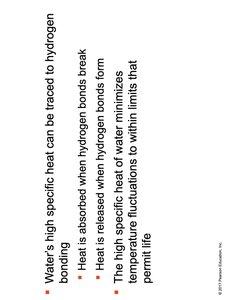
Water's high specific heat can be traced to hydrogen bonding.
Heat is absorbed when hydrogen bonds break; heat is released when hydrogen bonds form.
This property minimizes temperature fluctuations within limits that permit life.
Evaporative Cooling
Evaporation and Its Effects
Evaporation is the transformation of a substance from liquid to gas. The heat of vaporization is the heat a liquid must absorb for 1 g to be converted to gas.
As liquid evaporates, its remaining surface cools, a process called evaporative cooling.
Evaporative cooling of water helps stabilize temperatures in organisms and bodies of water.
Expansion Upon Freezing
Floating of Ice on Liquid Water
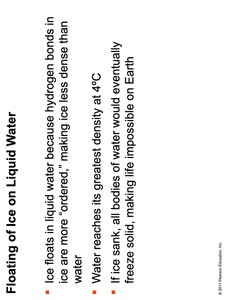
Ice floats in liquid water because hydrogen bonds in ice are more ordered, making ice less dense than liquid water.
Water reaches its greatest density at 4°C.
If ice sank, all bodies of water would eventually freeze solid, making life impossible on Earth.
Global Warming and Water
Impact of Global Warming on Icy Environments
Global warming is affecting icy environments around the globe, posing challenges to animals that depend on ice for survival.
The rate at which glaciers and Arctic sea ice are disappearing poses an extreme challenge to animals.
Water: The Solvent of Life
Solutions, Solvents, and Solutes
Water is a versatile solvent, capable of dissolving a wide range of substances due to its polarity.
A solution is a liquid that is a completely homogeneous mixture of substances.
The solvent is the dissolving agent; the solute is the substance that is dissolved.
An aqueous solution is one in which water is the solvent.
Hydration Shells and Dissolving Ionic Compounds
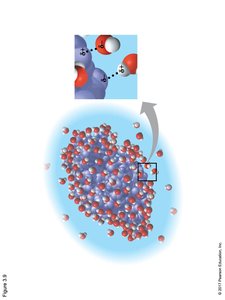
Water's polarity allows it to surround each ion in a dissolved ionic compound, forming a hydration shell.
Dissolving Nonionic and Polar Molecules
Water can also dissolve compounds made of nonionic polar molecules.
Large polar molecules such as proteins can dissolve in water if they have ionic and polar regions.
Hydrophilic and Hydrophobic Substances
Affinity for Water
Substances can be classified based on their affinity for water.
A hydrophilic substance has an affinity for water.
A hydrophobic substance does not have an affinity for water.
Oil molecules are hydrophobic because they have relatively nonpolar bonds.
Hydrophobic molecules related to oils are major ingredients of cell membranes.
Possible Evolution of Life on Other Planets
Water in the Search for Extraterrestrial Life
Biologists searching for life on other planets focus on those that might have water, as it is essential for life as we know it.
More than 800 planets have been found outside our solar system; some have evidence of water vapor.
Mars has been found to have water.
Acidic and Basic Conditions Affect Living Organisms
Formation of Ions in Water
Water can dissociate into ions, affecting the chemistry of living cells.
A hydrogen atom in a hydrogen bond between two water molecules can shift from one to the other.
The hydrogen atom leaves its electron behind and is transferred as a proton, or hydrogen ion (H+).
The molecule that lost the proton is now a hydroxide ion (OH-).
The molecule with the extra proton is now a hydronium ion (H3O+).

Dynamic Equilibrium and Biological Impact
Water is in a state of dynamic equilibrium in which water molecules dissociate at the same rate at which they are being reformed.
Though statistically rare, the dissociation of water molecules has a great effect on organisms.
Changes in concentrations of H+ and OH- can drastically affect the chemistry of a cell.
Acids, Bases, and the pH Scale
Acids and bases modify the concentrations of H+ and OH- in a solution. The pH scale is used to describe the acidity or basicity of a solution.
An acid increases the H+ concentration; a base reduces it.
Strong acids and bases dissociate completely in water; weak acids and bases reversibly release and accept hydrogen ions.
The pH Scale
In any aqueous solution at 25°C, the product of H+ and OH- is constant:
The pH of a solution is defined by the negative logarithm of H+ concentration:
For a neutral aqueous solution, , so
Acidic solutions have pH values less than 7; basic solutions have pH values greater than 7.
Most biological fluids have pH values in the range of 6 to 8.
Buffers
Maintaining pH Stability
Buffers are substances that minimize changes in concentrations of H+ and OH- in a solution, helping maintain stable pH in biological systems.
The internal pH of most living cells is close to 7.
Most buffer solutions contain a weak acid and its corresponding base, which combine reversibly with H+ ions.
Acidification: A Threat to Our Oceans
Human Impact and Ocean Chemistry
Human activities such as burning fossil fuels threaten water quality by increasing CO2 levels, which leads to ocean acidification.
CO2 is absorbed by oceans, forming carbonic acid and lowering pH.
Effects on Marine Life
As seawater acidifies, H+ ions combine with carbonate ions to produce bicarbonate.
Carbonate is required for calcification (production of calcium carbonate) by many marine organisms, including reef-building corals.
Summary Table: Water's Properties and Biological Importance
Property | Biological Importance |
|---|---|
Cohesion | Transport of water in plants |
High Specific Heat | Stabilizes temperature in organisms and environments |
Expansion Upon Freezing | Ice floats, preventing bodies of water from freezing solid |
Versatility as a Solvent | Facilitates biochemical reactions and transport of substances |
Additional info: Expanded explanations and context were added to ensure completeness and clarity for General Biology students.
