 뒤로
뒤로Water, pH, and Buffers: Foundations for Biological Homeostasis
스터디 가이드 - 스마트 노트
 자료에 맞춘 맞춤형 노트, 핵심 정의, 예시, 맥락을 확장해 제공합니다.
Water, pH, and Buffers
The Living Environment and Homeostasis
Homeostasis is the maintenance of a stable internal environment in living organisms. Water, pH, and buffers are essential for sustaining life and ensuring that biological processes occur within optimal ranges.
Properties of Water Supporting Life
Covalent and Polar Nature of Water
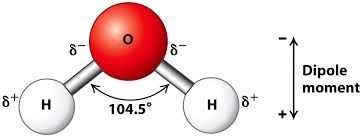
Water (H2O) is a polar molecule with covalent bonds between hydrogen and oxygen. The oxygen atom is more electronegative, creating a partial negative charge near the oxygen and a partial positive charge near the hydrogens. This polarity allows water to interact with various molecules and ions, making it an excellent solvent.
Covalent bonds: Strong bonds between H and O atoms within a water molecule.
Polarity: Unequal sharing of electrons leads to a dipole moment.
Hydrogen Bonding
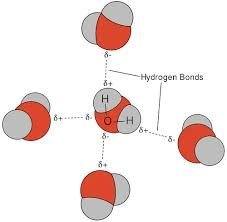
Hydrogen bonds form between the slightly positive hydrogen of one water molecule and the slightly negative oxygen of another. These bonds are weaker than covalent bonds but are crucial for water's unique properties.
Hydrogen bonds: Responsible for cohesion, adhesion, high heat capacity, and the structure of ice.
Cohesion, Adhesion, and Surface Tension
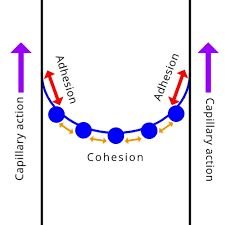
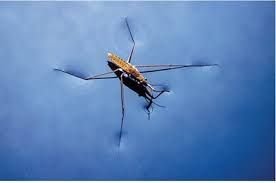
Cohesion refers to the attraction between water molecules, while adhesion is the attraction between water and other substances. These properties enable capillary action, which is vital for water transport in plants. Surface tension allows small organisms to move on water surfaces.
Cohesion: Water molecules stick together due to hydrogen bonding.
Adhesion: Water molecules stick to other surfaces.
Surface tension: The surface of water resists external force due to cohesive forces.
Dissolution of Substances
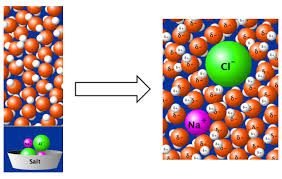
Water's polarity allows it to dissolve ionic and polar substances, making it the "universal solvent." This property is essential for biochemical reactions and transport of nutrients and waste in living organisms.
Solvent properties: Water dissolves salts, sugars, acids, and gases.
High Heat Capacity and Unique Properties of Ice
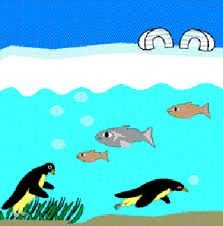
Water has a high specific heat capacity, meaning it can absorb or release large amounts of heat with little temperature change. Ice is less dense than liquid water due to the open lattice structure formed by hydrogen bonds, allowing it to float and insulate aquatic life in cold environments.
High heat capacity: Stabilizes temperatures in organisms and environments.
Ice floats: Protects aquatic life during freezing conditions.
Acids, Bases, and pH
Definitions of Acids and Bases
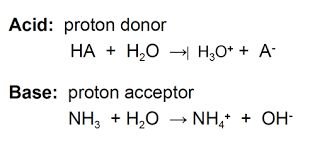
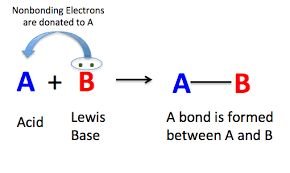
Acids are substances that donate protons (H+), while bases accept protons or donate hydroxide ions (OH-). The Brønsted-Lowry and Lewis definitions expand on these concepts.
Acid: Proton donor
Base: Proton acceptor
pH and Its Importance
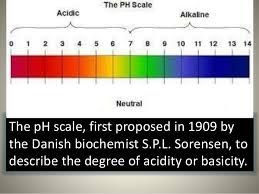
The pH scale measures the concentration of hydrogen ions in a solution, indicating its acidity or alkalinity. Biological systems require a narrow pH range for optimal function. S.P.L. Sorensen introduced the pH scale in 1909.
pH scale: Ranges from 0 (acidic) to 14 (alkaline), with 7 as neutral.
Importance: Enzyme activity, cellular processes, and metabolic reactions depend on proper pH.
Definition of pH and pOH
pH is defined as the negative logarithm of the hydrogen ion concentration, while pOH is the negative logarithm of the hydroxyl ion concentration. In pure water, [H+] = [OH-] = 10-7 M, so pH = 7.
pH:
pOH:
Relationship:
Interaction of Strong Acids and Bases with Water
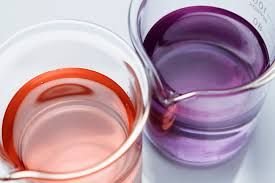
Strong acids and bases dissociate completely in water, significantly altering the pH. This can be visualized by color changes in pH indicators.
Buffers and Their Biological Importance
Definition and Function of Buffers
A buffer is a solution that resists changes in pH when small amounts of acid or base are added. Buffers are crucial in maintaining the pH of biological fluids within narrow limits.
Buffer system: Typically consists of a weak acid and its conjugate base.
Biological relevance: Blood, cytoplasm, and other fluids rely on buffers for homeostasis.
Buffer Equilibrium and the Henderson-Hasselbalch Equation
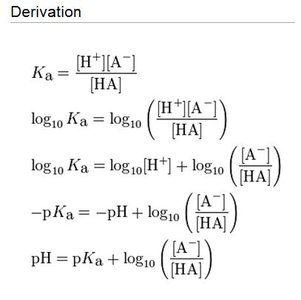
The equilibrium of a weak acid (HA) dissociating into H+ and A- is described by the acid dissociation constant (Ka). The Henderson-Hasselbalch equation relates pH, pKa, and the ratio of conjugate base to acid.
Equilibrium:
Henderson-Hasselbalch equation:
Ideal buffer: When ,
Amino Acids as Buffers
Titration of Amino Acids
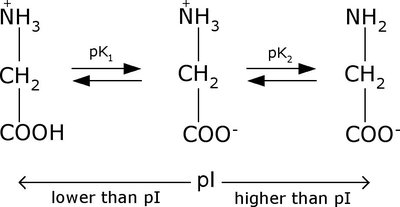
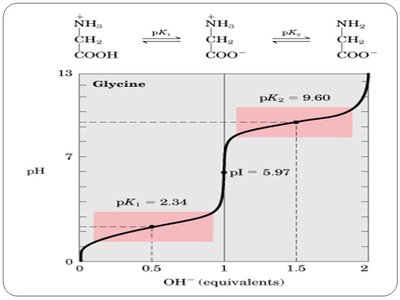
Amino acids can act as buffers due to their ionizable groups. The titration curve of glycine, for example, shows two buffering regions corresponding to its carboxyl and amino groups. The isoelectric point (pI) is where the amino acid has no net charge.
pK1: Carboxyl group dissociation
pK2: Amino group dissociation
pI: Point of zero net charge
pK Values of Amino Acids
Different amino acids have characteristic pK values for their ionizable groups, influencing their buffering capacity and behavior in biological systems.
Amino Acid | pKa (α-COOH) | pKa (α-NH3+) | pKa (Side Chain) | Isoelectric Point (pI) |
|---|---|---|---|---|
Glycine | 2.35 | 9.78 | - | 5.97 |
Lysine | 2.16 | 9.06 | 10.53 | 9.74 |
Aspartic acid | 2.10 | 9.82 | 3.86 | 2.98 |
Biological Buffer Systems
Major Buffer Systems in the Human Body
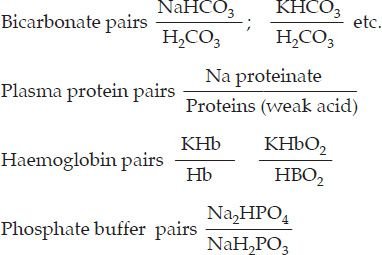
The body uses several buffer systems to maintain pH within physiological limits, including the bicarbonate, phosphate, plasma protein, and hemoglobin buffer systems.
Bicarbonate buffer:
Phosphate buffer:
Protein buffer: Plasma proteins and hemoglobin act as buffers.
Homeostatic Regulation of pH
The body constantly faces acid-base challenges from metabolism and respiration. The bicarbonate buffer system, along with respiratory and renal mechanisms, helps maintain blood pH. Disruptions can lead to metabolic or respiratory acidosis.
Bicarbonate production: Occurs in tissues and lungs.
Metabolic acidosis: Excess acid from metabolism; kidneys help compensate.
Respiratory acidosis: Impaired CO2 removal; lungs help compensate.
Practice and Application
Sample Problems and Clinical Relevance
Understanding pH and buffers is essential for interpreting clinical scenarios, such as the use of antacids (e.g., Gelusil, ENO) and acid-suppressing drugs (e.g., ranitidine, pantoprazole) in treating acidity-related disorders.
Antacids: Neutralize excess stomach acid.
Acid-suppressing drugs: Inhibit acid production in the stomach.
Additional info: Students are encouraged to solve pH calculation problems and consider the physiological impact of acid-base disturbances and their treatments.
