 뒤로
뒤로Water, pH, and Buffers: Foundations for Life and Homeostasis
스터디 가이드 - 스마트 노트
 자료에 맞춘 맞춤형 노트, 핵심 정의, 예시, 맥락을 확장해 제공합니다.
WATER, pH & BUFFERS
The Living Environment and Its Homeostasis
Homeostasis is the maintenance of a stable internal environment, crucial for life. Water, pH, and buffers are fundamental to biological homeostasis, enabling organisms to survive and thrive in changing conditions.
Properties of Water Which Support Life
Covalent and Polar Nature of Water
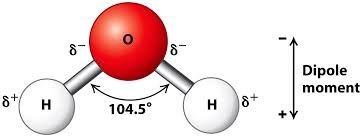
Water molecules are formed by covalent bonds between hydrogen and oxygen. The unequal sharing of electrons makes water a polar molecule, with a partial negative charge near the oxygen and partial positive charges near the hydrogens. This polarity is essential for many of water's unique properties.
Covalent Bond: Strong bond between H and O atoms.
Polar Nature: Results in a dipole moment, making water an excellent solvent.
Hydrogen Bonding
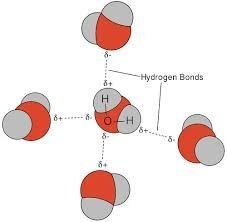
Hydrogen bonds form between water molecules due to polarity, leading to cohesion, adhesion, and other emergent properties.
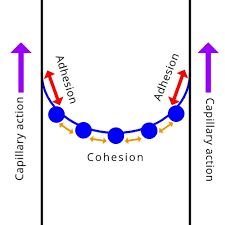
Cohesion: Water molecules stick to each other.
Adhesion: Water molecules stick to other surfaces.
Surface Tension: Allows small organisms to walk on water.
Cohesive and Adhesive Forces
Cohesion and adhesion enable capillary action, which is vital for water transport in plants and other biological systems.
Capillary Action: Movement of water through narrow spaces against gravity.
Dissolution of Substances
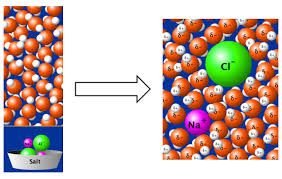
Water's polarity allows it to dissolve a wide range of substances, making it the universal solvent in biological systems.
Solubility: Ionic and polar compounds dissolve easily in water.
Surface Tension
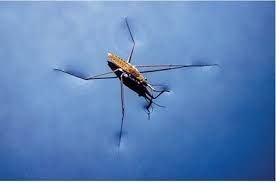
Surface tension is the result of cohesive forces at the surface of water, enabling certain organisms to move across water surfaces.
Example: Water striders use surface tension to walk on water.
High Heat Capacity
Water has a very high heat capacity, allowing it to absorb and release heat with minimal temperature change. This property stabilizes environmental and cellular temperatures.
Thermal Buffer: Protects organisms from rapid temperature fluctuations.
Anomalous Behaviour and Unique Properties of Ice
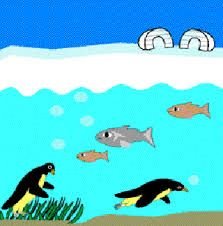
Ice is less dense than liquid water due to its crystalline structure, allowing it to float and insulate aquatic life during cold periods.
Example: Aquatic organisms survive under ice in winter.
Acids, Bases, and pH
Definitions of Acids and Bases
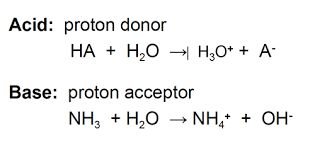
Acids and bases are fundamental to biological chemistry. Acids donate protons (H+), while bases accept protons or donate hydroxide ions (OH-).
Brønsted-Lowry Acid: Proton donor.
Brønsted-Lowry Base: Proton acceptor.
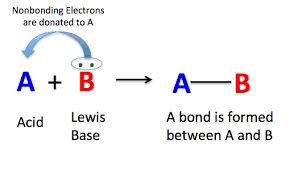
Lewis Acid: Electron pair acceptor.
Lewis Base: Electron pair donor.
pH and Its Importance
pH is a measure of hydrogen ion concentration, indicating the acidity or alkalinity of a solution. Biological systems require precise pH control for optimal function.
Sorenson's Scale: pH scale ranges from 0 (acidic) to 14 (alkaline), with 7 as neutral.
Importance: Enzyme activity, metabolic processes, and cellular function depend on pH.
Definition of pH and pOH
pH and pOH are logarithmic measures of hydrogen and hydroxide ion concentrations, respectively.
pH: $\text{pH} = -\log_{10}[\text{H}^+]$
pOH: $\text{pOH} = -\log_{10}[\text{OH}^-]$
Relationship: $\text{pH} + \text{pOH} = 14$
Neutral Water: $[\text{H}^+] = [\text{OH}^-] = 10^{-7}$, so pH = 7
Interaction of Strong Acids and Bases with Water
Strong acids and bases dissociate completely in water, significantly altering pH. This can impact biological systems if not regulated.
Buffers and Their Biological Importance
Definition and Function of Buffers
A buffer is a solution that resists changes in pH when small amounts of acid or base are added. Buffers are essential for maintaining homeostasis in living organisms.
Good Buffer: Resists pH changes effectively.
Biological Example: Blood contains several buffer systems.
Buffer Chemistry: Weak Acids and Bases
Buffers typically consist of a weak acid and its conjugate base. The equilibrium between these components allows the buffer to neutralize added acids or bases.
General Equation: $\text{HA} \rightleftharpoons \text{H}^+ + \text{A}^-$
Acid Dissociation Constant: $K_a = \frac{[\text{H}^+][\text{A}^-]}{[\text{HA}]}$
Henderson-Hasselbalch Equation
The Henderson-Hasselbalch equation relates pH, pKa, and the ratio of conjugate base to acid in a buffer system.
Equation: $\text{pH} = \text{p}K_a + \log_{10}\left(\frac{[\text{A}^-]}{[\text{HA}]}\right)$
Ideal Buffer: When $[\text{A}^-] = [\text{HA}]$, pH = pKa.
Amino Acids as Buffers
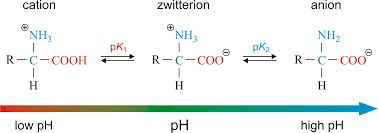
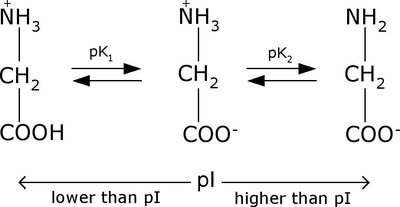
Amino acids can act as buffers due to their ionizable groups. Their titration curves illustrate how they resist pH changes across different environments.
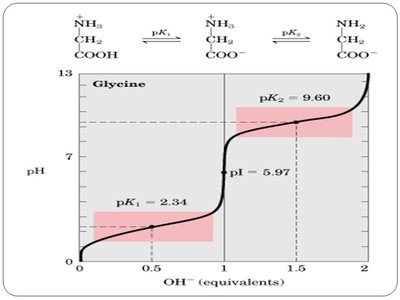
Glycine Example: Glycine titration shows buffering at pKa values.
Isoelectric Point (pI): The pH at which the amino acid has no net charge.
Titration of Amino Acids
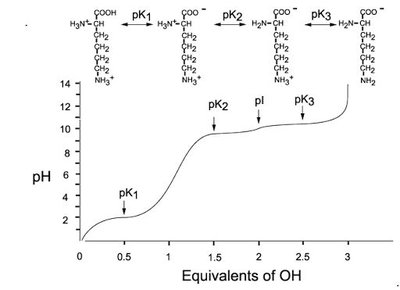
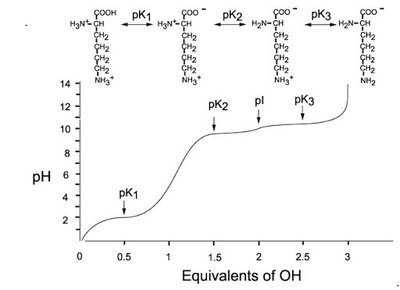
Titration curves for amino acids like glycine, lysine, and aspartic acid demonstrate their buffering capacity at specific pKa values.
Glycine: Buffers at pKa1 and pKa2.
Lysine: Has three ionizable groups, buffers at three pKa values.
Aspartic Acid: Buffers at two pKa values.
pKa Values of Amino Acids
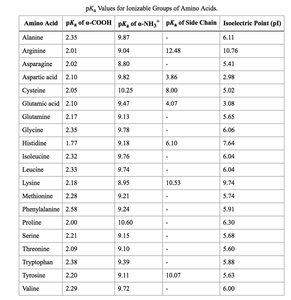
Amino acids have characteristic pKa values for their ionizable groups, which determine their buffering range and isoelectric point.
Amino Acid | pKaα-COOH | pKaα-NH3 | pKa of Side Chain | Isoelectric Point (pI) |
|---|---|---|---|---|
Alanine | 2.35 | 9.87 | - | 6.11 |
Arginine | 2.01 | 9.04 | 12.48 | 10.76 |
Aspartic acid | 2.10 | 9.82 | 3.86 | 2.98 |
Glycine | 2.35 | 9.78 | - | 5.97 |
Lysine | 2.18 | 8.95 | 10.53 | 9.74 |
Valine | 2.29 | 9.72 | - | 6.00 |
... | ... | ... | ... | ... |
Biological Buffer Systems
Why Can Your Body Tolerate pH Insults?
The body constantly faces threats to pH balance due to metabolic acids and environmental changes. Buffer systems, especially in blood, maintain pH within physiological range.
Bicarbonate System: Major buffer in blood, produced in lungs and tissues.
Metabolic Acidosis: Excess acid from metabolism, regulated by kidneys.
Respiratory Acidosis: CO2 retention, regulated by lungs.
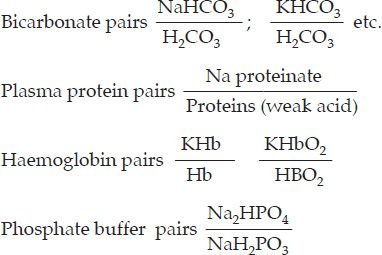
Major Buffer Systems in the Body
Several buffer pairs operate in the body to maintain pH homeostasis.
Buffer System | Components |
|---|---|
Bicarbonate | NaHCO3 / H2CO3, KHCO3 / H2CO3 |
Plasma Protein | Na proteinate / Proteins (weak acid) |
Haemoglobin | KHb / Hb, KHbO2 / HBO2 |
Phosphate | Na2HPO4 / NaH2PO3 |
Summary and Applications
Applications and Clinical Relevance
Understanding water, pH, and buffers is essential for biology, medicine, and environmental science. Clinical treatments for acidity (e.g., antacids, proton pump inhibitors) rely on these principles.
Antacids: Neutralize excess stomach acid.
Proton Pump Inhibitors: Reduce acid production.
Buffer Solutions: Used in labs and medicine to maintain pH.
Additional info: The notes have been expanded with academic context, including definitions, examples, and equations, to ensure completeness and clarity for exam preparation.
