 뒤로
뒤로Water: Structure, Properties, and Biological Importance
스터디 가이드 - 스마트 노트
 자료에 맞춘 맞춤형 노트, 핵심 정의, 예시, 맥락을 확장해 제공합니다.
Water: Structure, Properties, and Biological Importance
Review of Chemical Bonds
Chemical bonds are the forces that hold atoms together in molecules. Understanding the types of bonds is essential for grasping water's unique properties.
Covalent Bonds: Atoms share electrons. Can be nonpolar (equal sharing) or polar (unequal sharing).
Nonpolar Covalent Bonds: Electrons are shared equally (e.g., H2, C-H).
Polar Covalent Bonds: Electrons are shared unequally due to differences in electronegativity (e.g., O-H, C-O).
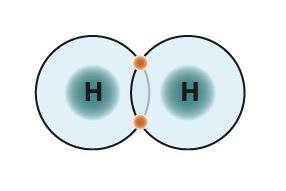

Electronegativity and Water's Polarity
Electronegativity is an atom's ability to attract electrons in a bond. Oxygen is more electronegative than hydrogen, resulting in polar covalent bonds in water (H2O).
Oxygen (O): 3.44
Hydrogen (H): 2.1
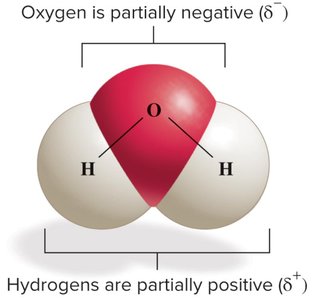
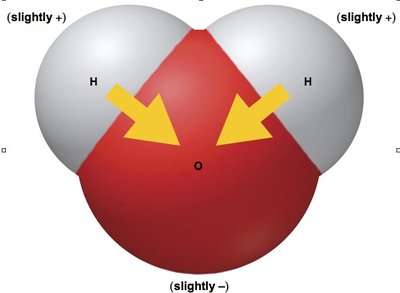
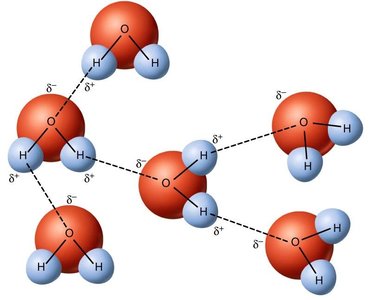
Electrons spend more time near oxygen, creating partial charges (δ- on O, δ+ on H).
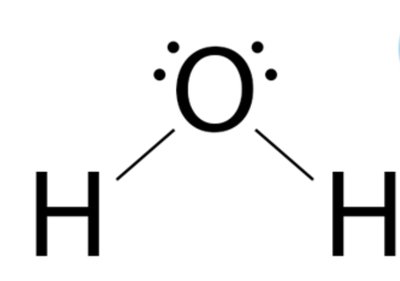
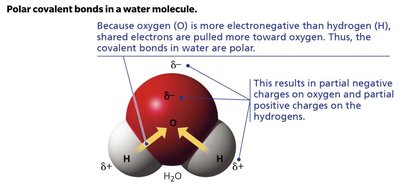
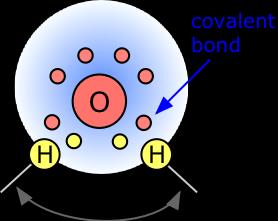
Water as a Polar Molecule
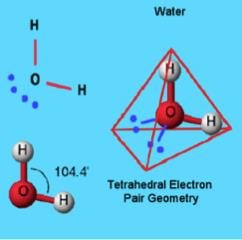
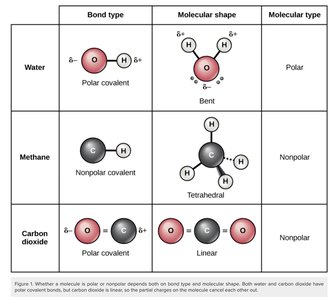
Water is a polar molecule due to its bent shape and polar covalent bonds. This polarity leads to distinct regions of partial positive and negative charge.
Asymmetrical (bent) shape: 104.5° bond angle.
Electron-rich region (O) and electron-poor regions (H).
Polarity makes water an excellent solvent for other polar substances.
Comparison: Water, Methane, and Carbon Dioxide
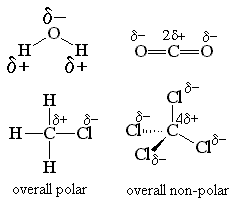
The molecular shape and bond polarity determine whether a molecule is overall polar or nonpolar.
Bond Type | Molecular Shape | Molecular Type |
|---|---|---|
Water | Bent | Polar |
Methane | Tetrahedral | Nonpolar |
Carbon Dioxide | Linear | Nonpolar |
Hydrogen Bonds
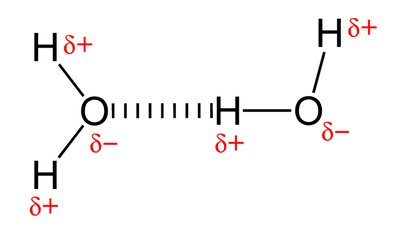
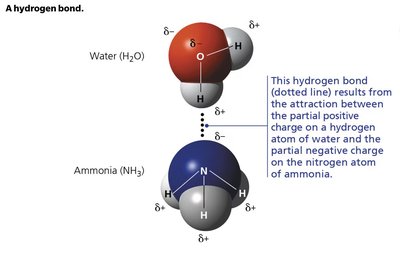
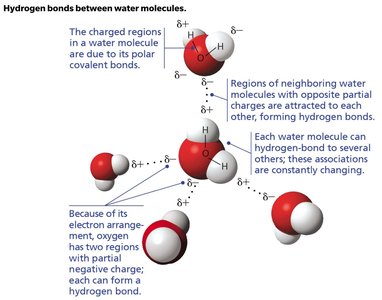
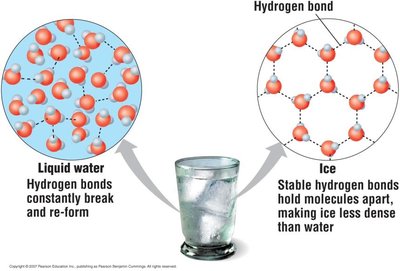
Hydrogen bonds are weak attractions between a partially positive hydrogen atom and a partially negative atom (usually O or N) in another molecule. While individually weak, collectively they have significant effects.
Hydrogen bonds are noncovalent (no electron sharing).
Responsible for water's unique properties and for stabilizing DNA and protein structures.
Emergent Properties of Water
Hydrogen bonding gives rise to water's emergent properties—characteristics that arise from the collective behavior of water molecules.
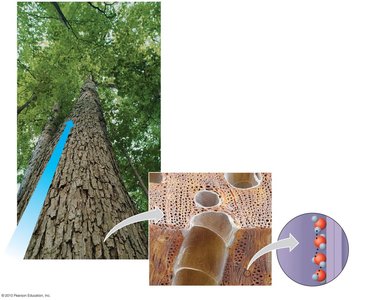
Cohesion: Water molecules stick to each other (surface tension).
Adhesion: Water molecules stick to other polar substances.
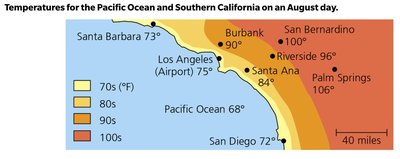
High Specific Heat: Water resists temperature changes.
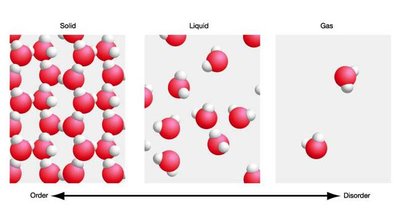
High Heat of Vaporization: Large amounts of energy are needed to convert water from liquid to gas.
Ice Floats: Solid water is less dense than liquid water due to stable hydrogen bonds.
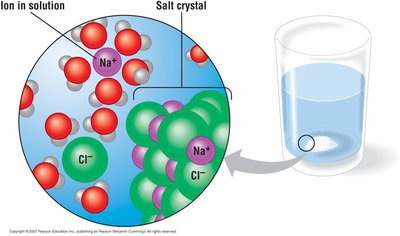
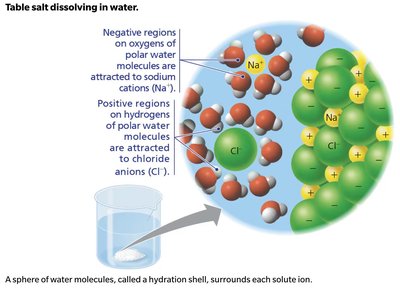
Excellent Solvent: Dissolves many polar and ionic substances.
Water as a Solvent
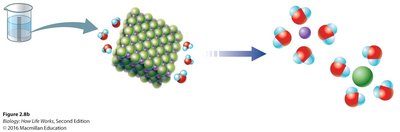
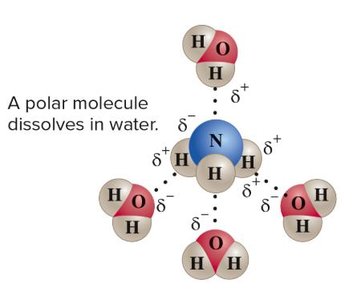
Water's polarity allows it to dissolve many substances, making it the "universal solvent" in biological systems.
Hydrophilic: Polar molecules and ions dissolve easily in water.
Hydrophobic: Nonpolar molecules do not dissolve in water.
Water forms hydration shells around ions and polar molecules, separating and surrounding them.
pH, Acids, Bases, and Buffers
Water can ionize into H+ and OH-, affecting the pH of solutions. The pH scale measures the concentration of hydrogen ions in a solution.
pH = -log10[H+]
Neutral water: [H+] = 1 × 10⁻⁷ M, pH = 7
Acids: Donate H+ (lower pH)
Bases: Accept H+ (raise pH)
Buffers: Substances that resist changes in pH by accepting or donating H+
Summary Table: Types of Bonds and Water's Role
Bond Type | Example | Role in Biology |
|---|---|---|
Polar Covalent | O-H in H2O | Creates polarity in water |
Nonpolar Covalent | C-H in CH4 | Hydrophobic interactions |
Ionic | NaCl | Dissolves in water |
Hydrogen Bond | Between H2O molecules | Emergent properties, DNA/protein structure |
Key Takeaways
Water's structure and polarity are fundamental to its biological roles.
Hydrogen bonding leads to unique properties essential for life.
pH and buffers are critical for maintaining biological function.
