뒤로
뒤로Water: Structure, Properties, and Biological Importance
스터디 가이드 - 스마트 노트
 자료에 맞춘 맞춤형 노트, 핵심 정의, 예시, 맥락을 확장해 제공합니다.
3. Water
Introduction to Water
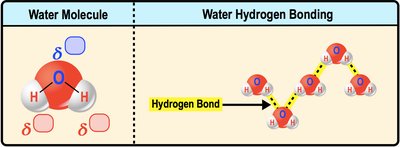
Water is a small, polar molecule essential for life, composed of two hydrogen atoms and one oxygen atom (H2O). Its unique structure and polarity give rise to several critical properties that support biological systems.
Polarity: Water molecules have partial negative (δ-) charges near the oxygen atom and partial positive (δ+) charges near the hydrogen atoms, resulting in a polar molecule.
Hydrogen Bonding: The polarity of water allows it to form hydrogen bonds between the slightly positive hydrogen of one molecule and the slightly negative oxygen of another.
Example: Water molecules are held together by hydrogen bonds, which are weaker than covalent bonds but crucial for water's properties.
Emergent Properties of Water
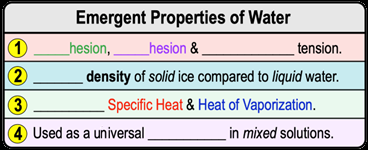
Hydrogen bonding gives water several emergent properties that are vital for life on Earth.
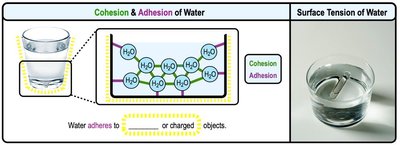
Cohesion and Adhesion: Water molecules stick to each other (cohesion) and to other substances (adhesion), contributing to surface tension.
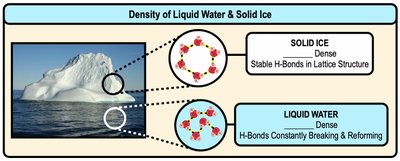
Density of Ice: Solid ice is less dense than liquid water due to the stable lattice of hydrogen bonds, causing ice to float.
High Specific Heat and Heat of Vaporization: Water resists temperature changes and requires significant energy to evaporate.
Universal Solvent: Water dissolves many substances, facilitating chemical reactions in biological systems.
Properties of Water: Cohesion & Adhesion
Cohesion and adhesion are key properties resulting from hydrogen bonding.
Cohesion: The ability of water molecules to stick to each other, leading to phenomena like surface tension.
Adhesion: The ability of water molecules to stick to other polar or charged substances.
Surface Tension: The measure of how difficult it is to break the surface of a liquid; water has high surface tension due to cohesion.
Example: A paperclip can float on water due to surface tension, and water can climb up plant vessels via cohesion and adhesion.
Properties of Water: Density
The density of water changes between its liquid and solid states, which is crucial for aquatic life.
Liquid Water: Molecules are closely packed, with hydrogen bonds constantly forming and breaking.
Solid Ice: Molecules are more spread out in a stable lattice, making ice less dense than liquid water.
Biological Importance: Ice floats, insulating the water below and allowing life to persist in aquatic environments during freezing temperatures.
Properties of Water: Thermal Properties
Water's thermal properties help regulate temperature in organisms and environments.
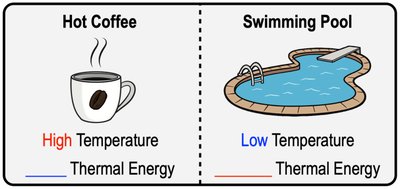
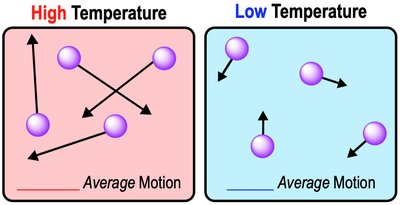
Kinetic Energy: The energy of motion in molecules; temperature measures the average kinetic energy.
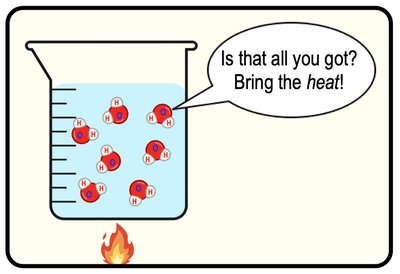
Specific Heat: The amount of heat required to raise the temperature of 1 gram of a substance by 1°C. Water's high specific heat allows it to resist temperature changes, stabilizing climates and organisms.
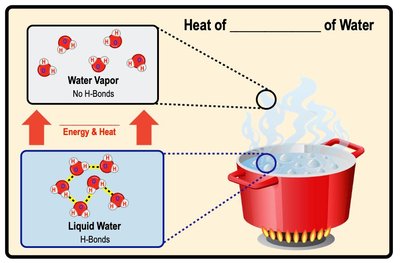
Heat of Vaporization: The amount of heat needed to convert 1 gram of liquid water to vapor. Water's high heat of vaporization enables evaporative cooling (e.g., sweating).
Example: Lakes heat up and cool down more slowly than the surrounding air, protecting aquatic life from rapid temperature changes.
Properties of Water: The Universal Solvent
Water is known as the "universal solvent" because it dissolves a wide variety of substances, facilitating chemical reactions in cells.
Solvent: The substance that dissolves another (water in biological systems).
Solute: The substance that is dissolved (e.g., salt, sugar).
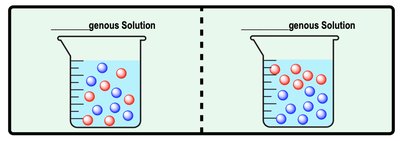
Solution: A homogeneous mixture of solute and solvent.
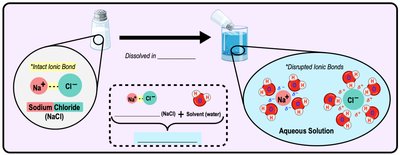
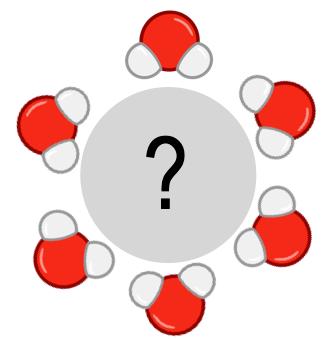
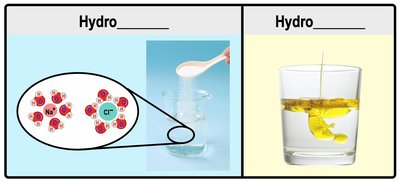
Hydration Shell: Water molecules surround and isolate ions or polar molecules, allowing them to dissolve.
Example: Table salt (NaCl) dissolves in water as Na+ and Cl- ions are surrounded by water molecules.
Homogeneous vs. Heterogeneous Solutions
Solutions can be classified based on how evenly their components are distributed.
Homogeneous Solution: Uniformly mixed; all parts are evenly distributed (e.g., saltwater).
Heterogeneous Solution: Not uniformly mixed; components are unevenly distributed (e.g., oil and water).
Hydrophilic vs. Hydrophobic Substances
Substances interact with water differently based on their polarity.
Hydrophilic: "Water-loving" substances that dissolve in water due to their polarity or charge (e.g., salts, ions).
Hydrophobic: "Water-fearing" substances that do not dissolve in water, typically nonpolar (e.g., oils, fats).
Acids and Bases
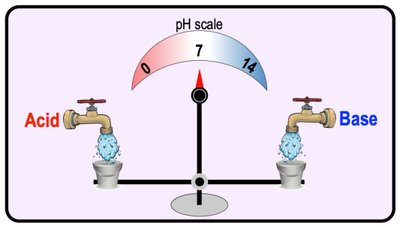
Acids and bases alter the concentration of hydrogen ions (H+) in aqueous solutions, affecting biological processes.
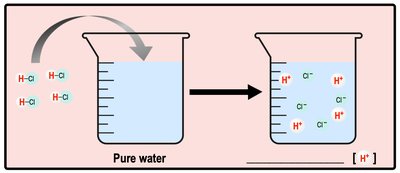
Acid: A substance that increases the concentration of H+ ions in solution (e.g., HCl).
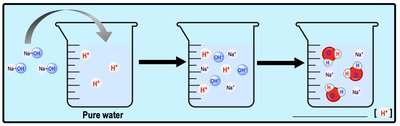
Base: A substance that decreases the concentration of H+ ions, often by releasing OH- ions (e.g., NaOH).
Example: Adding HCl to water increases [H+], making the solution acidic; adding NaOH decreases [H+], making it basic.
pH Scale
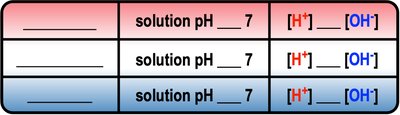
The pH scale measures the concentration of hydrogen ions in a solution, indicating its acidity or basicity.
pH: Defined as
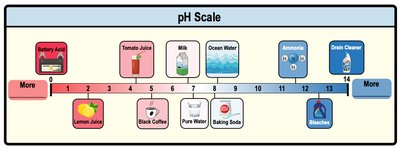
Scale: Ranges from 0 (most acidic) to 14 (most basic), with 7 being neutral.
Relationship: As [H+] increases, pH decreases (more acidic); as [H+] decreases, pH increases (more basic).
Example: Pure water has a pH of 7; lemon juice is acidic (pH ~2), while bleach is basic (pH ~13).
Buffers
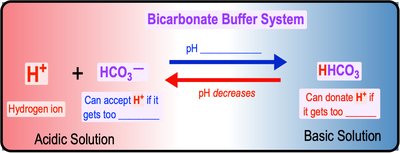
Buffers are substances that minimize changes in pH when acids or bases are added, helping organisms maintain homeostasis.
Function: Buffers can donate H+ when depleted or accept H+ when in excess.
Biological Importance: Most living organisms maintain a near-neutral pH (~7); buffers are critical for this stability.
Example: The bicarbonate buffer system in blood helps maintain pH by balancing H+ and HCO3-.