Ch. 16 - The Molecular Basis of Inheritance
Campbell - Campbell Biology 12th Edition
Urry12th EditionCampbell BiologyISBN: 9785794169850당신이 사용하는 게 아니라요?교과서 변경
16장, 문제 1

In his work with pneumonia-causing bacteria and mice, Griffith found that
a. The protein coat from pathogenic cells was able to transform nonpathogenic cells.
b. Heat-killed pathogenic cells caused pneumonia.
c. Some substance from pathogenic cells was transferred to nonpathogenic cells, making them pathogenic.
d. The polysaccharide coat of bacteria caused pneumonia.

검증된 단계별 안내
1
Understand the context of Griffith's experiment: Griffith was studying two strains of Streptococcus pneumoniae bacteria, one pathogenic (causing disease) and one nonpathogenic (harmless).
Recognize the key components of the experiment: Griffith used heat-killed pathogenic bacteria and live nonpathogenic bacteria to observe the effects on mice.
Identify the main observation: Griffith found that when he mixed heat-killed pathogenic bacteria with live nonpathogenic bacteria, the nonpathogenic bacteria became pathogenic and caused pneumonia in mice.
Analyze the implication of the experiment: This suggested that some 'transforming principle' from the dead pathogenic bacteria was transferred to the live nonpathogenic bacteria, transforming them into pathogenic bacteria.
Conclude the correct answer: Griffith's experiment demonstrated that some substance from pathogenic cells was transferred to nonpathogenic cells, making them pathogenic, which aligns with option c.

비슷한 문제에 대한 검증된 영상 답변:

이 영상 해법은 위 문제에 도움이 된다고 튜터들이 추천한 것입니다.
영상 길이:
55s
도움이 되었나요?

주요 개념

질문에 올바르게 답하기 위해 반드시 이해해야 하는 핵심 개념들은 다음과 같습니다.

Griffith's Experiment

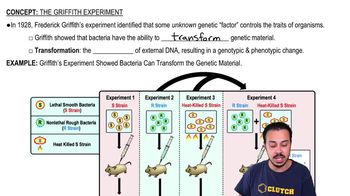
Griffith's experiment demonstrated the phenomenon of transformation, where a substance from heat-killed pathogenic bacteria could genetically alter nonpathogenic bacteria, making them pathogenic. This experiment was pivotal in suggesting that DNA might be the molecule responsible for heredity, as the transformation indicated a transfer of genetic information.
추천 영상:
가이드 코스
08:56
The Griffith Experiment

Transformation

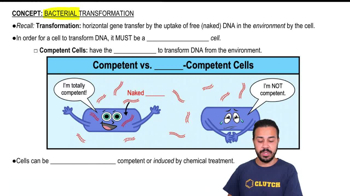
Transformation is a process where genetic material from one organism is taken up by another, leading to a change in its genotype and phenotype. In Griffith's experiment, nonpathogenic bacteria acquired the ability to cause disease after being exposed to material from dead pathogenic bacteria, indicating the transfer of genetic information.
추천 영상:
가이드 코스
03:06
Bacterial Transformation

Pathogenic vs. Nonpathogenic Bacteria

Pathogenic bacteria are capable of causing disease, while nonpathogenic bacteria do not. Griffith's experiment involved the interaction between these two types, showing that nonpathogenic bacteria could become pathogenic through the uptake of genetic material from dead pathogenic bacteria, highlighting the role of genetic material in determining bacterial virulence.
추천 영상:
가이드 코스
08:59
Pathogen Defenses