Ch. 16 - The Molecular Basis of Inheritance
Campbell - Campbell Biology 12th Edition
Urry12th EditionCampbell BiologyISBN: 9785794169850당신이 사용하는 게 아니라요?교과서 변경
16장, 문제 2

What is the basis for the difference in how the leading and lagging strands of DNA molecules are synthesized?
a. The origins of replication occur only at the 5′ end.
b. Helicases and single-strand binding proteins work at the 5′ end.
c. DNA polymerase can join new nucleotides only to the 3′ end of a pre-existing strand, and the strands are antiparallel.
d. DNA ligase works only in the 3′→5′ direction.

검증된 단계별 안내
1
Understand the structure of DNA: DNA is composed of two strands that are antiparallel, meaning one strand runs in the 5′ to 3′ direction and the other runs in the 3′ to 5′ direction.
Recognize the role of DNA polymerase: DNA polymerase is the enzyme responsible for synthesizing new DNA strands. It can only add nucleotides to the 3′ end of a pre-existing strand, which is crucial for understanding the synthesis of leading and lagging strands.
Identify the leading strand synthesis: The leading strand is synthesized continuously in the 5′ to 3′ direction as the DNA polymerase moves along the template strand, which is oriented in the 3′ to 5′ direction.
Identify the lagging strand synthesis: The lagging strand is synthesized discontinuously in short segments called Okazaki fragments. These fragments are synthesized in the 5′ to 3′ direction but require multiple starting points because the template strand runs in the 5′ to 3′ direction.
Understand the role of DNA ligase: DNA ligase is responsible for joining the Okazaki fragments on the lagging strand, creating a continuous DNA strand.

비슷한 문제에 대한 검증된 영상 답변:

이 영상 해법은 위 문제에 도움이 된다고 튜터들이 추천한 것입니다.
영상 길이:
1m

주요 개념

질문에 올바르게 답하기 위해 반드시 이해해야 하는 핵심 개념들은 다음과 같습니다.

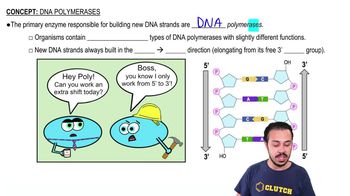
DNA Polymerase Directionality

DNA polymerase is an enzyme that synthesizes DNA molecules by adding nucleotides to a pre-existing chain. It can only add new nucleotides to the 3' end of a DNA strand, which means it synthesizes DNA in a 5' to 3' direction. This directionality is crucial for understanding why the leading and lagging strands are synthesized differently during DNA replication.
추천 영상:
04:01
DNA Polymerases

Antiparallel Strands

DNA strands are antiparallel, meaning they run in opposite directions. One strand runs 5' to 3', while the complementary strand runs 3' to 5'. This orientation is essential for DNA replication because it dictates how enzymes like DNA polymerase interact with the strands, leading to the continuous synthesis of the leading strand and the discontinuous synthesis of the lagging strand.
추천 영상:
05:15
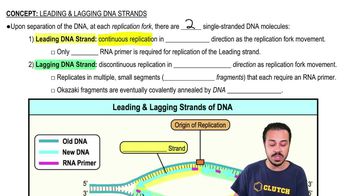
Leading & Lagging DNA Strands

Leading and Lagging Strand Synthesis

During DNA replication, the leading strand is synthesized continuously in the direction of the replication fork movement, while the lagging strand is synthesized discontinuously in short segments called Okazaki fragments. This difference arises because DNA polymerase can only add nucleotides to the 3' end, necessitating a backstitching mechanism for the lagging strand to accommodate the antiparallel nature of DNA.
추천 영상:
05:15
Leading & Lagging DNA Strands