Ch. 17 - Gene Expression: From Gene to Protein
Campbell - Campbell Biology 12th Edition
Urry12th EditionCampbell BiologyISBN: 9785794169850당신이 사용하는 게 아니라요?교과서 변경
17장, 문제 6

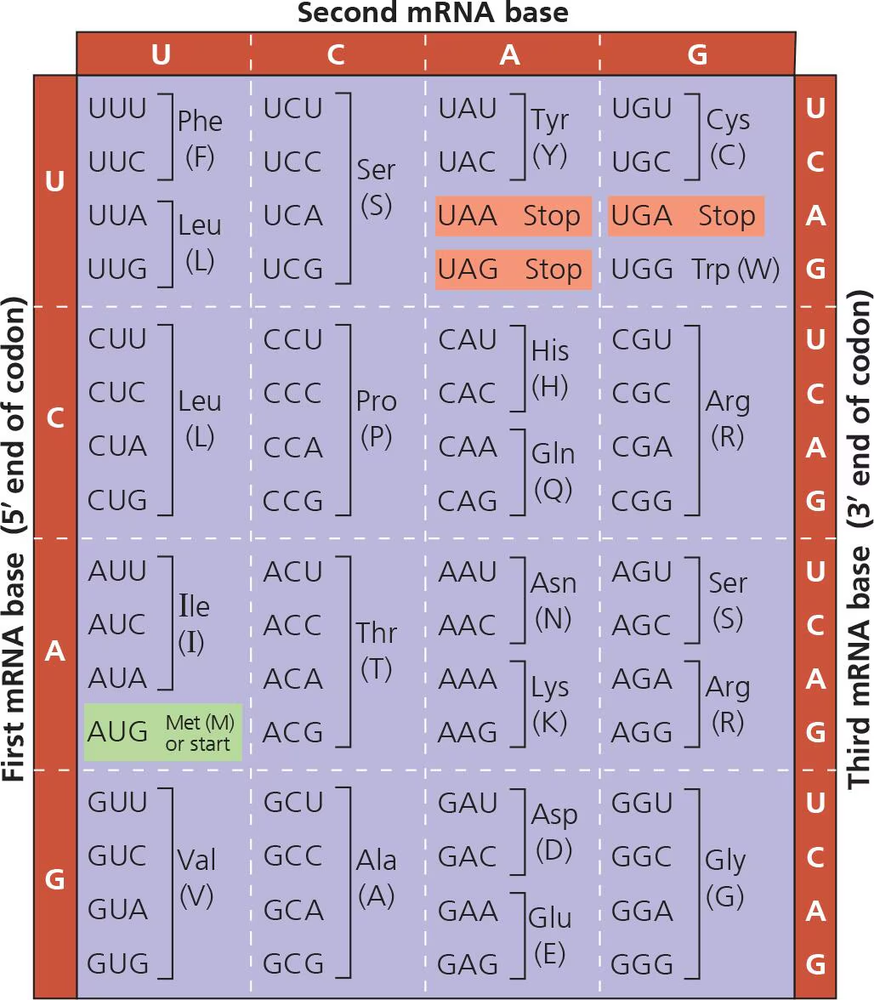
Using Figure 17.6, identify a 5′→3′ sequence of nucleotides in the DNA template strand for an mRNA coding for the polypeptide sequence Phe-Pro-Lys.


Genetic code chart showing mRNA codons for amino acids.


a. 5′-UUUCCCAAA-3′
b. 5′-GAACCCCTT-3′
c. 5′-CTTCGGGAA-3′
d. 5′-AAACCCUUU-3′

검증된 단계별 안내
1
Understand that the problem requires identifying the DNA template strand sequence that would result in an mRNA coding for the polypeptide sequence Phe-Pro-Lys.
Recall that the mRNA sequence is complementary to the DNA template strand and is synthesized in the 5′ to 3′ direction. The DNA template strand is read in the 3′ to 5′ direction.
Identify the mRNA codons for the amino acids: Phe (Phenylalanine) is coded by UUU or UUC, Pro (Proline) is coded by CCU, CCC, CCA, or CCG, and Lys (Lysine) is coded by AAA or AAG.
Construct the mRNA sequence from the given polypeptide sequence: Phe-Pro-Lys could be coded by the mRNA sequence 5′-UUUCCCAAA-3′.
Determine the complementary DNA template strand sequence by replacing each mRNA nucleotide with its complementary DNA base: A (adenine) with T (thymine), U (uracil) with A, C (cytosine) with G (guanine), and G with C. The complementary DNA sequence for the mRNA 5′-UUUCCCAAA-3′ is 3′-AAAGGGTTT-5′, which corresponds to the 5′-TTTGGGAAA-3′ when written in the 5′ to 3′ direction.

비슷한 문제에 대한 검증된 영상 답변:

이 영상 해법은 위 문제에 도움이 된다고 튜터들이 추천한 것입니다.
영상 길이:
1m
도움이 되었나요?

주요 개념

질문에 올바르게 답하기 위해 반드시 이해해야 하는 핵심 개념들은 다음과 같습니다.

DNA Template Strand

The DNA template strand is the sequence of DNA that is used as a template for RNA synthesis during transcription. It is complementary to the mRNA strand, meaning that the mRNA is synthesized in the 5′ to 3′ direction using the template strand's 3′ to 5′ sequence. Understanding this concept is crucial for determining the correct nucleotide sequence that codes for a specific polypeptide.
추천 영상:
05:15
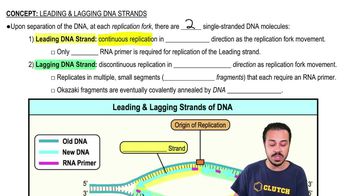
Leading & Lagging DNA Strands

Codon and Anticodon

A codon is a sequence of three nucleotides on mRNA that corresponds to a specific amino acid or stop signal during protein synthesis. The anticodon is the complementary sequence on tRNA that pairs with the mRNA codon during translation. Recognizing codon sequences for amino acids like Phe, Pro, and Lys is essential for identifying the correct DNA template sequence.
추천 영상:
07:20
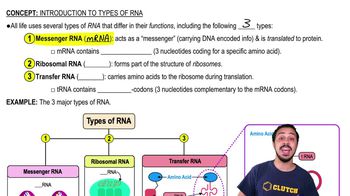
Introduction to Types of RNA

Transcription and Translation

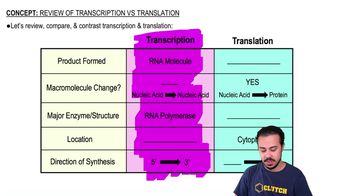
Transcription is the process of synthesizing mRNA from a DNA template, while translation is the process of decoding mRNA to build a polypeptide chain. These processes involve converting nucleotide sequences into amino acid sequences, which is fundamental for understanding how a DNA sequence can code for a specific polypeptide sequence like Phe-Pro-Lys.
추천 영상:
04:07
Review of Transcription vs. Translation