Ch. 19 - Viruses
Campbell - Campbell Biology 12th Edition
Urry12th EditionCampbell BiologyISBN: 9785794169850당신이 사용하는 게 아니라요?교과서 변경
19장, 문제 6

Redraw Figure 19.8 to show the replicative cycle of a virus with a single-stranded genome that can function as mRNA (a class IV virus).

검증된 단계별 안내
1
Begin by drawing the virus particle, which includes a protein coat (capsid) surrounding a single-stranded RNA genome. Label this as the 'Class IV virus'.
Illustrate the virus attaching to a host cell. This is typically shown by the virus binding to specific receptors on the host cell's surface.
Depict the entry of the viral RNA into the host cell. This can occur through direct injection or endocytosis, where the virus is engulfed by the cell membrane.
Show the viral RNA being used directly as mRNA by the host cell's ribosomes. This step involves the translation of viral proteins necessary for replication and assembly.
Finally, illustrate the assembly of new virus particles within the host cell. The newly synthesized viral RNA and proteins come together to form new virions, which are then released from the host cell to infect other cells.

비슷한 문제에 대한 검증된 영상 답변:

이 영상 해법은 위 문제에 도움이 된다고 튜터들이 추천한 것입니다.
영상 길이:
38s

주요 개념

질문에 올바르게 답하기 위해 반드시 이해해야 하는 핵심 개념들은 다음과 같습니다.

Class IV Virus

Class IV viruses are single-stranded RNA viruses whose genomes can directly function as mRNA. This means that upon entering a host cell, their RNA can be immediately translated by the host's ribosomes into viral proteins, facilitating rapid replication and infection processes.
추천 영상:
00:52
Classes of Signaling Receptors

Viral Replicative Cycle

The viral replicative cycle involves several stages: attachment, entry, replication, assembly, and release. For a Class IV virus, the cycle begins with the virus attaching to the host cell, followed by entry where the viral RNA is released into the cytoplasm, serving as mRNA for protein synthesis, leading to the assembly of new virions and their release from the host cell.
추천 영상:
13:59
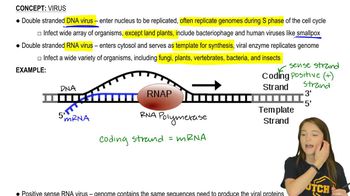
Viral Genetics

mRNA Functionality

mRNA, or messenger RNA, is crucial for protein synthesis as it carries genetic information from DNA to ribosomes, where it is translated into proteins. In the context of Class IV viruses, the viral RNA itself acts as mRNA, bypassing transcription and directly engaging the host's ribosomal machinery to produce viral proteins necessary for replication.
추천 영상:
06:04
Functional Groups