Ch. 33 - An introduction to Invertebrates
Campbell - Campbell Biology 12th Edition
Urry12th EditionCampbell BiologyISBN: 9785794169850당신이 사용하는 게 아니라요?교과서 변경
33장, 문제 6

In Figure 33.7, assume that the two medusae shown at step 4 were produced by one polyp colony. Review Concept 12.1 and Concept 13.3, and then use your understanding of mitosis and meiosis to select which of the following is true.
a. Both the medusae and the gametes are genetically identical.
b. Neither the medusae nor the gametes are genetically identical.
c. The medusae are not genetically identical but the gametes are genetically identical.
d. The medusae are genetically identical but the gametes differ genetically.

검증된 단계별 안내
1
Review Concept 12.1, which covers mitosis, a process where a single cell divides to produce two genetically identical daughter cells. This is important for understanding how the medusae could be genetically identical if they are produced by mitosis.
Review Concept 13.3, which covers meiosis, a process that results in four genetically diverse gametes. This is crucial for understanding how gametes can differ genetically.
Consider the life cycle of cnidarians, which includes both a polyp stage and a medusa stage. The medusae are typically produced asexually from the polyp colony through mitosis, leading to genetic identicality.
Understand that gametes are produced through meiosis, which involves genetic recombination and results in genetically diverse gametes.
Based on the understanding of mitosis and meiosis, determine which statement is true: (A) Both the medusae and the gametes are genetically identical, (B) Neither the medusae nor the gametes are genetically identical, (C) The medusae are not genetically identical but the gametes are genetically identical, or (D) The medusae are genetically identical but the gametes differ genetically.

비슷한 문제에 대한 검증된 영상 답변:

이 영상 해법은 위 문제에 도움이 된다고 튜터들이 추천한 것입니다.
영상 길이:
4m

주요 개념

질문에 올바르게 답하기 위해 반드시 이해해야 하는 핵심 개념들은 다음과 같습니다.

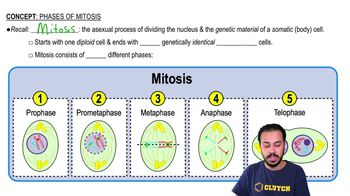
Mitosis

Mitosis is a type of cell division that results in two daughter cells, each having the same number and kind of chromosomes as the parent nucleus. It is essential for growth, repair, and asexual reproduction in organisms. In the context of the question, mitosis would be responsible for producing genetically identical medusae from a single polyp colony.
추천 영상:
03:21
Phases of Mitosis

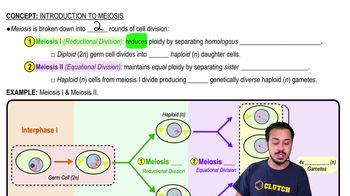
Meiosis

Meiosis is a specialized form of cell division that reduces the chromosome number by half, resulting in four genetically diverse gametes. This process is crucial for sexual reproduction and genetic diversity. In the scenario described, meiosis would lead to the production of gametes that are not genetically identical, contributing to genetic variation.
추천 영상:
04:49
Meiosis I & Meiosis II

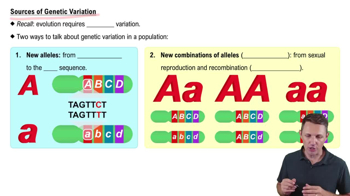
Genetic Variation

Genetic variation refers to the differences in DNA sequences among individuals within a population. It is a result of processes like meiosis, which includes crossing over and independent assortment. In the context of the question, understanding genetic variation helps explain why gametes produced through meiosis are not genetically identical, unlike the medusae produced through mitosis.
추천 영상:
가이드 코스
02:16
Sources of Genetic Variation