Ch. 40 - Basic Principles of Animal Form and Function
Campbell - Campbell Biology 12th Edition
Urry12th EditionCampbell BiologyISBN: 9785794169850당신이 사용하는 게 아니라요?교과서 변경
40장, 문제 5

An animal's inputs of energy and materials would exceed its outputs
a. If the animal is an endotherm, which must always take in more energy because of its high metabolic rate
b. If it is actively foraging for food
c. If it is growing and increasing its mass
d. Never; due to homeostasis, these energy and material budgets always balance

검증된 단계별 안내
1
Understand the concept of energy balance in animals: Energy balance refers to the relationship between the energy an animal takes in (through food) and the energy it expends (through activities and metabolic processes).
Consider the conditions under which an animal might take in more energy than it expends: This typically occurs during periods of growth, when the animal is building new tissues and increasing its mass.
Evaluate the options given in the problem: a) Endotherms have high metabolic rates, but this doesn't necessarily mean their energy input exceeds output. b) Actively foraging animals expend energy, which might not lead to a net gain. c) Growing animals require more energy for building tissues, which can lead to energy input exceeding output. d) Homeostasis aims for balance, but doesn't account for growth phases.
Focus on option c: Growing animals are in a phase where they are increasing their mass, which requires additional energy and materials beyond their immediate metabolic needs.
Conclude that during growth, an animal's energy and material inputs can exceed its outputs, as it is storing energy and materials for building new tissues.

비슷한 문제에 대한 검증된 영상 답변:

이 영상 해법은 위 문제에 도움이 된다고 튜터들이 추천한 것입니다.
영상 길이:
2m
도움이 되었나요?

주요 개념

질문에 올바르게 답하기 위해 반드시 이해해야 하는 핵심 개념들은 다음과 같습니다.

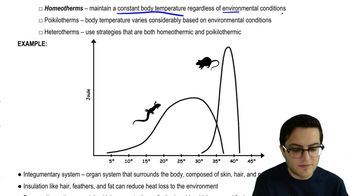
Endothermy

Endothermy refers to the physiological capability of an organism to maintain a stable internal body temperature through metabolic activity. Endotherms, such as mammals and birds, have high metabolic rates to generate heat, requiring substantial energy intake to sustain their body temperature, especially in varying environmental conditions.
추천 영상:
09:51
Thermoregulation

Energy Balance in Growth

During growth, an organism's energy and material inputs often exceed outputs as it accumulates biomass. This surplus is necessary for synthesizing new tissues and supporting increased metabolic demands. Growth phases require additional nutrients and energy, leading to a positive energy balance until the organism reaches maturity.
추천 영상:
06:53
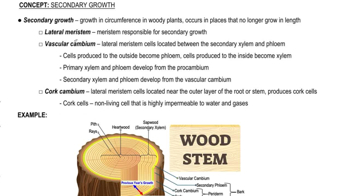
Secondary Growth

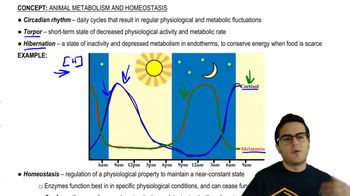
Homeostasis

Homeostasis is the process by which biological systems maintain stability while adjusting to changing external conditions. It involves regulatory mechanisms that balance inputs and outputs of energy and materials to sustain optimal internal conditions. However, during certain life stages or activities, temporary imbalances can occur, such as during growth or intense physical activity.
추천 영상:
11:49
Homeostasis
관련 실천
교과서 질문

Which of the following animals uses the largest percentage of its energy budget for homeostatic regulation?

a. Marine jelly (an invertebrate)

b. Snake in a temperate forest

c. Desert insect

d. Desert bird

885
views
교과서 질문

You are studying a large tropical reptile that has a high and relatively stable body temperature. How do you determine whether this animal is an endotherm or an ectotherm?

a. You know from its high and stable body temperature that it must be an endotherm.

b. You subject this reptile to various temperatures in the lab and find that its body temperature and metabolic rate change with the ambient temperature. You conclude that it is an ectotherm.

c. You note that its environment has a high and stable temperature. Because its body temperature matches the environmental temperature, you conclude that it is an ectotherm.

d. You measure the metabolic rate of the reptile, and because it is higher than that of a related species that lives in temperate forests, you conclude that this reptile is an endotherm and its relative is an ectotherm.

1746
views
교과서 질문

Consider the energy budgets for a human, an elephant, a penguin, a mouse, and a snake. The would have the highest total annual energy expenditure, and the would have the highest energy expenditure per unit mass.

a. Elephant; mouse

b. Elephant; human

c. Mouse; snake

d. Penguin; mouse

876
views
교과서 질문

Compared with a smaller cell, a larger cell of the same shape has

a. Less surface area

b. Less surface area per unit of volume

c. The same surface-area-to-volume ratio

d. A smaller cytoplasm-to-nucleus ratio

1602
views
교과서 질문

Which of the following would increase the rate of heat exchange between an animal and its environment?

a. Feathers or fur

b. Vasoconstriction

c. Wind blowing across the body surface

d. Countercurrent heat exchanger

1210
views
교과서 질문

Draw a model of the control circuit(s) required for driving an automobile at a fairly constant speed over a hilly road. Indicate each feature that represents a sensor, stimulus, or response.

711
views