
Ch. 40 - Basic Principles of Animal Form and Function
Campbell - Campbell Biology 12th Edition
Urry12th EditionCampbell BiologyISBN: 9785794169850당신이 사용하는 게 아니라요?교과서 변경
40장, 문제 2

Which of the following would increase the rate of heat exchange between an animal and its environment?
a. Feathers or fur
b. Vasoconstriction
c. Wind blowing across the body surface
d. Countercurrent heat exchanger

검증된 단계별 안내
1
Understand the concept of heat exchange: Heat exchange between an animal and its environment can occur through conduction, convection, radiation, and evaporation. Factors that increase heat exchange typically enhance one or more of these processes.
Analyze each option: Consider how each option affects heat exchange. Feathers or fur (option a) typically insulate and reduce heat exchange. Vasoconstriction (option b) reduces blood flow to the skin, decreasing heat exchange. Wind blowing across the body surface (option c) increases convection, enhancing heat exchange. A countercurrent heat exchanger (option d) is a mechanism that conserves heat rather than increasing exchange.
Focus on convection: Wind blowing across the body surface increases the rate of heat exchange by enhancing convection. Convection is the transfer of heat through the movement of fluids (air or water) across a surface.
Consider environmental factors: Wind increases the rate of heat exchange by removing the boundary layer of air around the body, allowing for more rapid heat loss or gain depending on the temperature of the wind relative to the body.
Conclude with the most effective option: Based on the analysis, wind blowing across the body surface (option c) is the factor that would most likely increase the rate of heat exchange between an animal and its environment.

비슷한 문제에 대한 검증된 영상 답변:

이 영상 해법은 위 문제에 도움이 된다고 튜터들이 추천한 것입니다.
영상 길이:
1m
도움이 되었나요?

주요 개념

질문에 올바르게 답하기 위해 반드시 이해해야 하는 핵심 개념들은 다음과 같습니다.

Heat Exchange

Heat exchange refers to the process by which heat is transferred between an animal and its environment. This can occur through various mechanisms such as conduction, convection, radiation, and evaporation. Understanding how these processes work is crucial for determining factors that affect the rate of heat exchange.
추천 영상:
05:55
Gas Exchange and Breathing

Convection

Convection is the transfer of heat through the movement of fluids or gases. When wind blows across the body surface, it enhances convection by moving warm air away from the body and replacing it with cooler air, thereby increasing the rate of heat exchange between the animal and its environment.

Countercurrent Heat Exchange

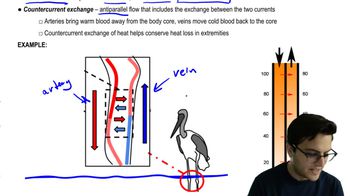
Countercurrent heat exchange is a mechanism where heat is transferred between fluids flowing in opposite directions. This system is efficient in minimizing heat loss, as seen in animals like birds and fish, where blood vessels are arranged to conserve heat. Understanding this concept helps in analyzing how it affects heat exchange rates.
추천 영상:
06:28
Countercurrent Exchange