
교과서 질문
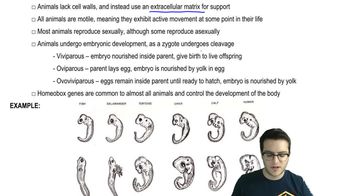
Which of the following is common to the development of both birds and mammals?
a. Holoblastic cleavage
b. Epiblast and hypoblast
c. Trophoblast
d. Gray crescent
876
views
 검증된 단계별 안내
 06:04
06:04
 05:58
05:58 07:18
07:18Which of the following is common to the development of both birds and mammals?
a. Holoblastic cleavage
b. Epiblast and hypoblast
c. Trophoblast
d. Gray crescent
In humans, identical twins are possible because
a. Extraembryonic cells interact with the zygote nucleus.
b. Convergent extension occurs.
c. Early blastomeres can form a complete embryo if isolated.
d. The gray crescent divides the dorsal-ventral axis into new cells.
Cells transplanted from the neural tube of a frog embryo to the ventral part of another embryo develop into nervous system tissues. This result indicates that the transplanted cells were
a. Totipotent.
b. Determined.
c. Differentiated.
d. Mesenchymal.
If an egg cell were treated with EDTA, a chemical that binds calcium and magnesium ions,
a. The acrosomal reaction would be blocked.
b. The fusion of sperm and egg nuclei would be blocked.
c. The fast block to polyspermy would not occur.
d. The fertilization envelope would not form.
The archenteron develops into
a. The mesoderm.
b. The endoderm.
c. The placenta.
d. The lumen of the digestive tract.
The cortical reaction of sea urchin eggs functions directly in
a. The formation of a fertilization envelope.
b. The production of a fast block to polyspermy.
c. The generation of an electrical impulse by the egg.
d. The fusion of egg and sperm nuclei.