Ch. 48 - Neurons, Synapses, and Signaling
Campbell - Campbell Biology 12th Edition
Urry12th EditionCampbell BiologyISBN: 9785794169850당신이 사용하는 게 아니라요?교과서 변경
48장, 문제 1

What happens when a resting neuron's membrane depolarizes?
a. There is a net diffusion of Na⁺ out of the cell
b. The equilibrium potential for K⁺ (Eₖ) becomes more positive
c. The neuron's membrane voltage becomes more positive
d. The cell's inside is more negative than the outside

검증된 단계별 안내
1
Understand the concept of depolarization: Depolarization refers to the process by which the membrane potential of a neuron becomes less negative (more positive) compared to the resting potential.
Identify the resting potential: A resting neuron's membrane potential is typically around -70 mV, which means the inside of the neuron is more negative compared to the outside.
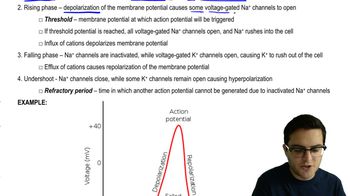
Consider the movement of ions: During depolarization, sodium ions (Na+) flow into the neuron, reducing the negative charge inside the cell and making the membrane potential more positive.
Evaluate the options: Analyze each option in the context of depolarization. Option c, 'The neuron's membrane voltage becomes more positive,' aligns with the definition of depolarization.
Conclude the correct choice: Based on the understanding of depolarization, the correct answer is option c, as depolarization results in a more positive membrane voltage.

비슷한 문제에 대한 검증된 영상 답변:

이 영상 해법은 위 문제에 도움이 된다고 튜터들이 추천한 것입니다.
영상 길이:
48s
도움이 되었나요?

주요 개념

질문에 올바르게 답하기 위해 반드시 이해해야 하는 핵심 개념들은 다음과 같습니다.

Neuron Membrane Depolarization

Depolarization of a neuron's membrane occurs when the membrane potential becomes less negative, moving towards zero. This is typically due to the influx of sodium ions (Na+) into the cell, which reduces the difference in charge between the inside and outside of the neuron, making the inside less negative compared to the resting state.
추천 영상:

Membrane Voltage

Membrane voltage, or membrane potential, refers to the electrical potential difference across a cell's membrane. In neurons, this voltage changes during depolarization, becoming more positive as sodium ions enter the cell. This shift is crucial for the initiation and propagation of action potentials, which are essential for nerve signal transmission.
추천 영상:
가이드 코스
06:04
Biological Membranes

Equilibrium Potential

The equilibrium potential is the membrane potential at which there is no net flow of a particular ion across the membrane. For potassium ions (K+), the equilibrium potential is typically negative. During depolarization, the focus is on sodium ions, and the equilibrium potential for K+ does not become more positive; rather, the overall membrane potential becomes more positive due to Na+ influx.
추천 영상:
가이드 코스
09:55
Action Potential