
Ch. 5 - The Structure and Function of Large Biological Molecules
Campbell - Campbell Biology 12th Edition
Urry12th EditionCampbell BiologyISBN: 9785794169850당신이 사용하는 게 아니라요?교과서 변경
5장, 문제 8

Construct a table that organizes the following terms, and label the columns and rows.
Monosaccharides
Fatty acids
Amino acids
Nucleotides
Polypeptides
Triacylglycerols
Polynucleotides
Polysaccharides
Phosphodiester linkages
Peptide bonds
Glycosidic linkages
Ester linkages

검증된 단계별 안내
1
Identify the terms that need to be organized in the table. This could include biological concepts, processes, or structures.
Determine the criteria for organizing these terms. Consider what categories or classifications are relevant, such as function, location, or type.
Label the columns and rows based on the criteria you have chosen. For example, if organizing cell organelles, columns could be labeled 'Organelle Name', 'Function', and 'Location in Cell'.
Place each term in the appropriate cell of the table according to the labels. Ensure that each term is correctly categorized based on the criteria.
Review the table to ensure clarity and accuracy. Make adjustments if necessary to improve the organization or labeling.

비슷한 문제에 대한 검증된 영상 답변:

이 영상 해법은 위 문제에 도움이 된다고 튜터들이 추천한 것입니다.
영상 길이:
35s
도움이 되었나요?

주요 개념

질문에 올바르게 답하기 위해 반드시 이해해야 하는 핵심 개념들은 다음과 같습니다.

Data Organization

Data organization involves arranging information systematically to enhance clarity and accessibility. In biology, this often means categorizing terms or data points into tables or charts, which helps in identifying relationships and patterns. Proper labeling of columns and rows is crucial for effective data interpretation.
추천 영상:
가이드 코스
06:52
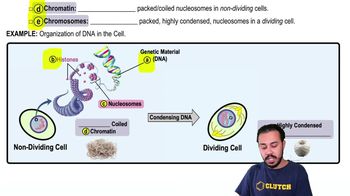
Organization of DNA in the Cell

Table Construction

Table construction is the process of creating a structured format to display data. It involves defining columns and rows to categorize information logically. In biology, tables are used to compare and contrast different biological terms or data, facilitating easier analysis and understanding of complex information.
추천 영상:

Labeling Techniques

Labeling techniques refer to the methods used to assign names or titles to columns and rows in a table. Effective labeling is essential for clarity, ensuring that each term or data point is easily identifiable. In biology, labels should be precise and descriptive to accurately reflect the content and aid in comprehension.
추천 영상:
가이드 코스
03:31
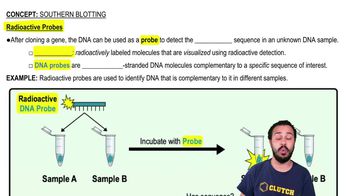
Southern Blotting
관련 실천
교과서 질문

Copy the polynucleotide strand in Figure 5.23a and label the bases G, T, C, and T, starting from the 5′ end. Assuming this is a DNA polynucleotide, now draw the complementary strand, using the same symbols for phosphates (circles), sugars (pentagons), and bases. Label the bases. Draw arrows showing the 5'→3' direction of each strand. Use the arrows to make sure the second strand is antiparallel to the first.

Hint: After you draw the first strand vertically, turn the paper upside down; it is easier to draw the second strand from the 5′ toward the 3′ direction as you go from top to bottom.

1965
views
교과서 질문

Which of the following pairs of base sequences could form a short stretch of a normal double helix of DNA?

a. 5′-AGCT-3′ with 5′-TCGA-3′

b. 5′-GCGC-3′ with 5′-TATA-3′

c. 5′-ATGC-3′ with 5′-GCAT-3′

d. All of these pairs are correct.

3757
views
교과서 질문

Enzymes that break down DNA catalyze the hydrolysis of the covalent bonds that join nucleotides together. What would happen to DNA molecules treated with these enzymes?

a. The two strands of the double helix would separate.

b. The phosphodiester linkages of the polynucleotide backbone would be broken.

c. The pyrimidines would be separated from the deoxyribose sugars.

d. All bases would be separated from the deoxyribose sugars.

3754
views
교과서 질문

The molecular formula for glucose is C6H12O6. What would be the molecular formula for a polymer made by linking ten glucose molecules together by dehydration reactions?

a. C60H120O60

b. C60H102O51

c. C60H100O50

d. C60H111O51

5988
views