Ch. 5 - The Structure and Function of Large Biological Molecules
Campbell - Campbell Biology 12th Edition
Urry12th EditionCampbell BiologyISBN: 9785794169850당신이 사용하는 게 아니라요?교과서 변경
5장, 문제 7

Which of the following pairs of base sequences could form a short stretch of a normal double helix of DNA?
a. 5′-AGCT-3′ with 5′-TCGA-3′
b. 5′-GCGC-3′ with 5′-TATA-3′
c. 5′-ATGC-3′ with 5′-GCAT-3′
d. All of these pairs are correct.

검증된 단계별 안내
1
Understand the basic principle of DNA base pairing: In a DNA double helix, adenine (A) pairs with thymine (T), and cytosine (C) pairs with guanine (G).
Examine option a: 5′-AGCT-3′ with 5′-TCGA-3′. Check if each base pairs correctly according to the base pairing rules: A with T, G with C, C with G, and T with A.
Examine option b: 5′-GCGC-3′ with 5′-TATA-3′. Check if each base pairs correctly: G with C, C with G, G with C, and C with G. Notice that T does not pair with G, and A does not pair with C.
Examine option c: 5′-ATGC-3′ with 5′-GCAT-3′. Check if each base pairs correctly: A with T, T with A, G with C, and C with G.
Determine which pair(s) follow the correct base pairing rules and conclude whether one or more pairs can form a normal double helix of DNA.

비슷한 문제에 대한 검증된 영상 답변:

이 영상 해법은 위 문제에 도움이 된다고 튜터들이 추천한 것입니다.
영상 길이:
1m

주요 개념

질문에 올바르게 답하기 위해 반드시 이해해야 하는 핵심 개념들은 다음과 같습니다.

DNA Structure

DNA is composed of two strands forming a double helix, where each strand consists of nucleotides with bases adenine (A), thymine (T), cytosine (C), and guanine (G). The strands are antiparallel, meaning they run in opposite directions, which is crucial for base pairing and the overall structure of DNA.
추천 영상:
04:41
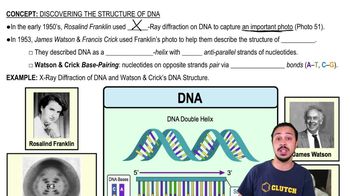
Discovering the Structure of DNA

Base Pairing Rules

In DNA, base pairing follows specific rules: adenine (A) pairs with thymine (T) via two hydrogen bonds, and cytosine (C) pairs with guanine (G) via three hydrogen bonds. These complementary base pairs are essential for the stability and replication of the DNA double helix.
추천 영상:
04:33
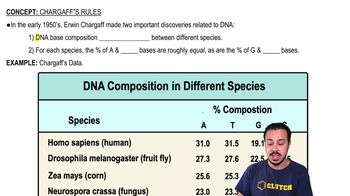
Chargaff's Rules

Antiparallel Orientation

The antiparallel orientation of DNA strands means one strand runs in the 5′ to 3′ direction, while the complementary strand runs in the 3′ to 5′ direction. This orientation is necessary for proper base pairing and the formation of the double helix, ensuring the strands align correctly for replication and transcription.
추천 영상:
04:41
Discovering the Structure of DNA
관련 실천
교과서 질문

The structural level of a protein least affected by a disruption in hydrogen bonding is the

a. Primary level.

b. Secondary level.

c. Tertiary level.

d. Quaternary level.

3240
views
교과서 질문

Copy the polynucleotide strand in Figure 5.23a and label the bases G, T, C, and T, starting from the 5′ end. Assuming this is a DNA polynucleotide, now draw the complementary strand, using the same symbols for phosphates (circles), sugars (pentagons), and bases. Label the bases. Draw arrows showing the 5'→3' direction of each strand. Use the arrows to make sure the second strand is antiparallel to the first.

Hint: After you draw the first strand vertically, turn the paper upside down; it is easier to draw the second strand from the 5′ toward the 3′ direction as you go from top to bottom.

2059
views
교과서 질문

Construct a table that organizes the following terms, and label the columns and rows.

Monosaccharides

Fatty acids

Amino acids

Nucleotides

Polypeptides

Triacylglycerols

Polynucleotides

Polysaccharides

Phosphodiester linkages

Peptide bonds

Glycosidic linkages

Ester linkages

1732
views
교과서 질문

Enzymes that break down DNA catalyze the hydrolysis of the covalent bonds that join nucleotides together. What would happen to DNA molecules treated with these enzymes?

a. The two strands of the double helix would separate.

b. The phosphodiester linkages of the polynucleotide backbone would be broken.

c. The pyrimidines would be separated from the deoxyribose sugars.

d. All bases would be separated from the deoxyribose sugars.

3813
views
교과서 질문

The molecular formula for glucose is C6H12O6. What would be the molecular formula for a polymer made by linking ten glucose molecules together by dehydration reactions?

a. C60H120O60

b. C60H102O51

c. C60H100O50

d. C60H111O51

6233
views