Ch. 7 - Membrane Structure and Function
Campbell - Campbell Biology 12th Edition
Urry12th EditionCampbell BiologyISBN: 9785794169850당신이 사용하는 게 아니라요?교과서 변경
7장, 문제 6

An artificial 'cell' consisting of an aqueous solution enclosed in a selectively permeable membrane is immersed in a beaker containing a different solution, the 'environment,' as shown in the accompanying diagram. The membrane is permeable to water and to the simple sugars glucose and fructose but impermeable to the disaccharide sucrose.
Diagram of a cell in a beaker showing solute concentrations and membrane permeability for osmosis study.
a. Draw solid arrows to indicate the net movement of solutes into and/or out of the cell.
b. Is the solution outside the cell isotonic, hypotonic, or hypertonic?
c. Draw a dashed arrow to show the net osmosis, if any.
d. Will the artificial cell become more flaccid, more turgid, or stay the same?
e. Eventually, will the two solutions have the same or different solute concentrations?

검증된 단계별 안내
1
Examine the diagram to identify the solutes present inside and outside the artificial cell. Note that the membrane is permeable to water, glucose, and fructose, but not to sucrose.
Determine the concentration gradient for each permeable solute (glucose and fructose) across the membrane. Solutes will move from areas of higher concentration to areas of lower concentration.
Draw solid arrows on the diagram to indicate the net movement of glucose and fructose based on their concentration gradients. If glucose is more concentrated inside the cell, draw an arrow pointing outwards, and vice versa for fructose.
Assess the tonicity of the solution outside the cell by comparing the total solute concentration inside and outside the cell. If the external solution has a higher solute concentration, it is hypertonic; if lower, hypotonic; if equal, isotonic.
Draw a dashed arrow to represent the net movement of water (osmosis) based on the tonicity assessment. Water will move towards the area with higher solute concentration. Determine if the cell will become more flaccid (losing water), more turgid (gaining water), or stay the same, and predict whether the solute concentrations will eventually equalize.

비슷한 문제에 대한 검증된 영상 답변:

이 영상 해법은 위 문제에 도움이 된다고 튜터들이 추천한 것입니다.
영상 길이:
4m
도움이 되었나요?

주요 개념

질문에 올바르게 답하기 위해 반드시 이해해야 하는 핵심 개념들은 다음과 같습니다.

Selective Permeability

Selective permeability refers to the ability of a membrane to allow certain molecules or ions to pass through it while blocking others. In the context of the artificial cell, the membrane permits the passage of water, glucose, and fructose but restricts sucrose, influencing the movement of solutes and water between the cell and its environment.
추천 영상:
04:43
Natural Selection

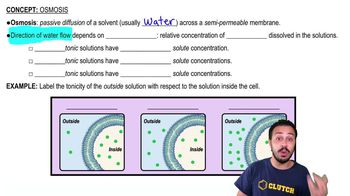
Osmosis

Osmosis is the movement of water across a selectively permeable membrane from a region of lower solute concentration to a region of higher solute concentration. This process aims to equalize solute concentrations on both sides of the membrane, affecting the cell's turgidity and the net movement of water in the artificial cell scenario.
추천 영상:

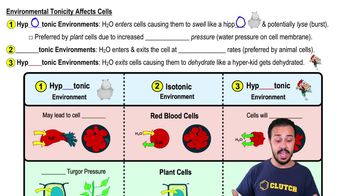
Tonicity

Tonicity describes the relative concentration of solutes in two solutions separated by a membrane, determining the direction of water movement. Solutions can be isotonic, hypotonic, or hypertonic, affecting whether the artificial cell becomes more turgid, flaccid, or remains unchanged based on the solute concentration gradient between the cell and its environment.
추천 영상:
가이드 코스
10:15
Environmental Tonicity Affects Cells