Ch. 7 - Membrane Structure and Function
Campbell - Campbell Biology 12th Edition
Urry12th EditionCampbell BiologyISBN: 9785794169850당신이 사용하는 게 아니라요?교과서 변경
7장, 문제 4

Which of the following processes includes all the others?
a. Osmosis
b. Diffusion of a solute across a membrane
c. Passive transport
d. Transport of an ion down its electrochemical gradient

검증된 단계별 안내
1
Begin by understanding the concept of passive transport. Passive transport is the movement of substances across cell membranes without the need for energy input. It relies on the concentration gradient of the substances.
Recognize that osmosis is a specific type of passive transport. It refers to the movement of water molecules across a selectively permeable membrane from an area of lower solute concentration to an area of higher solute concentration.
Identify that diffusion of a solute across a membrane is another form of passive transport. It involves the movement of solute molecules from an area of higher concentration to an area of lower concentration, following the concentration gradient.
Understand that the transport of an ion down its electrochemical gradient is also a type of passive transport. This process involves ions moving across a membrane due to both concentration differences and electrical charge differences.
Conclude that passive transport is the overarching process that includes osmosis, diffusion of a solute across a membrane, and transport of an ion down its electrochemical gradient, as all these processes occur without the input of energy and rely on gradients.

비슷한 문제에 대한 검증된 영상 답변:

이 영상 해법은 위 문제에 도움이 된다고 튜터들이 추천한 것입니다.
영상 길이:
1m
도움이 되었나요?

주요 개념

질문에 올바르게 답하기 위해 반드시 이해해야 하는 핵심 개념들은 다음과 같습니다.

Passive Transport

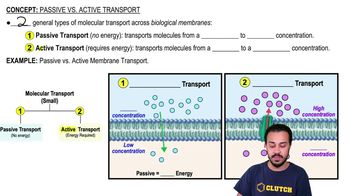
Passive transport is the movement of substances across cell membranes without the need for energy input. It relies on the concentration gradient, allowing molecules to move from areas of high concentration to low concentration. This includes processes like diffusion, osmosis, and facilitated diffusion, making it a broad category encompassing other transport mechanisms.
추천 영상:
가이드 코스
04:18
Passive vs. Active Transport

Diffusion

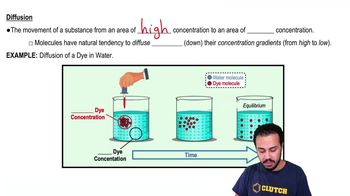
Diffusion is the process by which molecules spread from areas of high concentration to areas of low concentration. It is a fundamental mechanism of passive transport and can occur across cell membranes when molecules are small enough or when facilitated by specific proteins. Diffusion is essential for the distribution of nutrients and gases within biological systems.
추천 영상:

Osmosis

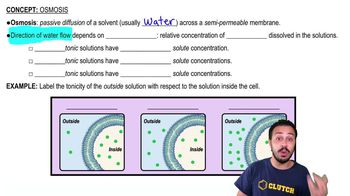
Osmosis is a specific type of diffusion that involves the movement of water molecules across a selectively permeable membrane. It occurs when there is a difference in solute concentration on either side of the membrane, driving water to move towards the higher solute concentration to achieve equilibrium. Osmosis is crucial for maintaining cell turgor and homeostasis.
추천 영상:
관련 실천
교과서 질문

According to the fluid mosaic model of membrane structure, proteins of the membrane are mostly

a. Spread in a continuous layer over the inner and outer surfaces of the membrane.

b. Confined to the hydrophobic interior of the membrane.

c. Embedded in a lipid bilayer.

d. Randomly oriented in the membrane, with no fixed inside-outside polarity.

4186
views
교과서 질문

Based on Figure 7.18, which of these experimental treatments would increase the rate of sucrose transport into a plant cell?

a. Decreasing extracellular sucrose concentration

b. Decreasing extracellular pH

c. Decreasing cytoplasmic pH

d. Adding a substance that makes the membrane more permeable to hydrogen ions

2518
views
교과서 질문

In what way do the membranes of a eukaryotic cell vary?

a. Phospholipids are found only in certain membranes.

b. Certain proteins are unique to each membrane.

c. Only certain membranes of the cell are selectively permeable.

d. Only certain membranes are constructed from amphipathic molecules.

4419
views
교과서 질문

An artificial 'cell' consisting of an aqueous solution enclosed in a selectively permeable membrane is immersed in a beaker containing a different solution, the 'environment,' as shown in the accompanying diagram. The membrane is permeable to water and to the simple sugars glucose and fructose but impermeable to the disaccharide sucrose.

a. Draw solid arrows to indicate the net movement of solutes into and/or out of the cell.

b. Is the solution outside the cell isotonic, hypotonic, or hypertonic?

c. Draw a dashed arrow to show the net osmosis, if any.

d. Will the artificial cell become more flaccid, more turgid, or stay the same?

e. Eventually, will the two solutions have the same or different solute concentrations?

3462
views
교과서 질문

Which of the following factors would tend to increase membrane fluidity?

a. A greater proportion of unsaturated phospholipids

b. A greater proportion of saturated phospholipids

c. A lower temperature

d. A relatively high protein content in the membrane

3739
views